If your SEO report shows "impressions up 40%" and your booking calendar looks exactly like last month, you are not being lied to. You are being shown a real number that does not matter.
The direct answer: before you sign with any SEO company in Abuja, ask one question — "what specific action do you count as a win, and how does it connect to a name on my calendar?" If the answer is a ranking position or a traffic chart, you already have your answer. If the answer is a tracked action — a call, a form fill tied to a service page, a booked consultation — you are talking to a firm that gets paid the way you do: on outcomes, not activity.
Traffic Was Never the Product
Most businesses walk in asking for the wrong thing: "double my website traffic." It sounds reasonable, and it is how a great deal of SEO budget gets spent on nothing.
Traffic without intent is a cost, not an asset — it burns your sales team's hours filtering visitors who were never going to buy. A vanity metric is any number that looks impressive and changes nothing: raw visits, generic keyword positions, time-on-page for a page nobody was going to act on. The number that matters is the opposite — tied to a decision you can actually make.
We would take 100 visitors searching with real commercial intent over 10,000 who landed on a generic post and left. If a competitor ranks above you for reasons no one ever explained, the fix is rarely "more content." It is aiming the same effort at the searches that actually convert.
What "Appointments, Not Traffic" Means in Practice
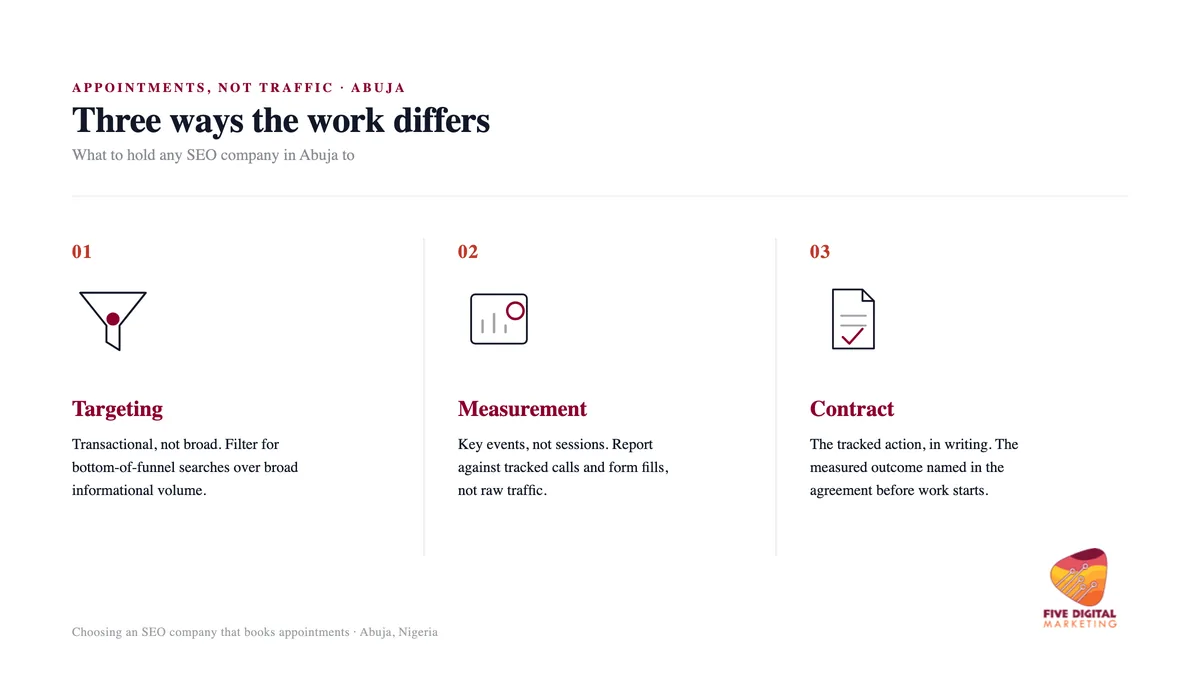
This is not a slogan. It is a specific difference in what gets built and what gets measured — and you can hold any SEO company in Abuja to all three parts of it.
The targeting difference
Instead of chasing every keyword adjacent to your service, the work is built around a city-page and intent-cluster architecture that deliberately filters for bottom-of-funnel, transactional searches over broad informational ones — the same distinction Google itself draws between relevance and genuine commercial intent. "How does local SEO work" and "local SEO company near me" are two different buyers. Treating them the same is precisely how a firm ends up reporting traffic instead of pipeline.
The measurement difference
Most firms report what is easy to pull: sessions, impressions, average position. Google Analytics itself separates raw events from "key events" — the specific actions a business cares about, like a form submission or a booked call — and most never configure that distinction, because the easy number looks better on a slide. Configuring and reporting against key events, not total traffic, is the difference between a report you can act on and a report you can only admire.
The contract difference
If "appointments, not traffic" is not written into what you are measured against — the exact tracked action, the reporting cadence, and what happens if that action does not materialize — it is a slogan, not a mechanism. Ask for it in writing before you ask for anything else.
What an Appointment-Focused Report Actually Contains
The fastest way to tell the two apart is to ask for a sample report before you sign. Here is what each one puts on the first page.
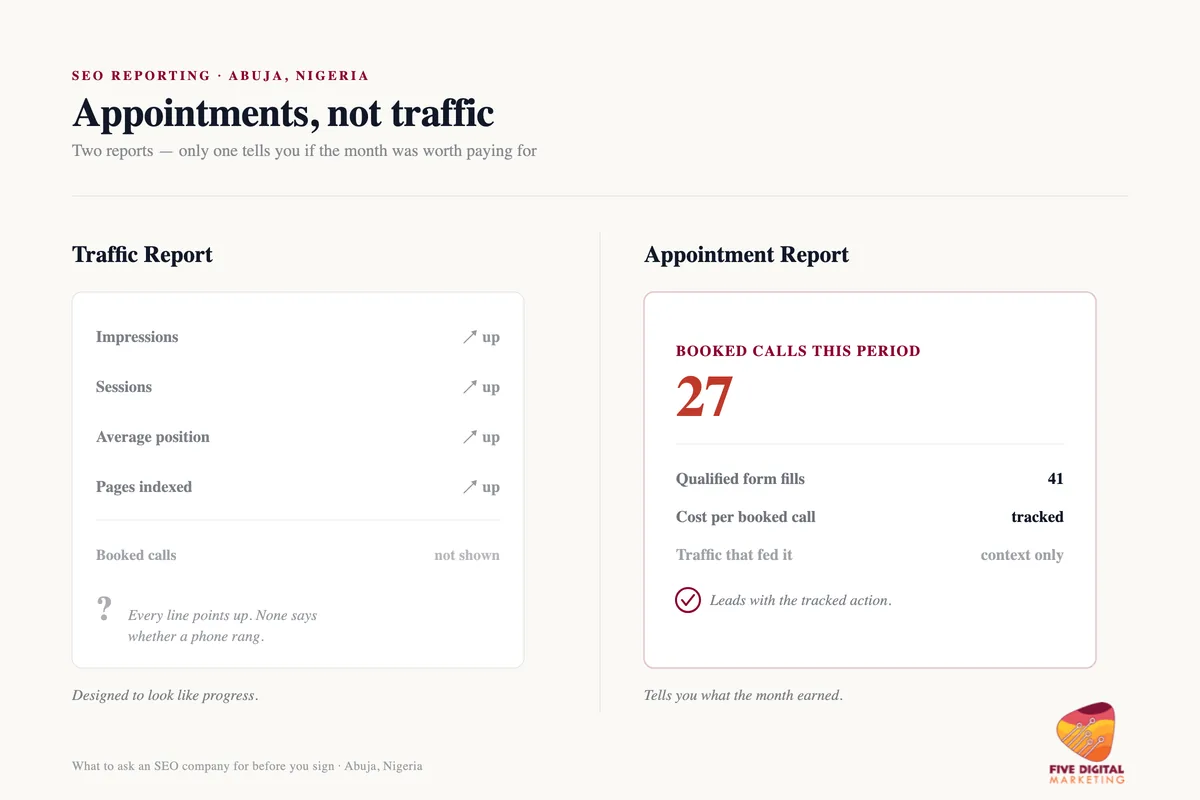
A traffic report leads with the numbers that are easy to grow and hard to bank: total sessions, impressions, average keyword position, "pages indexed." Every line moves up and to the right, and not one of them tells you whether a single person picked up the phone. It is designed to look like progress.
An appointment-focused report leads with the tracked action and works backward. It opens with the count of key events for the period — calls, qualified form submissions, booked consultations — then shows which pages and which searches produced them, then the cost per tracked action, and only then, as supporting context rather than the headline, the traffic that fed it. When a number drops, the report says why and what changes next month. You can read the first paragraph and know whether the month was worth paying for.
The tell is the order. A firm that leads with traffic and buries conversions is telling you which number it is comfortable being judged on. A firm that leads with the tracked action is telling you the opposite — and it is a small, revealing thing to ask for before any money changes hands.
The Proof: The Number We Are Proudest Of Is Not the Biggest One
We hold our own results to this standard, and the cleanest evidence is a contrast inside our own Google Search Console data.
On the term that actually describes our business, "marketing agencies in abuja," we sit at the top of page one — position 1.33 — pulling a 5.32% click-through rate from 94 impressions. That is a high click-through rate because it is the right intent: people searching that phrase are choosing a firm, and they click. Meanwhile a broader, higher-volume term like "best seo company in abuja" showed more raw impressions and, sitting far down the results, converted zero of them to clicks. Same site, same period — one term books attention because the intent and the position line up, the other is pure impression noise.
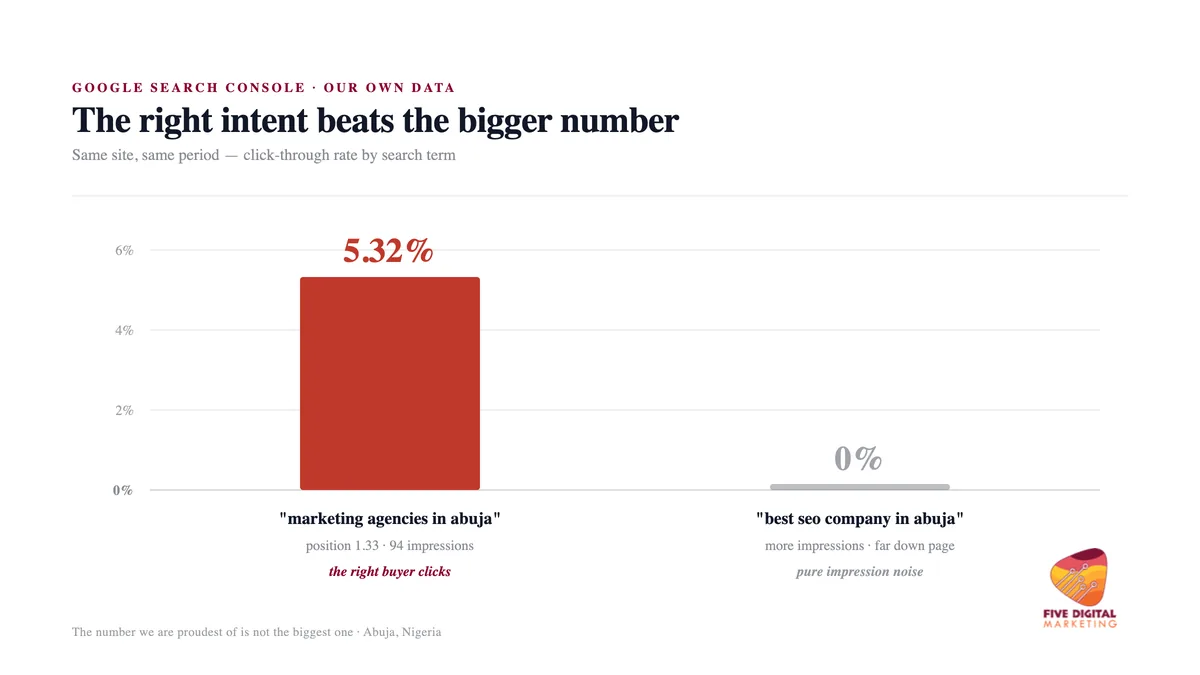
That is the whole argument in one screenshot: impressions are not the goal, and the number worth being proud of is the one tied to a click from a buyer, not the biggest bar on the chart. The full ranking mechanics behind that position are documented separately — the complete 161-day timeline if you want them — and a client case on the same mechanic shows the pattern at a different scale. Here the point is narrower: we measured quality of traffic, not quantity, because quality is what shows up on a calendar.
Who This Standard Is For, and Who It Isn't
It fits businesses where a single appointment or client conversation has real, calculable value — regional B2B service firms, established professional practices, property operators, specialized commercial contractors. The kind of business where ten qualified conversations beat ten thousand anonymous visits without argument.
It does not fit a business that genuinely needs raw volume — a content site monetized by ad impressions, where traffic is the product. If that is your model, hold your agency to a different standard than this one. And if you are not yet sure your business is visible on Google at all, that is a more foundational problem — solve it before you evaluate anyone on appointments.
Frequently Asked Questions
What is a vanity metric in SEO reporting?
A vanity metric is any number that looks impressive but connects to no business decision — raw traffic, generic keyword position, impressions with no tie to revenue. It is easy to report and easy to misread as progress, which is exactly why it fills so many monthly reports.
Why does my SEO report show "improvement" when nothing changes in my business?
Because most reports measure activity, not outcomes — rankings moved, impressions rose, pages got indexed. All of that can be true while your booked-appointments calendar stays flat, because none of those numbers was ever tied to a tracked conversion action.
What is the difference between traffic-focused and appointment-focused SEO?
Traffic-focused SEO optimizes for the broadest keyword set and reports on volume. Appointment-focused SEO narrows targeting to transactional, bottom-of-funnel searches and reports against specific tracked actions — calls, form fills, booked consultations — not sessions.
What questions should I ask an SEO company in Abuja before hiring them?
Ask exactly what action counts as success, how it is tracked, what reporting cadence you will get, and what happens if that action does not materialize on the agreed timeline. A firm with a real mechanism answers specifically; a firm without one answers with a ranking promise.
How do I know if my SEO company is optimizing for the wrong thing?
Read your monthly report. If every metric is a ranking position or a traffic number with no reference to a specific tracked business action, that is the signal. Ask what counts as a "win" in your contract — the answer reveals what they are actually optimizing toward.
Can an SEO company guarantee appointments?
No honest firm guarantees a number of appointments, because demand and close rate are not fully in their control — and any firm that does is selling a ranking promise in disguise. What a credible firm can commit to is the mechanism: transactional targeting, key-event tracking, and a contract that measures the tracked action rather than raw traffic.
The Question That Decides It
Every firm says it "focuses on results." Few will tell you exactly which action they count, how it is tracked, and what happens if it does not appear. If you want a straight answer to that question for your own business — not a ranking pitch — book a Growth Diagnostic and we will walk through exactly what we would track and why.
Prefer a faster first exchange? Message us on WhatsApp.