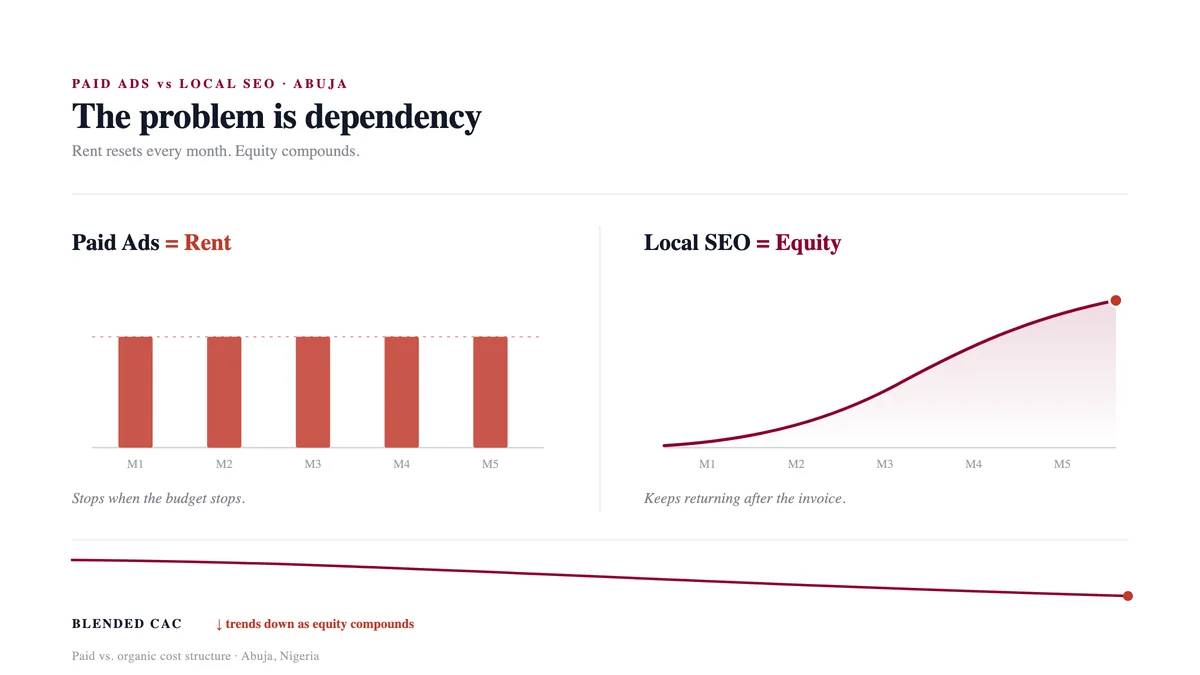
Here is the short version, before the story: a business in Abuja does not have to choose between running Google Ads and ranking in local search. The expensive mistake is treating them as the same kind of spend. One is rent — it works while you pay and stops the moment you don't. The other is equity — slower to build, and it keeps returning after the invoice is settled. The goal is not to switch paid off. It is to build the second thing underneath the first, so your blended cost per acquisition falls over time instead of resetting every month.
The direct answer to "how long does that take?" For a business starting with no organic footprint, local SEO takes roughly 8-16 weeks before it produces leads that cost you nothing per click, and about 5-6 months before organic search carries real, steady pipeline weight alongside your paid campaigns. We know the numbers because we ran the system on our own site and logged every week of it. This is that log.
The Problem Is Dependency, Not Paid Media
If you are spending ₦5,000,000 to ₦20,000,000 a month across Google and Meta, you already know the feeling: the day the budget pauses, the pipeline pauses with it. That is not a flaw in your campaigns. It is the definition of rented attention — the platform's model depends on you never being able to stop. Paid media is genuinely good at what it does: immediate, controllable volume you can turn up this afternoon. Nothing here argues for turning it down.
The problem is having only that. When every lead you will ever get requires a live budget, your cost of acquisition has a floor it can never drop below, and that floor rises every year as auction competition climbs. A local SEO asset is the thing that sits underneath and slowly lowers the floor — so the same pipeline costs you less in month twelve than it did in month one.
Most agencies will not frame it this way, because most agencies are paid the way the ad platforms are: for activity, not for equity. You get a monthly report showing impressions climbed and positions "moved," while your booked-appointments calendar looks exactly like last month's. If you have been handed that report and felt the gap between the graph and your bank account, your skepticism is earned. This post is the opposite of that report — it is one number that matters, traced to its source.
What Actually Builds the Asset
"We'll do your SEO" means nothing without a mechanism. Google is explicit that local ranking comes down to relevance, distance, and prominence. Here is the order we build against those three, and it is the same order we used on ourselves.
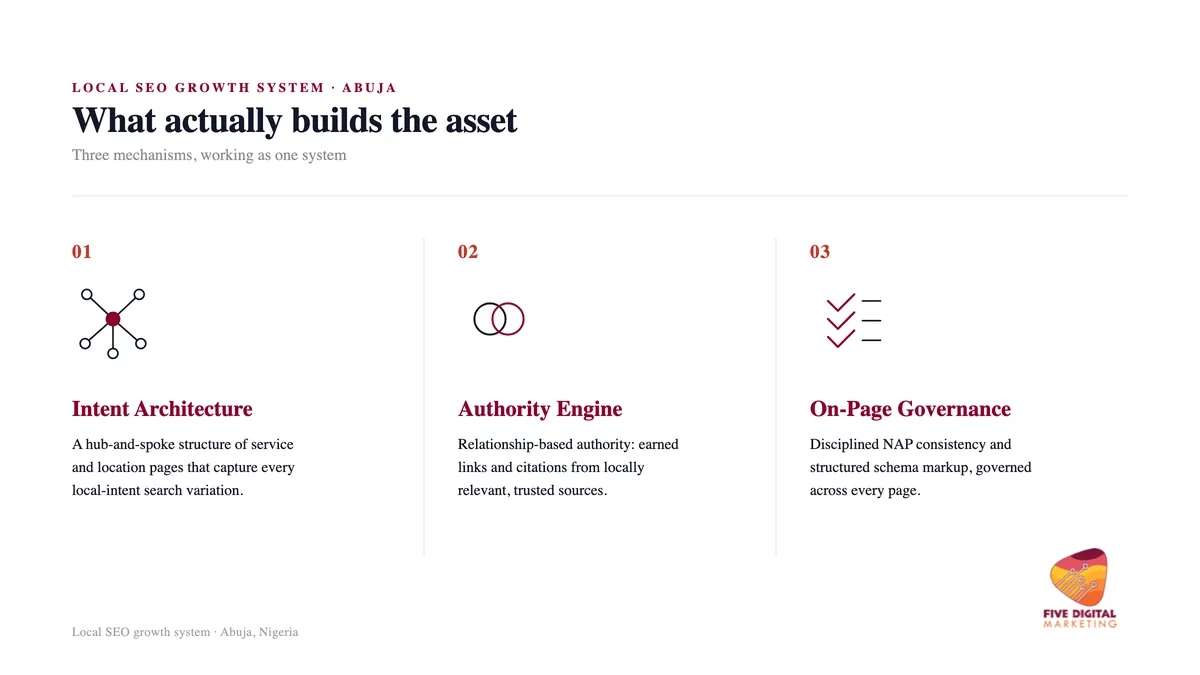
1. Intent architecture, not one page trying to rank for everything
A single homepage cannot credibly rank for every area and service you cover, and search engines can tell a page genuinely built for a location from one that swapped in a city name. The mechanism is a hub-and-spoke structure: one authoritative page for the core service, with dedicated pages for each high-value area, each carrying a proof point specific to that place. A page that says "we serve Wuse" with nothing actually about Wuse is, to a search engine, the same as no page at all.
2. An authority engine, not directory spam
This is the step most agencies replace with volume — hundreds of low-authority directory submissions that move almost nothing and can quietly damage a serious brand's credibility. We do not do that. The real mechanism is relationship-driven: auditing existing vendor and partner relationships for legitimate links, earning mentions from genuinely relevant local institutions, and publishing work worth citing in the first place. It is slower, and it is the version independent local-ranking research keeps finding correlates with durable rank — not link count.
3. On-page governance, down to the punctuation
Search engines cross-reference your business name, address, and phone number everywhere they appear. If your listing reads "5 Digital Marketing" in one place and "5Digital Mktg" in another, that inconsistency suppresses your local visibility, and most businesses never learn it is happening. Alongside that consistency, every page needs accurate LocalBusiness schema built to Google's structured-data specification — real service areas, correct geographic data, no template placeholders. If you are not sure your business shows up at all — an earlier-stage problem — start here first.
None of this is exotic. It is disciplined execution of unglamorous fundamentals, held past the point where most competitors quit — starting with targeting the searches that actually convert rather than the ones with the biggest volume. That is the whole moat.
The Proof: 161 Days on Our Own Site
We did not ask a client to be the test case. We ran this exact framework on 5digitalmarketing.com starting 23 February 2026 and measured it against Google's own data.
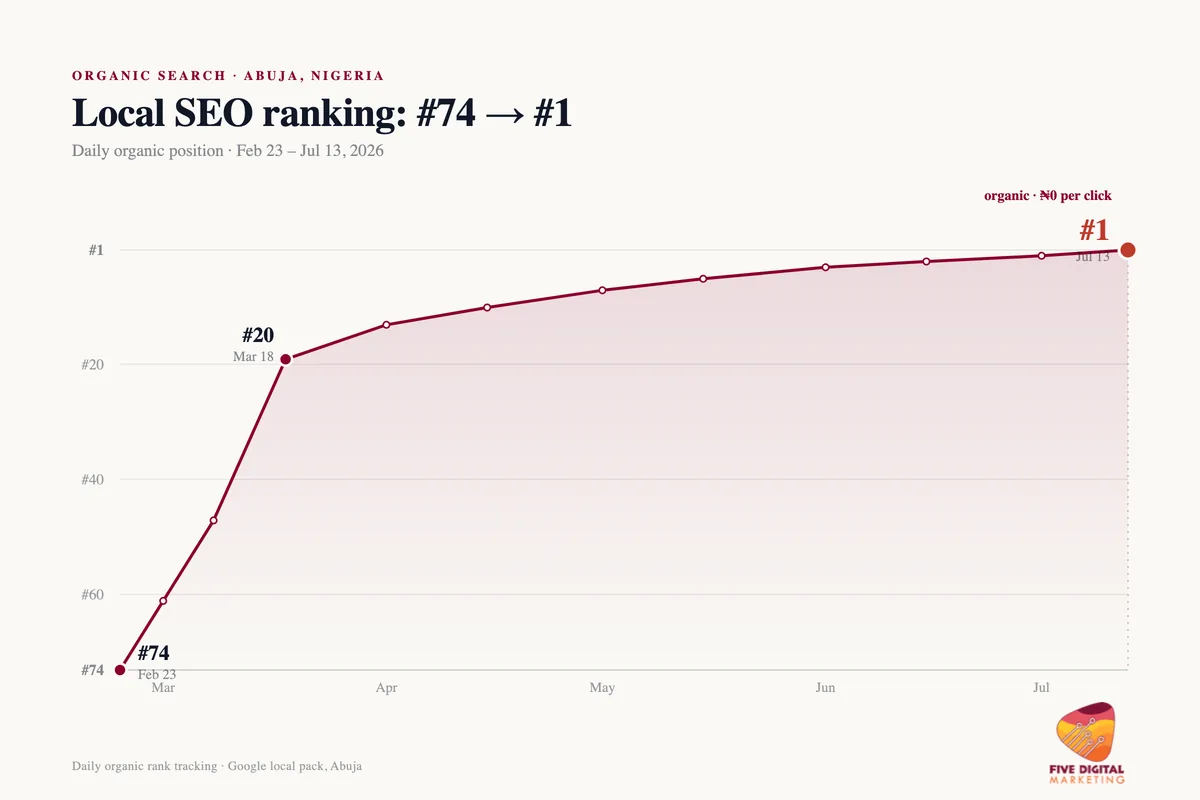
Where it started. Our flagship local category term sat at position 74 — page eight, unreachable by any real searcher.
What the record shows, dated and sourced:
- Days 1-14 (late Feb → early March): citation cleanup and intent architecture went live. Daily impressions on our core local terms climbed from roughly 50/day to 80-167/day — before a single ranking moved. That is the asset accumulating before it becomes visible.
- 18 March (day 24): on the money query, our organic result was screenshot-verified at position 20 — off page eight, onto the edge of visibility, in under a month.
- 13 July (day 161): Google Search Console's own export shows that term at position 1.33 — the top of page one — with 94 impressions on the term that actually describes our business.
So the arc, stated precisely because precision is the point: 74 at the start, a verified #20 by day 24, #1 by day 161. Every step traceable to a dated source, not a projection.
The number that matters for your decision, not ours: every one of those impressions and clicks arrived at zero incremental cost. We paid Google nothing for that July placement, exactly as we paid nothing in February. To replace that same visibility with ads, the spend would recur every month, forever. The gap between those two is the equity — and it is why our blended cost per acquisition is lower now than when we started, with the paid campaigns still running the whole time.
We are not claiming this generalizes to every business — competitive density, domain age, and existing authority all move the timeline. And it is not our only evidence: a client example on the same mechanic shows a different starting point and pace. But these numbers are real data from a real 161-day window on our own domain.
Who This Is For, and Who It Isn't
This layer assumes your Google Business Profile foundation is already in place; it is built on top of that, not instead of it. It fits businesses where one closed relationship is worth enough that a 3-6 month build is a rational trade for a channel that stops billing you per lead: regional B2B service firms, established professional practices, property and real-estate operators, specialized commercial contractors. If your transaction value can absorb a build window in exchange for a lower blended CAC over the next twelve months, the full system is worth a conversation.
It is not for a business that needs volume next week regardless of durability — for that, keep your paid campaigns exactly where they are; they are the honest answer to a next-week problem. And it is not for anyone optimizing purely for the lowest up-front invoice rather than the lowest true cost of a customer over a year. Naming who this is not for is not a disclaimer. It is how you can trust the rest.
Frequently Asked Questions
Does local SEO replace Google Ads?
No — and any agency that promises it will is setting you up to be disappointed. Local SEO lowers your dependence on paid media by building an organic channel that costs nothing per click, but the durable position is to run both: paid for immediate, controllable volume, and a compounding local asset underneath it that keeps working when a budget pauses. The win is a lower blended cost per acquisition, not a switched-off ad account.
How long does local SEO take to show results in Abuja?
For a business with no existing organic footprint, expect 8-16 weeks before non-paid leads begin arriving and roughly 5-6 months before organic search carries stable pipeline weight. On our own site the first ranking movement on the core term was visible by day 24 and reached the top of page one by day 161. Competitive density and domain age shift that range.
What does it mean to call local SEO a "compounding asset"?
It means the value does not reset when you stop paying. A paid ad stops the moment the budget pauses; a well-built local page, an earned local link, or an accurate listing keeps generating visibility at no recurring cost. The return compounds instead of returning to zero every billing cycle — which is the difference between renting a position and owning one.
Is local SEO different from regular SEO?
Yes. General SEO competes for broad, often national intent and leans heavily on content authority and backlinks. Local SEO competes for geographically-anchored searches and weighs signals like listing consistency, local citations, and location-specific relevance far more heavily. A business in Abuja is playing the local game, and the ranking factors are not the same ones a national blog optimizes for.
Why not just pay for backlinks to rank faster?
Purchased directory links and link farms provide minimal ranking value and carry real penalty risk. Authority built through genuine vendor relationships, relevant local sponsorships, and citation-worthy content compounds, because search engines weight earned, topically-relevant links far above volume — and it cannot be wiped out by an algorithm update the way manipulative links can. Faster-looking is usually slower, once a penalty lands.
How do I know if my business is a fit for this versus staying on paid ads?
If your average customer value is high enough that a 3-6 month build is worth trading for a channel that does not bill per lead, it is a fit — as an addition to your paid media, not a replacement. If you need volume next week regardless of long-term cost, keep the paid campaigns running and revisit this when you have room to build. A short diagnostic usually makes clear which situation you are actually in.
Where This Leaves You
Paid media is not the problem, and nothing here says to touch it. Depending on it as your only channel is the problem, because it fixes your cost of acquisition at a floor that only rises. The businesses that build real durability run both: paid for the volume they can control today, and a compounding local asset underneath that lowers the blended cost of every customer over time — the same asset that now earns them a place in the AI answers a paid budget cannot buy into.
If you want a straight read on where your business sits right now — how much of your pipeline is rent and how much is equity — book a Growth Diagnostic and we will show you the exact gap, not a 50-page report. If our GMB ROI breakdown is closer to where your thinking is, start there. Prefer a faster first exchange? Message us on WhatsApp.