Most content published to "help SEO" is the same five paragraphs with a different city name dropped in. It answers a question nobody asked, places a keyword in the first sentence, and disappears into a blog nobody returns to. It was optimized. It just was not worth reading.
The direct answer to why it ranks for nothing: a page ranks when it passes one test — does it contain information the reader could not already get from the top five existing results for the same query? If the answer is no, it is commodity content in an SEO wrapper, and no amount of technical optimization changes that. Original SEO content passes the test because it carries something that only exists because someone did the work.
The Belief That Quietly Costs You Rankings
"SEO is just fixing meta tags and building links." Most businesses walk in with some version of it, and it is not wrong so much as incomplete. Technical SEO and citations are real and necessary — and they are the minimum cost of entry, not an advantage. Every competitor you have can hire someone to fix their meta tags too.
The advantage that is actually defensible is what Google's own patent literature calls information gain — a documented method for scoring how much a page adds beyond what the searcher already saw above it. Google's guidance says the quiet part plainly: content built primarily to attract search traffic, rather than to help the person reading it, is exactly the pattern its systems are built to hold down, not lift.
This is the standard sitting on top of our own Local SEO Growth System: the city-page architecture and authority engine only pay off if the content on them clears this bar. A perfectly structured site full of interchangeable paragraphs still reads as an interchangeable site — to Google, and to the buyer.
The Test, in One Sentence
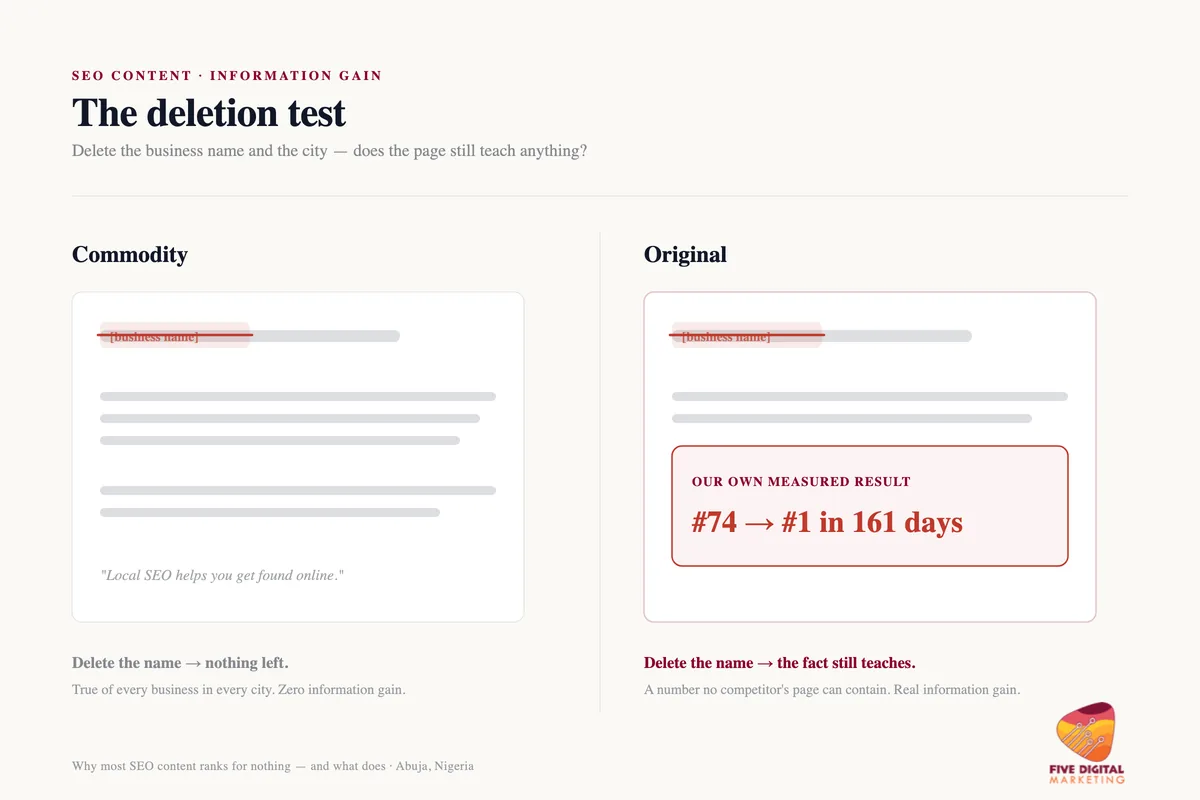
Ask this of any page before it publishes: delete the business name and the city — does the page still teach the reader anything they did not already know?
Commodity content fails on contact. "Local SEO helps your business get found online" is true of every business in every city; it carries zero information gain. Content that ranks survives the test because it holds something a generic pass cannot fake — a specific number from a specific case, a real operational detail, a dated timeline that actually happened.
A law firm comparing content vendors runs this test whether it names it or not. So does a regional managed-service provider, a commercial brokerage, a specialized contractor. The businesses this system is built for do not need more words on their site. They need the handful of pages that say something no one else's site can.
Why This Is the Whole Game in 2026
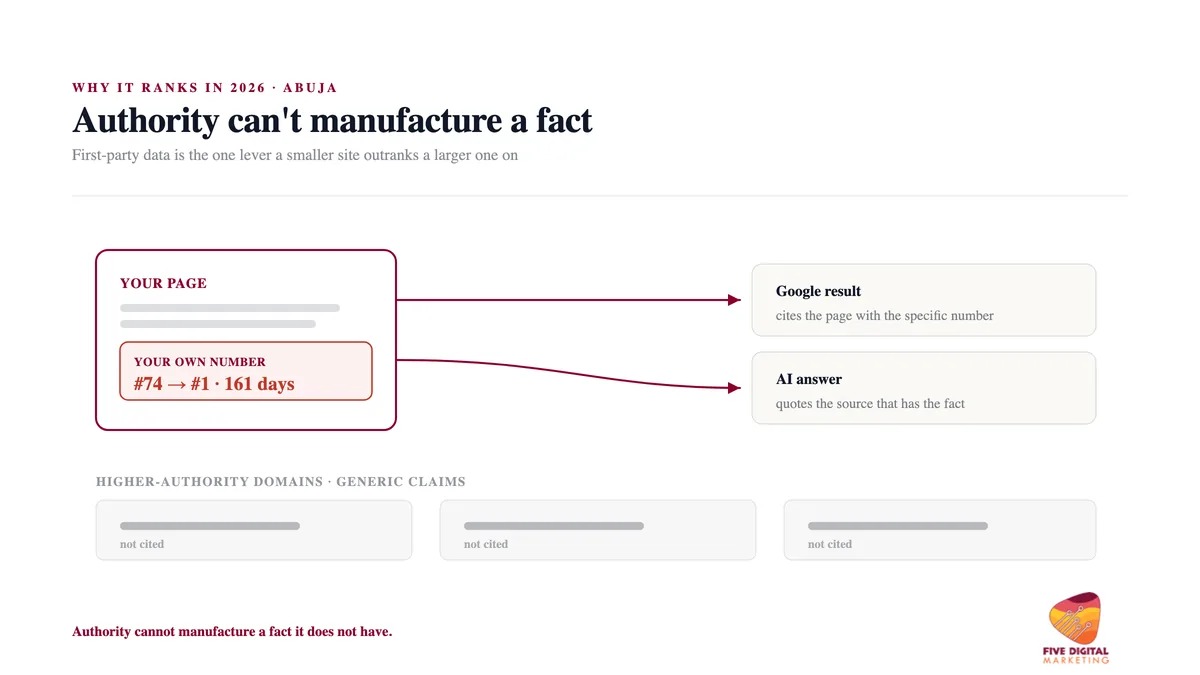
There is a second reason this matters more now than a year ago, and it is the sharpest argument for doing the harder kind of content. A higher-authority domain will usually outrank you on a generic claim — they have the backlinks and the age, and you will not win "what is local SEO" against a site the size of a national publisher.
What they cannot do is publish your data. When a page states a fact that exists nowhere else — a measured result from your own operation — it becomes the only citable source for that fact. That is true for Google's information-gain scoring, and it is now true for the AI answer engines that assemble roughly two-thirds of local search responses: they quote the source that has the specific number, not the biggest brand with the vaguest claim. First-party data is the one lever where a smaller firm outranks a larger one, on both surfaces, because authority cannot manufacture a fact it does not have.
Proof: The Pages That Earn Their Place Are the Ones With Our Own Numbers
The strongest pages we run could not have been produced by summarizing five competitor articles — they required us to have done the measuring first.
Our local SEO timeline post cites our own site moving from position 74 to 1.33 across a real 161-day window. Our post on agency reporting cites our actual 5.32% click-through rate on the term that describes our business. Neither of those numbers exists on any competitor's page, because they are not facts about the industry — they are facts about us. Strip our name off either page and the argument collapses, which is exactly the sign that the information gain is real and not decoration.
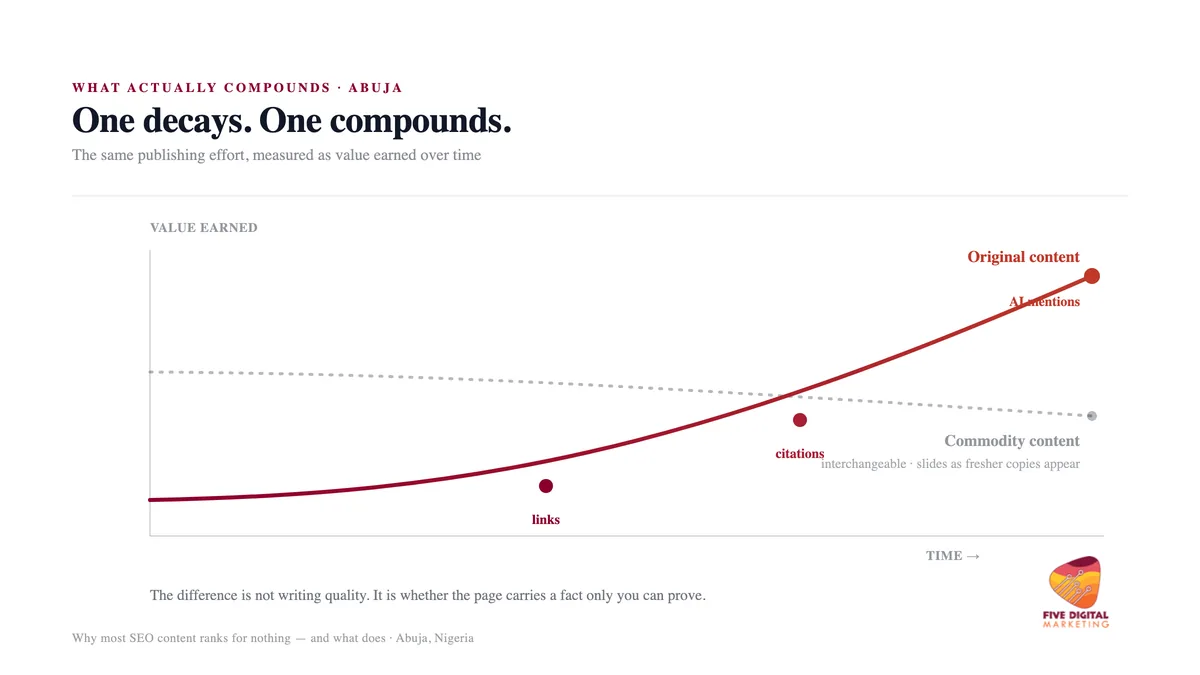
That is the entire distinction, and it is not about writing flair. It is whether the page contains something that exists only because we did the work, or something that exists because we searched for what everyone else had already written. The first kind compounds — it earns links, citations, and AI mentions over time. The second kind sinks, no matter how clean the meta tag.
What the Harder Kind of Content Actually Requires
Three things, none exotic:
Original data or a real case. One specific number from your own operation beats a generic industry statistic every time, even a small one. "Position 74 to 1.33 in 161 days on our own site" is information gain. "SEO takes time" is not.
A claim specific enough to be wrong. Content that earns its place commits to something falsifiable. If nothing in a piece could be disproven, nothing in it was a claim — the same discipline behind independent research into what moves local rankings, which names checkable factors instead of reassurance.
A structure built for the question, not a template. The generic five-heading blog shape exists because it is fast to produce, not because it serves the reader. Matching structure to the actual search intent behind your local authority engine is part of the information-gain test, not separate from it.
None of this requires more words. Our strongest pages are rarely the longest — they are the ones with the highest ratio of things-nobody-else-said per paragraph.
Who This Standard Is For, and Who It Isn't
It is worth the extra effort for businesses where a prospect is genuinely comparing you against alternatives before a high-value decision — established professional practices, regional B2B service firms, brands where reputation is the product. For a business like that, a generic page does not merely fail to rank; it signals the same lack of differentiation to a human reader that Google's ranking systems are built to detect. A real client example shows what one specific, non-generic proof point does for credibility that a generic page never could.
It is not worth the same investment for a business publishing purely to fill a content quota, with no real differentiation to draw on yet. If you do not have a genuine data point, case, or operational detail to build a page around, that is a business-maturity gap content cannot paper over — worth solving before a content investment, not instead of one. Getting the underlying numbers in place first is also the logic behind tracking real ROI rather than a vague content plan.
Frequently Asked Questions
What does "information gain" mean in SEO content?
It is how much new information a page adds beyond what already ranks in the top results for the same search. Google's patent literature describes scoring pages on exactly this basis — content that only repeats what is already ranking adds little, no matter how well it is optimized.
Why does generic AI-written content underperform even when it is well-optimized?
Because optimization and information gain are different things. A page can have a flawless title tag, correct keyword placement, and clean structure while still saying nothing a reader could not get from the five results above it — and that gap is what search systems and human readers both notice.
How do I know if my current content is commodity content?
Delete the business name and city from the page and read it again. If it could belong to any competitor in the same city, it is commodity content, however polished the writing.
Can a smaller business really outrank a higher-authority site with content?
On generic claims, rarely — authority and age win those. On its own original data, yes: a page stating a fact that exists nowhere else becomes the only citable source for it, which is the one position a larger competitor cannot buy their way into, on search results and AI answers alike.
What should I ask a content vendor before hiring them?
Ask what specific, original information they plan to include that is not already on your top five competitors' pages. A vendor with a real process names something concrete; a vendor without one describes a writing style instead.
Does SEO content need to be long to rank?
No. Length without information gain is commodity content, just more of it. What matters is how much of the page contains something a reader could not already find elsewhere — not the word count.
The Standard That Actually Sorts It
Commodity content and content that ranks can look identical at a glance — same headings, same keyword placement, same call to action. The difference only shows when you ask what is actually inside. If you want a straight read on which category your current content falls into, book a Growth Diagnostic and we will run the deletion test against what is live on your site right now.
Prefer a faster first exchange? Message us on WhatsApp.