Not every search that names your city is worth ranking for. Some of them are buyers. Most of them are not.
The direct answer: a bottom-of-funnel local search names the service and signals readiness to act now — "emergency plumber Wuse," "book local SEO audit Abuja." An informational search names the topic and signals research — "how does local SEO work," "what is a Google Business Profile." Both mention your category; only one converts at any meaningful rate. Building content or campaigns around the wrong one is exactly how a business ends up with rising traffic and a flat calendar.
Why Intent Beats Volume, Every Time
Traffic without intent is a cost, not an asset. It burns the sales team's hours filtering visitors who were never close to buying, and it burns content budget on pages that rank for searches nobody was going to act on. That filtering discipline is built into how we structure the Local SEO Growth System — we would take 100 visitors with real commercial intent over 10,000 who landed on a generic explainer and left.
If you have read our post on choosing an SEO company that reports appointments, not traffic, this is the mechanism underneath that standard. That post is about how to judge whether an agency filters for intent. This one is about how the filtering actually works — whether you are doing it yourself or checking someone else's work.
The Four-Way Split (and Why Most Content Only Uses Two)
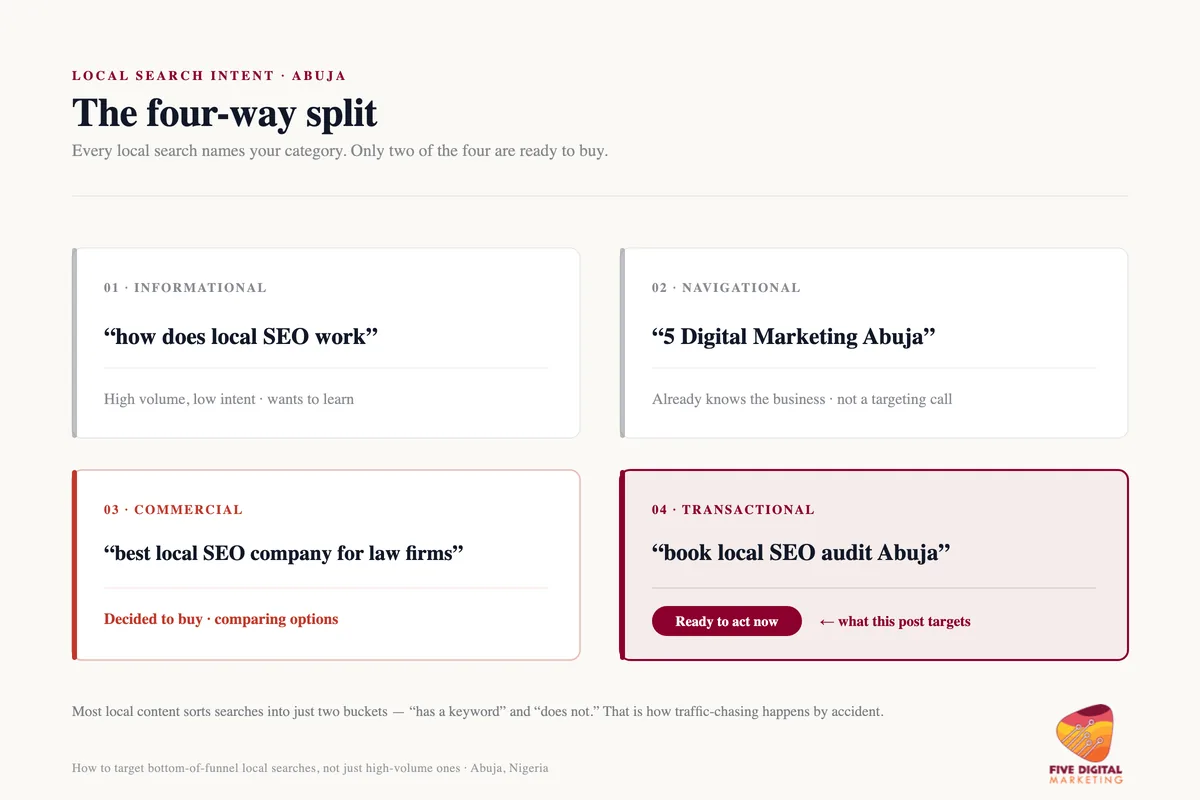
Search intent breaks into four recognized categories: informational, navigational, commercial, and transactional. Most local content really distinguishes only two — "has a keyword" and "does not" — which is precisely how traffic-chasing happens by accident.
Informational — "how does local SEO work," "what is NAP consistency." The searcher wants to learn, not buy. High volume, low intent.
Navigational — "5 Digital Marketing Abuja." Someone looking for a business they already know. Not really a targeting decision.
Commercial — "best local SEO company for law firms," "SEO agency vs in-house." The searcher has decided to buy and is comparing options.
Transactional — "local SEO services Abuja," "book local SEO audit." Ready to act now. This is the zone this post is about.
The Split Applied to Our Own Keyword Decisions
Here is the classification run against our real keyword research — the actual calls we made, not invented examples.
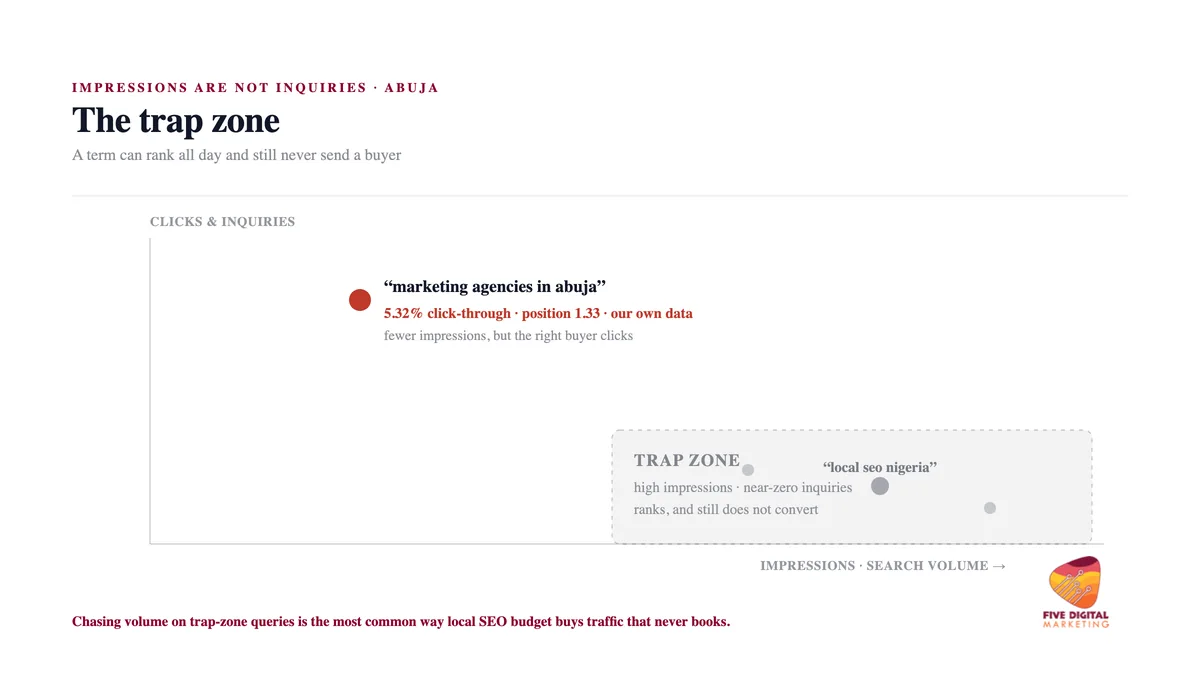
High-intent, worth building for: "marketing agencies in abuja" and its close variants sit at the top of our own rankings today — position 1.33 on our tracked data — and we targeted them deliberately, because the phrasing itself signals someone actively looking for a firm to hire, not someone researching what agencies do. The full ranking story lives in our local SEO timeline post; the point here is the choice that came before the ranking: we picked the term for its intent, not its volume.
Informational, worth answering but not chasing hard: "how to choose a digital marketing agency" carries real volume, but it is a research-stage question. We answer it — our guide on vetting an agency exists for that reader — but we do not build the primary strategy around competing for it, because that searcher is not ready to act.
The trap zone: broad category phrases like "local seo nigeria" look like they should convert because they contain the service name. They do not, reliably — the intent behind them sits closer to informational than transactional, and the businesses ranking hardest for them are often getting impressions without inquiries. Chasing volume on trap-zone queries is the single most common way local SEO budget gets spent on content that technically ranks and still does not convert. That over-impressioned, under-clicked pattern is the same one our content-quality post treats from the content side.
How to Classify a Keyword Without Guessing
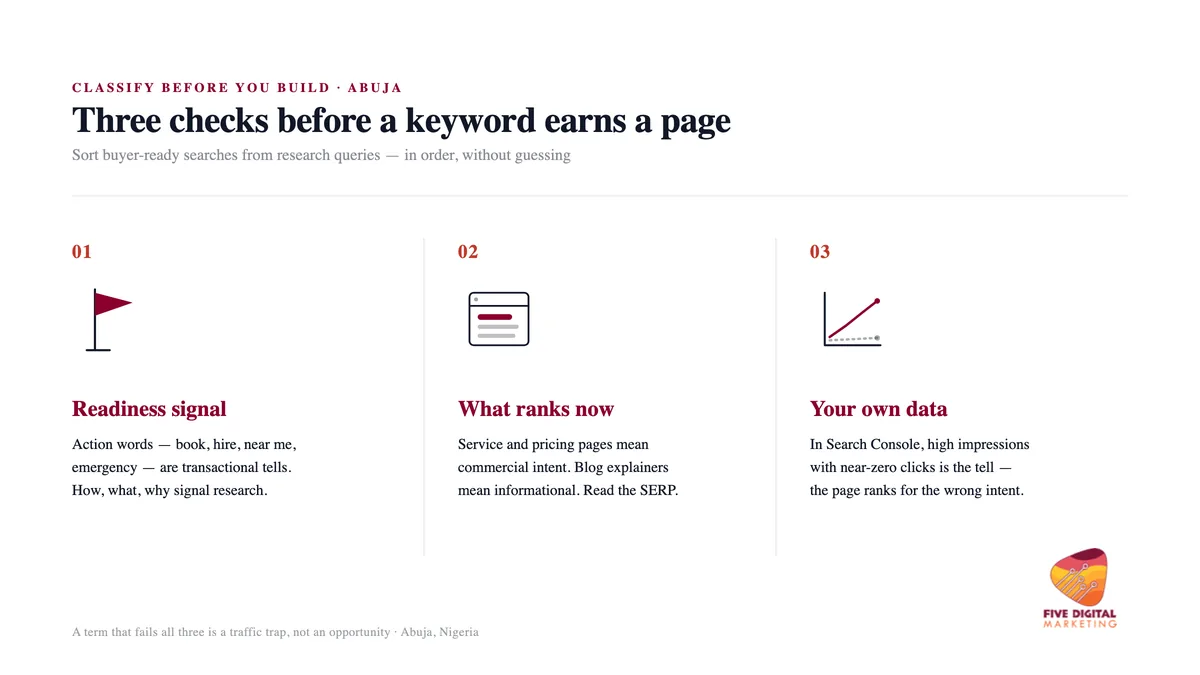
Three checks, in order, before a term earns a dedicated page:
1. Check for an action or readiness signal. "Book," "hire," "near me," "same day," "emergency" are transactional tells — the same proximity-and-urgency signals Google itself weighs heavily in local ranking. "How," "what," "why," "guide" are informational tells. Most terms sort correctly on this alone.
2. Check what actually ranks for it now. If the current top results are service and pricing pages, the intent is commercial or transactional. If they are blog explainers and encyclopedia-style overviews, it is informational — Google's search quality rater guidelines evaluate exactly this intent match, not keyword presence alone.
3. Check your own Search Console data for the term. If you already earn impressions on it, a high impression count with near-zero clicks over time is the tell — the term is either mis-targeted or the current page's intent does not match the query. Impressions without clicks is not "almost ranking"; it is often "ranking for the wrong intent."
Enterprise and multi-location businesses feel this most: with more location and service pages, the temptation to build every combination is stronger, and the cost of building against trap-zone queries compounds with every page — a pattern independent local-ranking research finds gets worse at scale without deliberate filtering.
Who This Filter Is For, and Who It Isn't
It matters most for businesses with a real sales process behind the click — regional B2B service firms, established professional practices, property operators, enterprise multi-location businesses — anywhere a sales team's time is a finite cost. Ten qualified conversations beat ten thousand anonymous visits, and the filter is what buys the first at the expense of the second.
It matters less where genuine top-of-funnel education is part of the sale itself. If informational content is how you build trust across a long consideration window, that is a legitimate strategy, and this filter should not be applied as strictly. And if you are not yet sure your business appears on Google at all, that is a more foundational problem — solve it first.
Frequently Asked Questions
What is bottom-of-funnel search intent?
It is a search from someone ready to act now rather than research — a phrase with an action verb, an urgency signal, or an explicit service-plus-location combination. These convert at meaningfully higher rates than informational searches, even when the informational searches carry more volume.
How do I know if a keyword is worth targeting?
Check three things: whether it contains an action or readiness signal, what type of pages currently rank for it, and — if you have data — whether it earns impressions without clicks. A term that fails all three is more likely a traffic trap than a real opportunity.
Should I still create informational content at all?
Yes, with a different goal. Informational content builds trust and supports a longer sales cycle, but it should not be measured against the same conversion expectations as bottom-of-funnel content, and it should not consume most of a limited content budget.
What is the difference between commercial and transactional intent?
Commercial intent means the searcher has decided to buy but is still comparing vendors — "best local SEO company for law firms." Transactional means they are ready to act immediately — "book local SEO audit." Both are high-value; transactional converts faster.
How is this different from evaluating an SEO agency?
Evaluating an agency is about who does the work. This is the judgment call underneath it — which searches deserve a dedicated page at all — whether you make that call yourself or check whether an agency makes it well.
Do multi-location businesses need to do this differently?
The principle is identical, but the cost of getting it wrong multiplies. A single business builds one wrong page; a ten-location business builds the same mistake ten times — which is why this filtering step matters more at scale, not less.
The Filter, Not the Volume
More keywords is not a strategy. The right handful, filtered correctly, outperforms a broad net every time — it is the whole difference between a compounding local search asset and a pile of pages that technically exist. If you want a read on which of your current or planned pages actually target buyer-ready searches, book a Growth Diagnostic and we will run the filter against your own keyword list.
Prefer a faster first exchange? Message us on WhatsApp.