It can be the owner, a member of staff, a freelancer or an agency, or several of them together. Either way, three things have to keep happening: the work gets done, the results get reviewed, and someone decides what changes next. It can't be nobody in particular.
Advertising that runs beyond a single campaign is ongoing work. An ad can't tell you whether the budget fits the goal, or notice that the enquiries are the wrong kind, or ask for a change. People do that. When nobody owns those decisions, they tend to wait, and the ads carry on doing whatever they were last set up to do. Even stopping your ads for a while is a decision someone has to own.
What goes wrong when nobody owns marketing?
I run Facebook and Instagram ads for businesses, so I see this from the side of the person running them. Three gaps come up in my client work.
The budget is set before the objective. Most clients I work with have a small budget and plan to stretch it across several locations and several goals at once: reach, impressions and leads. The budget should follow the objective. When it comes first, nobody owns the question of what the money is meant to achieve, so nobody comes back to it. If you're not sure what your ads should earn, start by working out what a customer contributes.
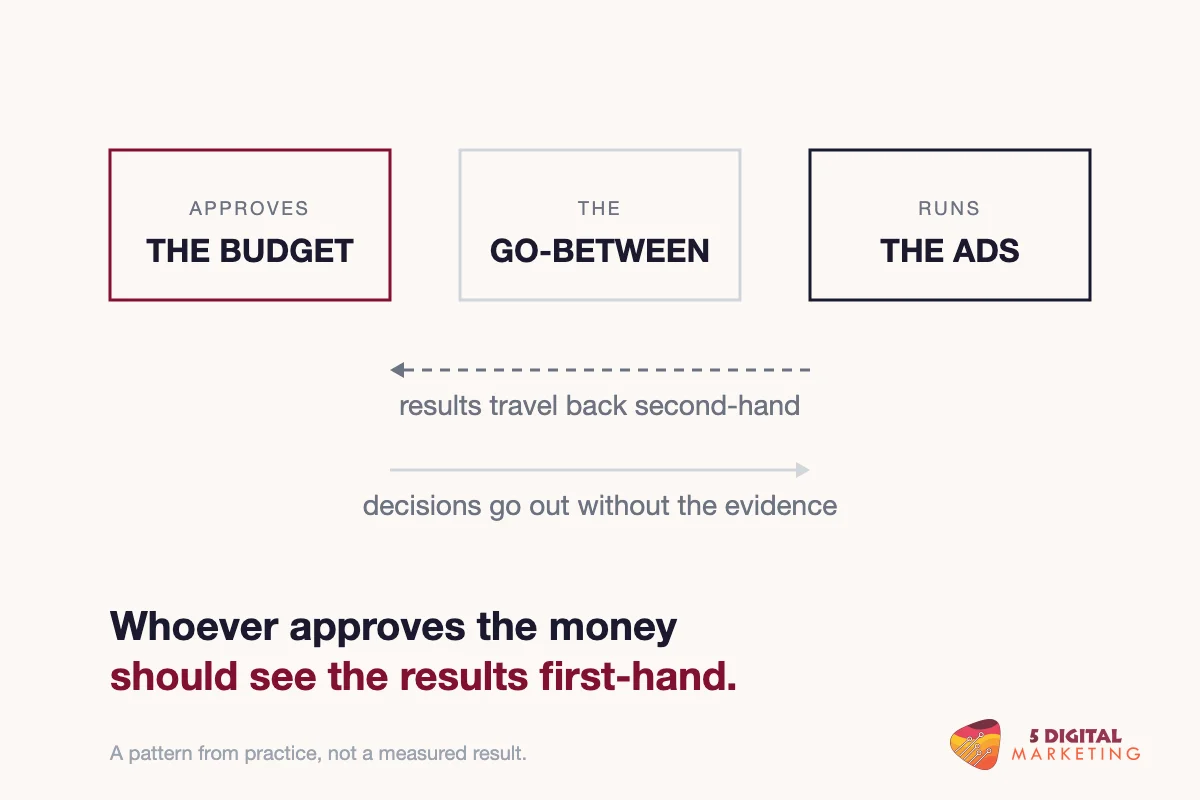
The go-between carries messages, not decisions. Someone is given the job of talking to whoever runs the ads, often without knowing the platform. They can pass the results along, but they can't say what the results mean or what should change.
The person who approves the money is furthest from the evidence. They push for more results, and they're wary of approving more funding, which is reasonable. But their contact with the person spending the money is one step removed, sometimes several. Results reach them second-hand, and decisions come back without the evidence behind them. Communication between the two breaks down.
None of this is anyone being careless. These are gaps in who owns what.
Why doesn't "I'll look at it when I get time" work?
Lack of time is one of the reasons owners give for not doing more. In a 2026 BrightLocal survey of 1,002 US owners of local businesses, 23% said they don't have enough time to improve their online presence, and 25% weren't convinced it would make a difference. Owners could name more than one reason.
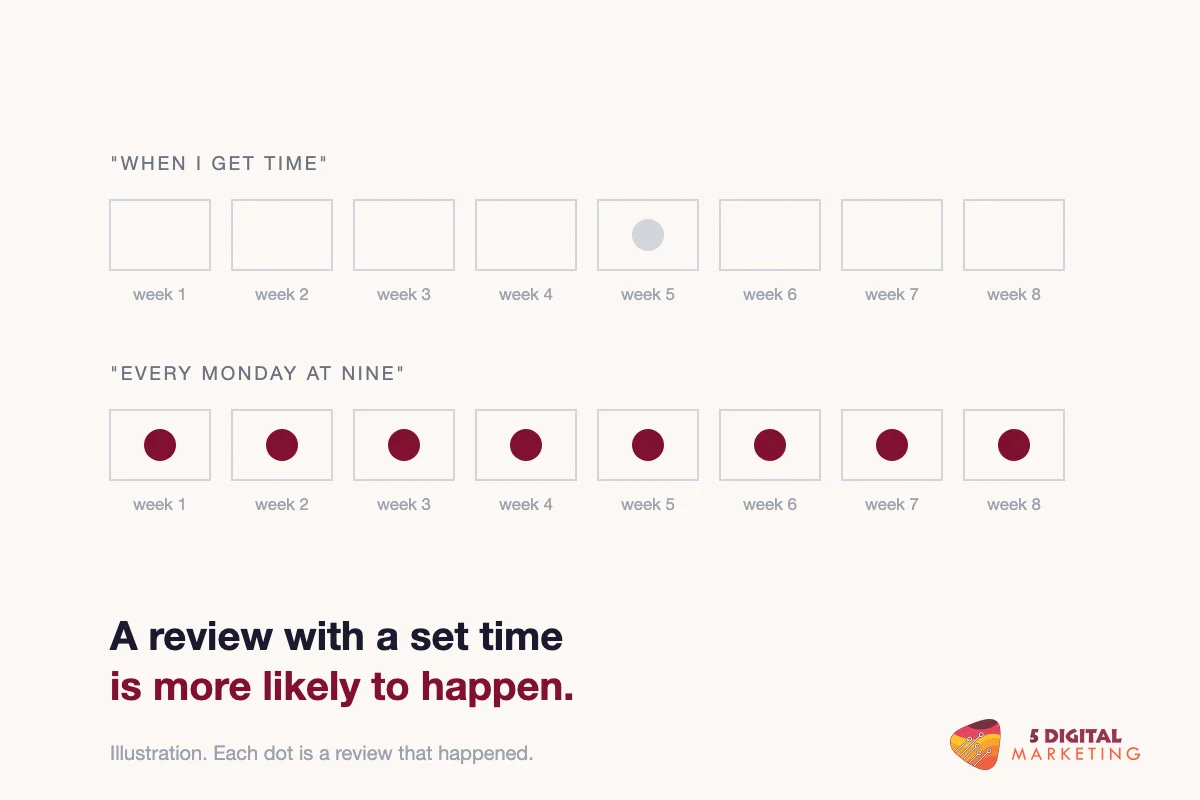
"When I get time" sounds like a plan, but it has nothing that sets it off. Psychologists call a plan that names the moment and the action an implementation intention. Paschal Sheeran, Olivia Listrom and Peter Gollwitzer reviewed 642 tests of this kind of planning. People acted on an intention more often when they had decided in advance when and how they would do it.
The effect varies a lot from one situation to another, and most of the studies weren't about work, let alone advertising. So treat it as a nudge. A review booked for every Monday at nine is more likely to happen than one planned for when things quieten down.
Does it matter if nobody is sure whose job it is?
Travis Tubre and Judith Collins reviewed the workplace studies on unclear roles. Role ambiguity, not knowing what you're responsible for, tends to go with weaker job performance.
That's a link. It doesn't prove that naming an owner will lift your sales. In my client work, though, a decision that is nobody's in particular often waits.
Consultants see the same thing in large companies. In 2006, Paul Rogers and Marcia Blenko, then at Bain & Company, wrote that ambiguity about who is accountable often stalls decisions, and named the line between a company and its outside partners as one of four common bottlenecks. Their answer is to name who recommends, who must agree, who gives input, who carries the decision out and who decides. They were writing about large companies, but a similar line can run between a business and anyone outside it who runs its ads.
Looking at results matters too. Benjamin Harkin and colleagues pulled together 138 randomised studies. Monitoring progress tended to help people reach their goals, and it helped more when the results were written down or shared with others. The authors note that nearly all of the studies were about health goals, so they say little about business directly. The part that carries over is simple: results nobody looks at can't change anything.
What does the person responsible for marketing own?
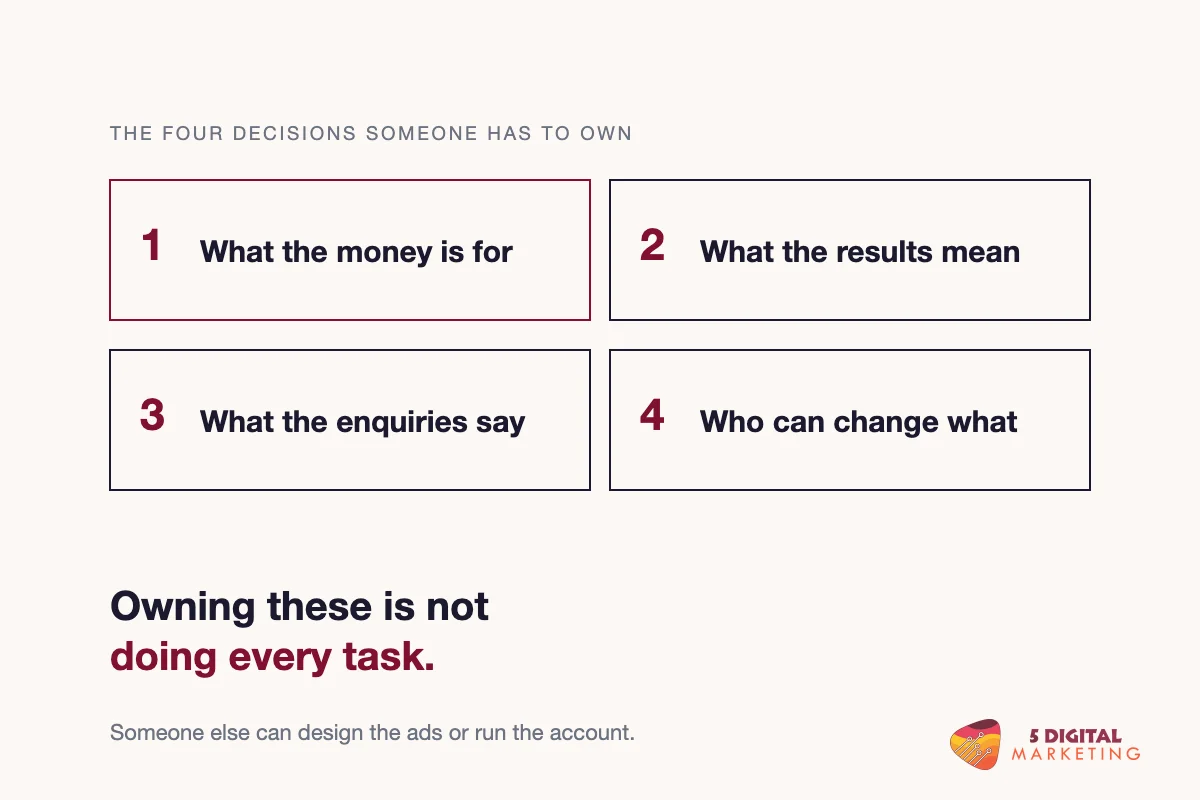
Four decisions keep coming back for as long as you advertise.
- What the money is for. Who decides the objective before the budget is set, and when the two are checked against each other. If the budget is small, one option is fewer goals rather than more money.
- What the results mean. Reading the report and saying what should change because of it.
- What the enquiries say. Making sure feedback from whoever answers the phone or the chats, such as "these people wanted something we don't offer", gets back to whoever runs the ads.
- Who can change what. What this person can decide alone, what needs approval, and how quickly approval comes.
Owning these doesn't mean doing every task. Someone else can design the ads or run the account. The owner's job is to make sure each of these four happens, with the authority to act on it.
One more point stands on its own. The person who approves the budget should see the results first-hand. They don't need to learn the platform. They need a short, regular look at the same numbers the person running the ads sees, with someone who can explain them. The monitoring research above points the same way: checking progress helped more when the results were recorded or shared.
Who owns marketing as the business grows?
The four decisions stay the same as you grow. What changes is who makes them and who does the work. The table is my rule of thumb from client work.
| Stage | Who could own the four decisions | What to watch |
|---|---|---|
| Only you | You, and you'll do most of the work too. | Put the review on a fixed day. |
| A small team | You decide what the money is for and approve the budget. A staff member, freelancer or agency may run the ads. | The person running things day to day can become a go-between. Make sure they can make decisions, and that you see the results first-hand. |
| A larger team | A marketing lead or an outside partner may run it, while you or your managers decide the objective and the budget. | Make sure whoever approves the budget sees the results first-hand. |
At every stage, someone has to be named for each decision. A bigger team adds people, and with them more places for a decision to fall between two of them.
What if ownership isn't the problem?
Naming an owner fixes one kind of gap. It doesn't fix every problem with your ads, and it's worth knowing which one, if any, applies.
- Someone already owns it, with the time, access and authority, and results are still weak. Look at the ads themselves (the set-up, targeting and creative), how results are measured, the offer, the price, demand, and how quickly enquiries are followed up. A new owner won't change those on their own.
- The person has the title but not the time, the skills or the authority. Renaming the job won't help. Give them what they need, or make the job smaller.
- Accountability is set up as blame. Jennifer Lerner and Philip Tetlock reviewed the research on accountability. Being accountable improves some decisions, leaves others unchanged and makes some worse, depending on how it's set up. My advice: make answering for a decision mean going through the evidence and the reasoning together, not looking for someone to blame.
- You've decided to pause. A pause needs an owner too: someone who reviews it and decides when to start again. If you're weighing that up, here's what changes when you stop advertising.
Check your own setup
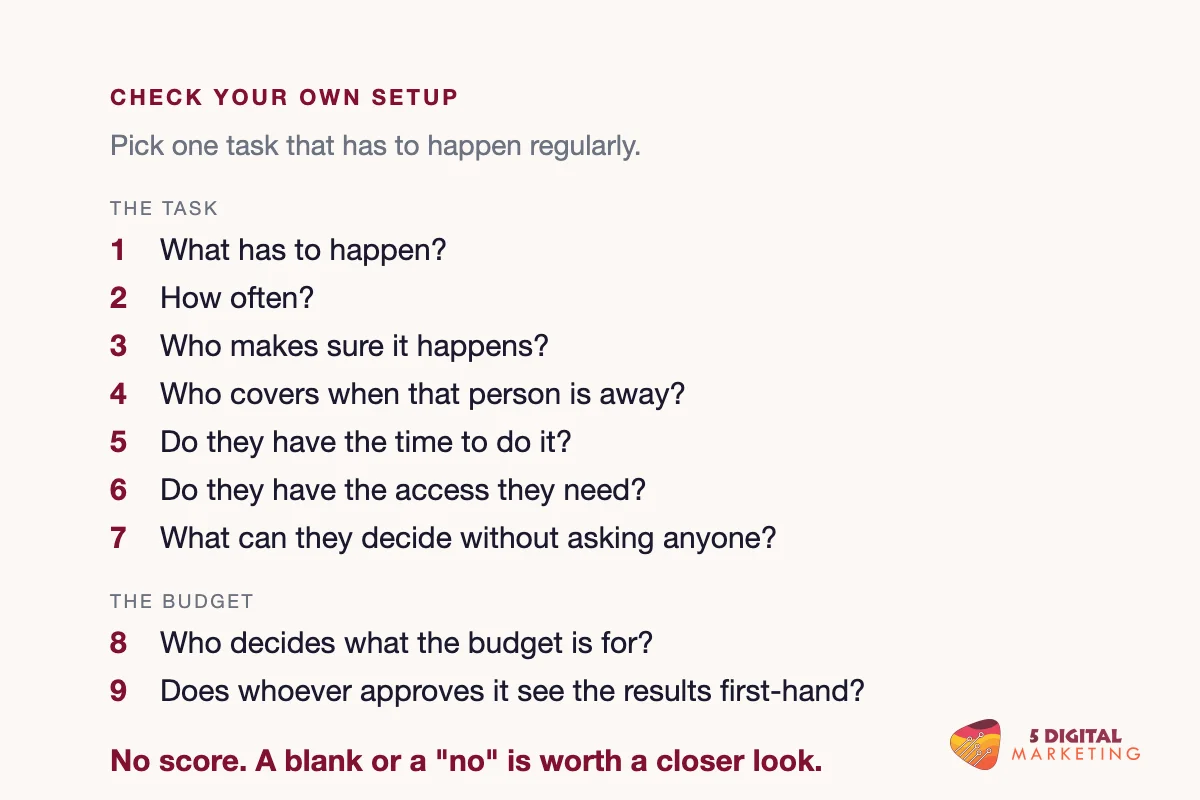
Pick one thing that has to happen regularly, such as reviewing the results or deciding the ad budget. Write a short answer to each question.
About the task you picked:
- What has to happen?
- How often?
- Who makes sure it happens?
- Who covers when that person is away?
- Do they have the time to do it?
- Do they have the access they need?
- What can they decide without asking anyone?
About the budget:
- Who decides what the budget is for?
- Does the person who approves it see the results first-hand?
There's no score. A blank or a "no" is worth a closer look. If every answer is clear, your arrangement may already be fine, and nothing needs to change.
Questions owners ask
Does a small business need a full-time marketing manager?
Not necessarily. What it needs is someone who makes sure the work, the review and the next decision happen, with the authority to act. In a small business that's often the owner, with others doing parts of the work. A job title on its own doesn't close the gap.
What if someone already handles our ads but results are still weak?
Then check whether they own the four decisions above or only run the account. If they own them and have what they need, the cause could also be the ads themselves, how results are measured, the offer, the price, demand or how enquiries are followed up.
Who should approve the advertising budget?
Whoever can say what the money is for. Whoever approves it, owner or manager, needs to see the numbers first-hand, not a summary passed on by someone else. That can be a short, regular look at the same report the person running the ads works from, with someone there to explain it.