There is a number most service businesses have never worked out. It is not complicated. It is also not the one people assume. Before the number, two things have to be separated. Almost every conversation about this collapses them together and arrives somewhere wrong.
Some businesses sell a thing. Others sell time.
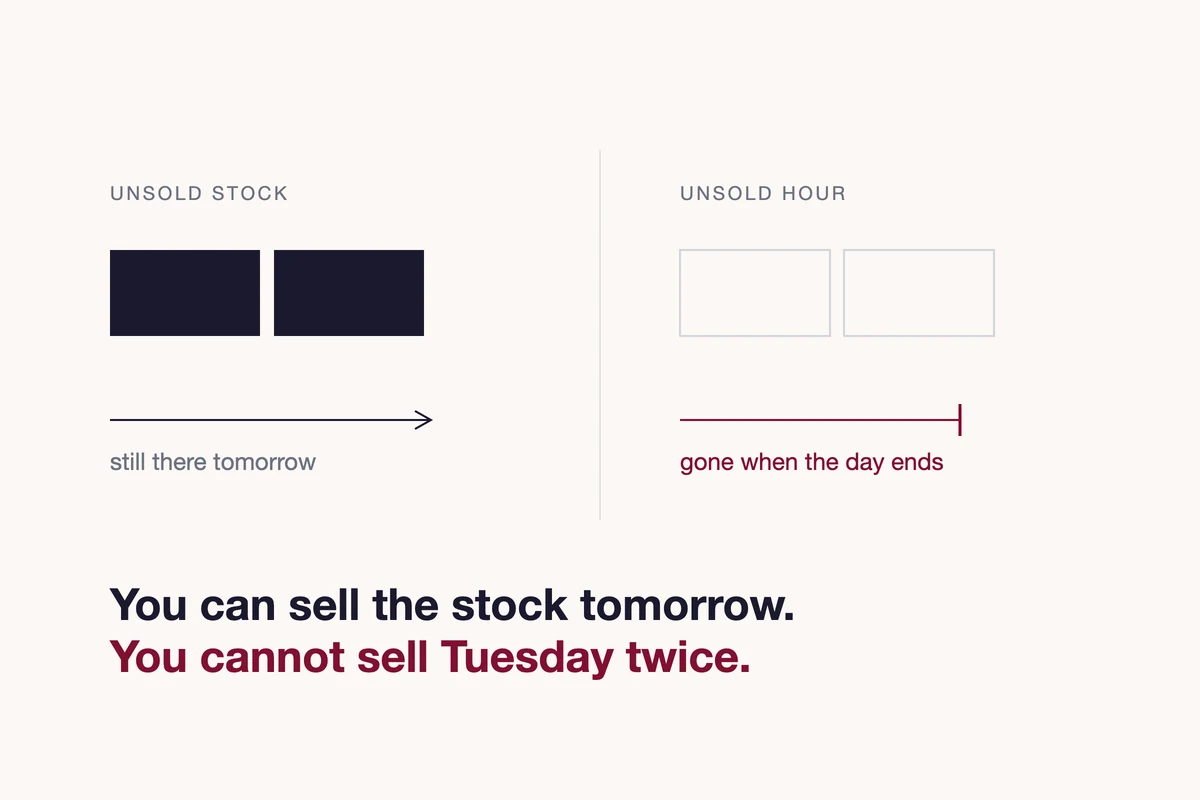
A shop that doesn't sell a bag of rice today still has the rice tomorrow. Nothing has been lost except the wait.
A clinic that doesn't fill Tuesday at two o'clock does not have Tuesday at two o'clock tomorrow. The room survives. The consultant survives. But that particular hour of available time cannot be moved, stored or sold later. Last night's empty room at a guesthouse is the same. So is an unfilled place in a class that has already started, or a table that sat empty through Friday service.
This isn't two categories of business so much as two things a business can sell, and plenty sell both. A salon sells hours on the floor and also sells product off the shelf. The shelf can wait. The hours can't.
Worth being precise here, because the loose version of this argument is wrong. An empty chair is not automatically an unsold one. A gym place may already be paid for by a monthly member who didn't come in. A missed appointment may have been charged for. What expires is unsold available time, not every empty space you can see.
So that's the first half: some of what you sell has a deadline built into it.
What keeps running while nothing sells
The second half is the cost side, and it needs the same care.
Some costs of keeping the doors open don't move with how busy you are, at least across a given period. Rent doesn't. Insurance and annual licences don't. Salaried staff are paid the same on a slow Tuesday as a full one. Equipment finance is due on its date regardless.
Others do move, and it's worth not pretending otherwise. Power has a baseline plus whatever the day's activity adds. Cleaning has a routine part and a part that depends on use. Commission, casual shifts and overtime all track how busy you were.
Accounting has a name for the gap this creates. A business pays to make capacity available. Some of it goes unsold. The share attributable to the unsold part is called the cost of unused capacity. It's a normal idea, taught in ordinary management accounting. It isn't a marketing invention and it isn't a rhetorical trick.
Which brings us to the part that usually gets stated badly.
The honest version of the empty slot
So here is the thing worth holding on to. You paid to make that hour available, and nothing came in to help cover it. The rent was going to be paid either way. The hour was going to be staffed either way. The only variable was whether anything arrived to contribute towards it.
That is not a metaphor or a sales line. It is what your own accounts already say, whether or not anyone has ever pointed at it.
No one sends you an invoice for the hour that didn't sell. You just quietly paid for it.
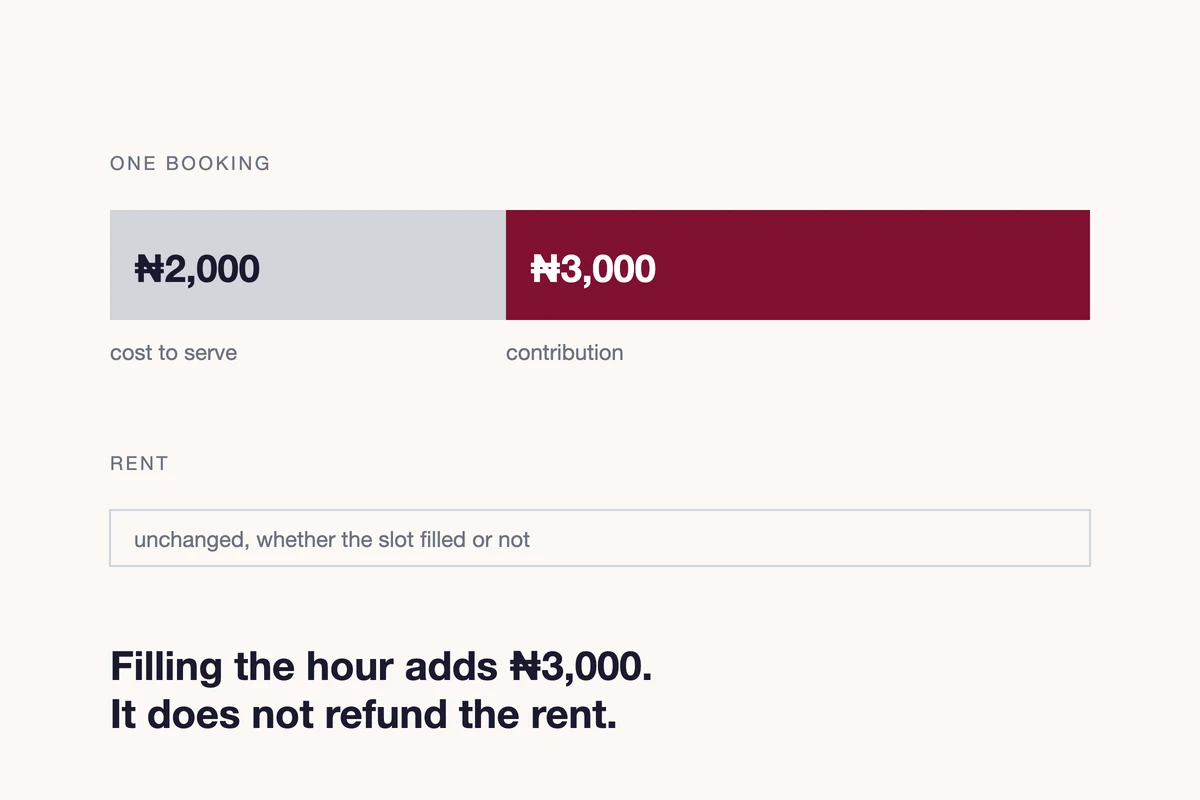
What is not true is that filling the slot would have refunded the rent. It wouldn't. Rent isn't reduced by being busy.
What filling it does is add contribution. That is what you received for the work, minus what it cost you to do it. Say an appointment brings in ₦5,000 and consumes ₦2,000 in materials and time. It contributes ₦3,000 towards everything else you pay for. That ₦3,000 is the real figure. It is not the share of rent that hour was carrying. Those are two different numbers, and neither one predicts the other.
This distinction sounds like pedantry until you try to make a decision with it. Judge advertising against the rent an empty hour is "wasting" and you are working from the wrong number entirely. Judge it against contribution and you get one you can actually compare to what acquiring a customer costs.
So the question is not "how much is my empty capacity costing me." It is closer to this. What does a filled one contribute, and what would it cost to fill?
That is answerable. Most businesses have simply never answered it.
Why the quiet stretches keep arriving anyway
The usual explanation is that quiet periods just happen. The season, the economy, the road works, January.
Season is real. It is also doing a lot of work in that sentence, and it hides something steadier. Every month, a trickle of your customers stops coming for reasons that have nothing to do with the calendar.
Research on why people leave service providers has run for thirty years. The consistent finding is that there are many reasons, not one. Keaveney's 1995 study of service switching sorted hundreds of customer accounts into eight distinct categories. Later work by East and colleagues drew out something more useful still: a large share of switching happens without prior dissatisfaction. People move house. Their circumstances change. Their need ends. Something opens closer to where they now work. Someone recommends an alternative and they try it.
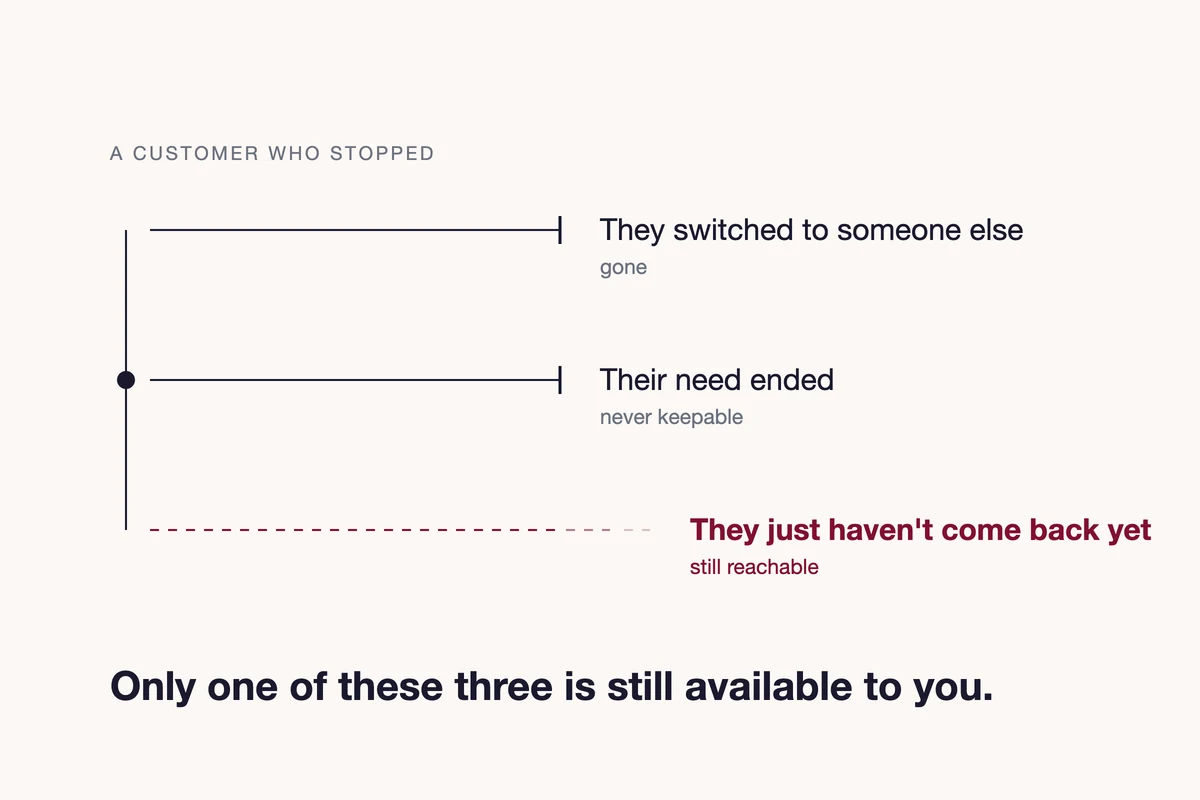
It's also worth separating three things that look identical from behind the counter. A customer who switched to someone else is not the same as one whose need ended. Neither is the same as someone who simply hasn't got round to coming back. The first is lost, the second was never keepable, and the third is still available.
None of this is a judgement on the work. A business can be genuinely good and still see this every month. Most of the causes sit outside the building.
And then there's one more, which is harder to see than any of them.
The part nobody can see from behind the counter
Some customers didn't choose anything. They just didn't think of you.
This is better established than it sounds. Nedungadi's experiments in 1990 showed something specific and slightly uncomfortable. How easily a brand comes to mind affects whether it gets considered and chosen. That works independently of how well it's regarded. Making one option easier to recall changed what people picked, without changing what they thought of anything.
There is a related thing worth noticing, though it shows something different. Running lead campaigns for a medical diagnostics business, enquiries came in at one in the morning. At four. At eleven at night. Those timestamps tell you when people acted. They don't tell you what those people were thinking beforehand. What they do show is that the moment someone decides to act doesn't check whether you're open.
The practical translation is that being liked and being remembered at the right moment are two different things. A customer can hold a good opinion of your clinic. Then their back starts hurting again, and someone else's name surfaces first. No decision was made against you. You weren't in the room.
The honest boundary on this: nobody can tell you that most of your lapsed customers forgot. That isn't measurable from outside, and anyone who gives you a percentage is repeating something they can't source. What the evidence supports is more modest and still useful. A business can be remembered favourably without coming to mind in a particular buying situation, and reminders can make it easier to retrieve.
Advertising isn't the only thing that does the reminding. Signage someone drives past. A recommendation at a party. A search result. An existing appointment. A message from a friend who goes to you. All of it reinforces. Silence from one channel is not silence everywhere.
What the arithmetic actually says
Say some share of your customers stops coming each period and nobody replaces them. The base then shrinks in a predictable way. Each period's departures come off a base that is already smaller than the one before.
That's the mechanism people mean by "compounding," though the word misleads slightly. The number of people leaving each month gets smaller, not larger, because there are fewer left to leave. The decline doesn't suddenly steepen.
What can change suddenly is whether you're profitable, and for a different reason. Your fixed costs sit there as a line. Contribution comes in and covers some of it. As contribution drifts down it can cross that line. The month it does is the month everything feels different. Nothing accelerated. A threshold was crossed.
This is why a business can feel fine for a long time and then not fine quite quickly. Nothing dramatic happens in between. The underlying drift was steady. The consequence wasn't.
When more advertising isn't the answer
Four situations change the answer, and they are worth ruling out before you act.
If you are already close to full, fix capacity before demand. If your customers sit on contracts with real switching costs, your outflow is small and this matters less to you. If referrals or your location already bring enough of the right people, don't break what works. And if enquiries sit unanswered for days, more of them will make things worse rather than better.
One more, because it is the one people skip: advertising can simply fail to pay at your numbers. Customers may have come anyway. Reaching them may cost more than they contribute. That is a channel problem, not a verdict on your business.
Unbooked time isn't automatically waste either. Preparation, maintenance and a bit of slack are things a well-run business keeps on purpose.
None of that describes most businesses selling time. If none of it describes yours, what follows is the part that decides it.
The decision taken during a quiet month
Now the part that's worth being careful about.
When money gets tight, marketing is one of the easier things to stop. It usually has no contract, no notice period and nobody's salary attached. So it often goes early.
Sometimes that's exactly right. If the advertising wasn't earning more than it cost, stopping it improves your position immediately. Continuing out of discipline would be waste.
But if it was earning more than it cost, stopping it removes contribution at the moment you have least of it. That's a different outcome entirely, and it looks identical on the day you make the decision.
The research on advertising through downturns points in both directions depending on the situation. Some studies have found firms that maintained or increased their advertising share did better afterwards. Others have found advertising works harder during expansions than contractions. What nobody has established is a rule that applies to every business in every condition.
So the useful question isn't whether to keep advertising during a quiet stretch. It's whether the advertising you're doing brings in more contribution than it costs. Most businesses cut or continue without ever knowing, which means the decision is being made on mood.
The number worth working out this week
Not a campaign. One figure, and you can get close enough with what you already have.
Take a group of comparable customers. Work out the average contribution per visit: what you received, less discounts and refunds, less what it cost you to serve them. Then multiply by how many times a customer like that comes in a year.
If you can't estimate how long people stay, don't guess. Use twelve months, and call it a twelve-month figure rather than a lifetime one.
That number is what one more customer of that type is worth to you in a year, before you've spent anything to find them. It is rough. It is undiscounted, it ignores overheads, and it is not the whole amount you can safely spend acquiring someone.
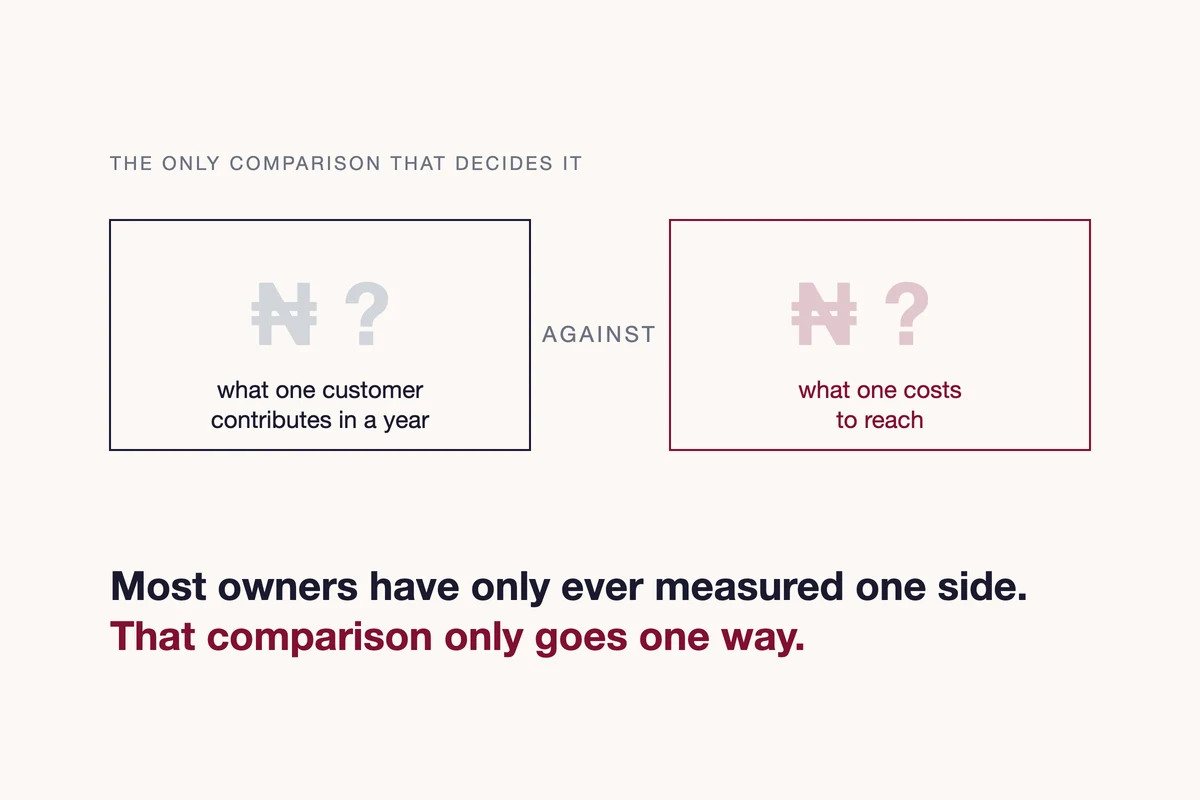
It is also the first honest figure most owners in this position have ever had. Once you know roughly what a customer contributes, you can ask what one costs to reach. That is a comparison you can finally make.
Until then, you are weighing a cost you can see against a benefit you have never measured. That is not really a comparison at all.