Nothing happens on the day you stop advertising, which is why the decision is so easy to get wrong. People don't forget you overnight, so a pause doesn't erase you. But it stops renewing you. Memory of your business fades slowly, and meanwhile your customers keep reaching their moments to buy, on their own timetable.
On the day itself, the phone rings about as often as it did yesterday and the money you didn't spend is still in the account. Some of your customers' buying moments will land inside the pause, though. Whether that costs you anything comes down to three things: how long you stay off, how often your customers buy, and what else keeps your name in front of them.
Why the ad budget goes first
When owners tell me they're switching their ads off, it's usually for one of two reasons. Either they aren't sure what the ads are bringing in, or money is tight and the ad budget is the first line to go, whatever it was producing.
I understand both. The first is a measurement problem, and working out what a customer contributes to your business settles most of it. The second is about cash, and sometimes cash makes the decision for you.
Neither one asks what the pause does over the weeks that follow. And the way most restarts go can make that first doubt look justified when it isn't.
Do customers forget you when you stop advertising?
Not overnight. Out of sight isn't out of mind, at least not straight away.
Nicole Hartnett, a senior marketing scientist at the Ehrenberg-Bass Institute, led one of the main studies of brands that stop advertising. On memory, she's blunt: "people won't forget a brand's distinctive assets overnight. Or even years." Distinctive assets are the things people recognise a brand by without reading its name: the logo, the colours, the look.
So the customers who already use you still know who you are. Your sign is still up, people still pass your name on, and anyone searching for what you do can still find you. One channel going quiet doesn't make the business silent. If someone tells you a two-week break undoes everything you've built, they're claiming more than anyone has measured.
How long does advertising last?
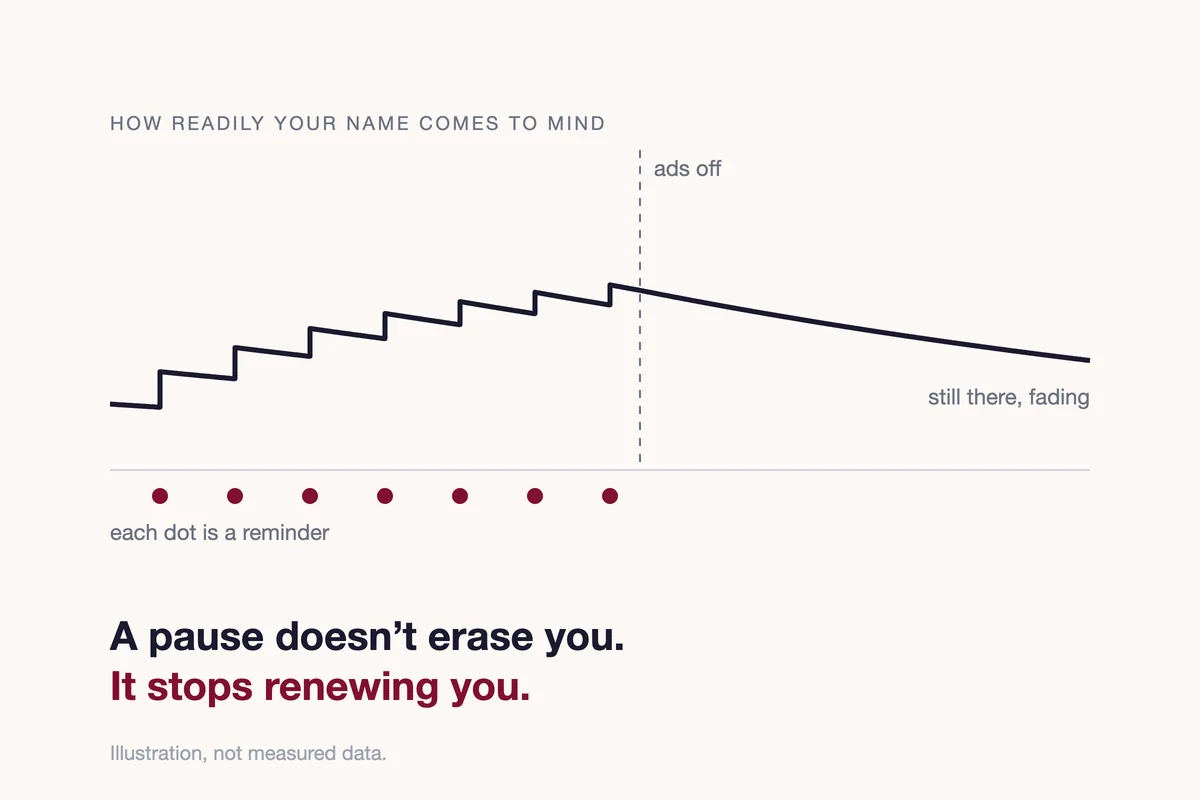
Longer than the ads run, but not forever. Its effect wears off gradually once the reminders stop.
Hartnett's next line is the catch: "But people will forget them eventually." Those memories, she says, can "degrade without reinforcement."
Reinforcement is the word that matters. Every time a customer sees you, it tops up how readily your name comes to mind. Switch off the reminders and the level starts to drop, slowly enough that you won't notice it from one week to the next.
Researchers have measured this for advertising in particular. A 2015 study by Susanne Schmidt and Martin Eisend combined the results of many earlier experiments on ad repetition. Seeing an ad again and again helped people remember the brand and like it. Both effects wore off as time passed since they last saw it.
Being liked and being remembered aren't the same thing, which the quiet-day article goes into. The point here is the clock.
Your customers keep their own calendar
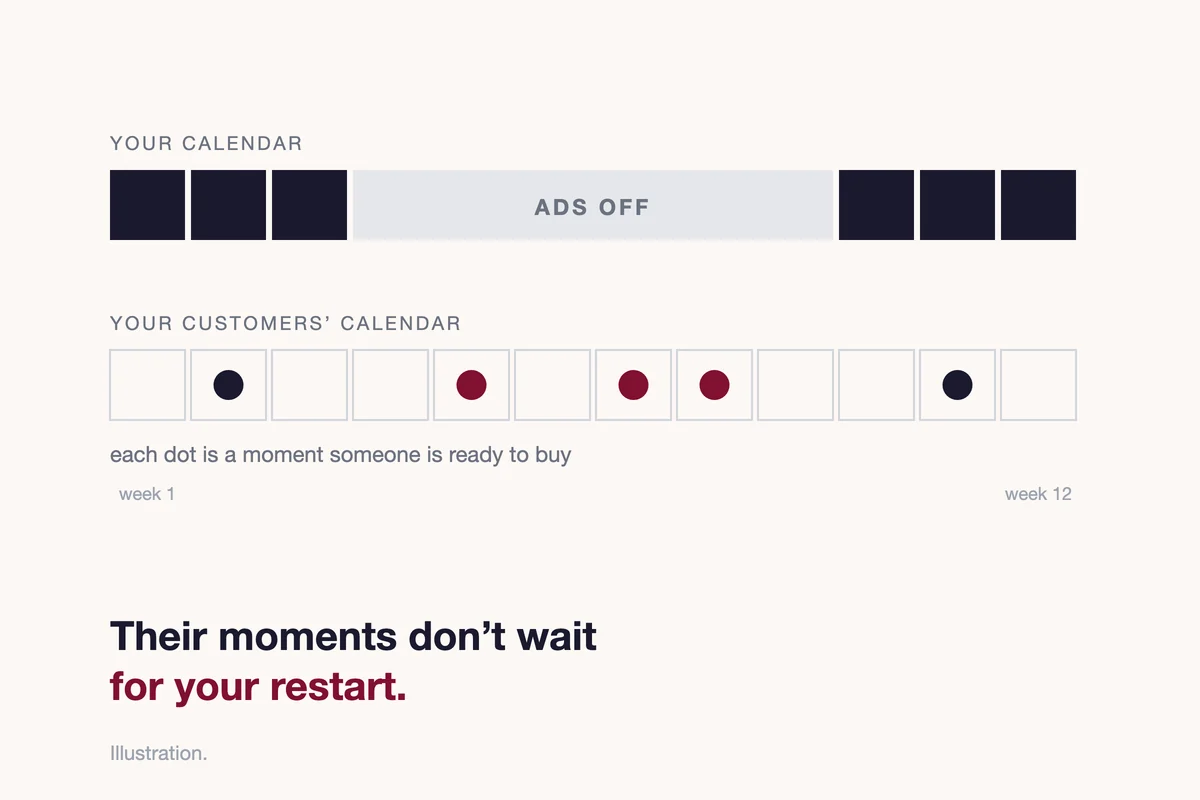
Picture two calendars. Yours has the pause pencilled in: ads off this month, back on when things pick up. Your customers' calendar has their check-ups, birthdays, trips and the start of a new school term, and it has no idea yours exists.
Their moments arrive whether you're advertising or not, and some of them will land inside your pause.
For business buyers, there's a well-known estimate of how spread out those moments are. John Dawes of the Ehrenberg-Bass Institute calls it the 95:5 rule. A company changes its bank or law firm roughly once every five years, so in any quarter about 95% of them aren't shopping. Your customers may not be companies, but the idea carries. At any moment, most of the people who'll buy from you this year aren't buying today. Advertising, Dawes argues, works mainly by building a memory link that switches on when the buyer does come into the market.
The researchers who studied brands going dark argue something similar: the longer people go between purchases, the more room there is for their memory of a brand to fade. That's their explanation of what they found rather than something they measured. If your customers come back once or twice a year, take it seriously.
There's a hint about who notices a pause, too. In a run of large advertising experiments at eBay, published in 2015, the ads did little for regular customers, who came back anyway. They made a difference with new customers and with people who bought rarely. That was search advertising for an online marketplace, so read it as an illustration, not a forecast for your business. It still squares with common sense. Your regulars will mostly find their way back. The person whose need comes round once a year is the one a pause can miss. Nobody decides against you. Their moment comes while you're quiet.
A made-up example. A dental practice sees most patients every six months, and it switches its ads off for eight weeks.
- Patients halfway through treatment carry on as normal. The pause costs nothing there.
- Patients whose check-up falls due in those eight weeks might remember to book. Or they might book with whoever comes to mind first.
- Someone new to the area, looking for a dentist that month, finds whoever is visible.
Which group matters most depends on the practice.
Does stopping advertising hurt sales?
Stop for a year or more and, in the studies we have, brands tended to lose ground. Stop for a few weeks and the evidence runs out.
The best-known research on what happens when brands stop advertising comes from two Ehrenberg-Bass studies. The first followed 41 alcohol brands in Australia over two decades. The second covered 365 brands across 22 consumer goods categories in the United States. In both, brands that went a year or more without advertising tended to lose sales or market share. The losses built up steadily, and the longer the silence, the more common they got.
Before you borrow those findings, know their limits. These were products on shop shelves, not appointments or hotel rooms. They weren't controlled experiments, so other things changing at the same time weren't ruled out. And every stop they looked at lasted a year or longer. The authors say themselves that shorter stops are likely far more common in practice, and that they still need studying.
So no one can tell you what your six-week pause will cost. If someone quotes you a percentage, it most likely comes from shop-shelf brands that went quiet for a year.
How long does it take to recover after you stop advertising?
Often longer than the break itself. "When brands stop advertising," Hartnett says, "it takes a disproportionate time to reclaim lost sales." For brands that went quiet for a whole year, her research "suggests that it may take over a year of spend to make up for a one-year hiatus."
Shorter breaks have less behind them. The closest figure comes from the analytics firm Analytic Partners. Drawing on more than 700 marketing mix models, it reported in September 2026 that brands going dark for twelve weeks took twenty-four weeks to rebuild lost momentum. That's industry analysis rather than a peer-reviewed study, and it was unveiled at an advertising company's launch event, so hold it loosely. It points the same way, though.
The studies miss something that, in my experience, owners notice most. When you switch the ads back on after a long break, the enquiries don't come straight back. It takes a while to become the first name people think of again. That's an observation from practice, not a measured result, and the climb will be longer for some businesses than others.
The restart trap
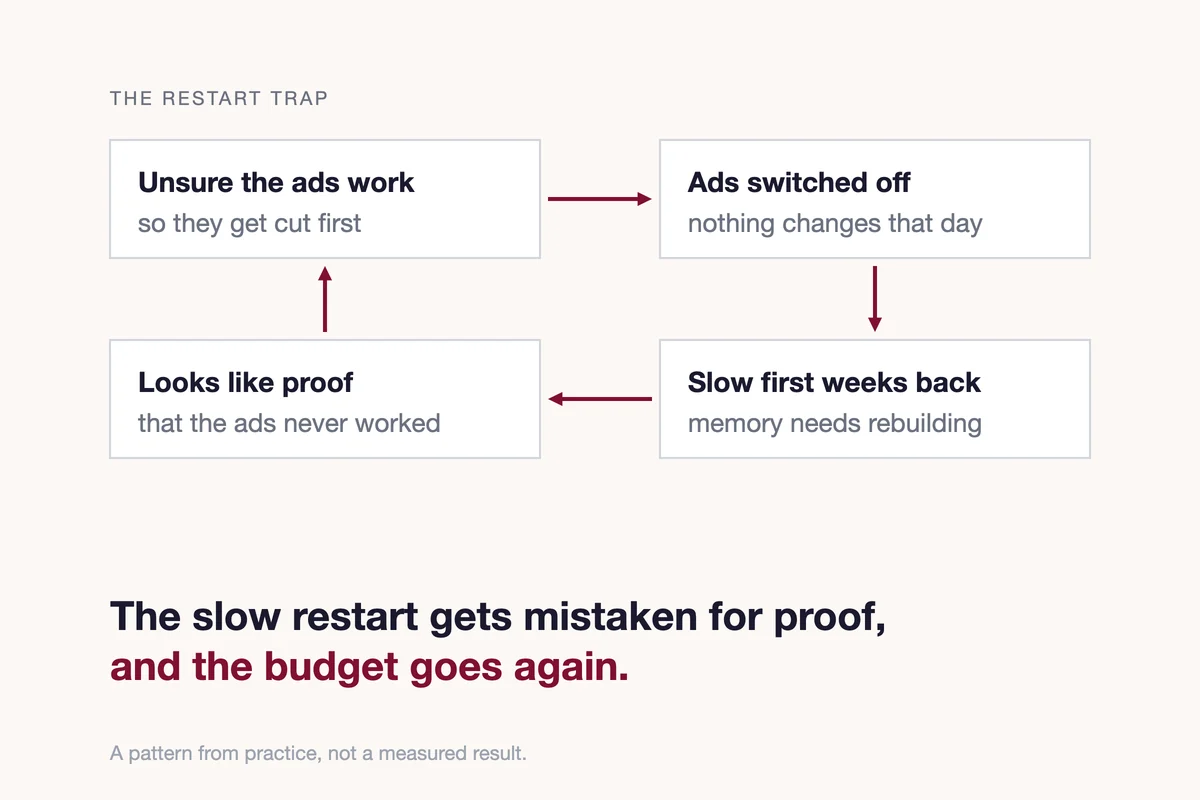
Remember the first reason owners give for pausing: they weren't sure the ads were working. Then they restart, the first weeks are slow, and the slow weeks look like proof. The ads can end up blamed for a slow patch the pause helped cause, and the budget goes again at the next tight month.
Owners who've advertised for years tend to treat it as a long game, and I think this is why. They've sat through a slow restart or two, and they don't mistake it for the ads failing.
When is pausing your advertising the right call?
Some pauses are the right decision.
- Testing. Switching ads off to try new creative, a new offer or a different audience is how results improve. Usually some ads keep running while others are off, so the business stays visible. There's research behind resting tired ads, too. An ad people have seen too often stops working, and a 1998 study of media scheduling showed a break can restore it. People forget the details, so it feels new when it comes back.
- The ads weren't paying. If the extra business they brought in contributed less than they cost, stopping improves your position straight away.
- You're full. If you can't serve more people, more enquiries help nobody.
- The cash isn't there. Then it's a cash decision. Call it that, and plan the restart.
Switching on and off is normal, too. An analysis of 370 brands found it was the most common way advertisers scheduled their spending. The same analysis points to a middle path when cash is the issue. Keeping a low, steady level of advertising running between bigger pushes held up well across the scenarios the researchers simulated.
The pause to watch is the default one: no reason beyond the budget being easy to cut, and no date to come back.
Before you pause, write down four things
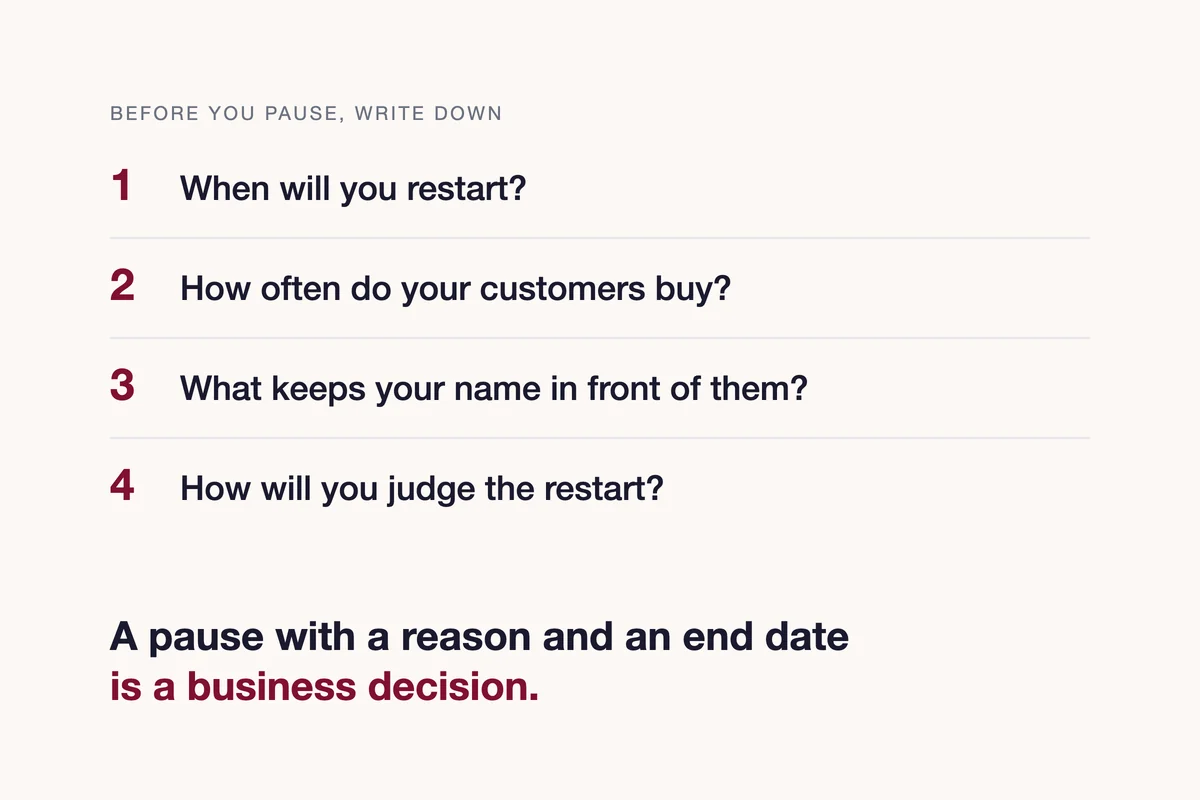
You're the only one who can run this check, and it won't take long.
- When will you restart? Put a date on it, even a rough one.
- How often does a typical customer buy from you? If most come back every few weeks, a short pause meets few of their buying moments. If they buy once or twice a year, or take months to decide, more of those moments fall inside the gap.
- What will keep your name in front of people while the ads are off? List it honestly: regulars, referrals, your sign, your search listing, messages to past customers. For some businesses the list is long. For others it's mostly the ads.
- How will you judge the pause, and the restart? Write down your weekly enquiries before you stop, then compare the first weeks back with that number. Don't judge the restart on its first few weeks alone. The comparison won't prove cause on its own, but it beats memory.
A short pause, customers who buy often and a long list at question three, and the pause may cost you little. No end date, customers who buy rarely and a list that's mostly ads, and expect it to cost more than it looks like on the day you decide.
A pause with a reason and an end date is a business decision. One with neither is the ad budget going first again.
Questions owners ask
Should I stop advertising when business is slow?
Only if the ads weren't paying, you can't serve more customers, or the cash isn't there. A slow spell doesn't make advertising worthless, and the customers who buy from you later still need to remember you when they're ready. If you do stop, set an end date and plan the restart before you switch off.
Is it better to pause ads or lower the budget?
If cash is the problem rather than results, lowering the budget is usually the gentler option, because it keeps you visible while you save. In one analysis of 370 brands, a low, steady level of advertising between bigger pushes held up well in simulations. A full pause makes more sense when the ads weren't paying at all.
What is the 95:5 rule in marketing?
It's an estimate from Professor John Dawes of the Ehrenberg-Bass Institute, published in 2021. Up to 95% of business buyers aren't in the market for many goods and services at any one time. A company changes its bank or law firm roughly once every five years, so only about 5% are shopping in any quarter.