Facebook and Instagram ads in Nigeria have no fixed price. Meta runs an auction, so your cost moves with the result you optimise for, your audience, the competition you bid against, your creative, and where the click lands. The honest way to plan is to work backward from the outcome: separate your ad spend, the 7.5% VAT and any management fee, then judge the work by qualified enquiries, not clicks or raw leads.
I ran my first Facebook ad campaign in 2012. Back then a naira went a long way and almost nobody in Nigeria was buying ads, so attention was cheap and mistakes were cheaper. Thirteen years later the platform is crowded, the naira is thinner, and the question I still get asked most is the simplest one: how much does this actually cost? Anyone who answers with a single fixed number is guessing. Here is the honest version, the kind I would give a friend over lunch.
Below: why the price is never fixed, what your money is really split into, the difference between a cheap lead and a lead that pays, and how to set a budget you can defend.
Two businesses, same budget, opposite results
Here is the part nobody tells you. I have watched two businesses put the same budget behind the same platform in the same month, and walk away with opposite results: one full of enquiries, the other convinced Facebook ads "don't work in Nigeria." Same platform, same budget, same month. The price of the ad was never the difference. What separated them was the skill to make Meta charge less for the same result. Almost nobody selling you ads explains that, so let me.
First, the two costs people mix up (and pay for twice)
When someone asks me "how much do Facebook ads cost," they are usually asking two questions at once, and the answers are completely different:
- Ad spend: the money that goes to Meta to actually show your ads. You set this. It can be a few thousand naira a day or a few million.
- Management fee: the money that goes to the person running the campaigns. It is a separate line from your ad spend. It is charged either as a flat monthly retainer, common on smaller budgets, or as a share of your spend as budgets grow, and it scales with scope. What matters is not the size of the fee but the cost per result it buys you. A good manager makes Meta charge less for the same outcome, which is where their fee pays for itself. Be wary of one all-in number that folds fee and spend together, because it usually leaves too little for real ad spend.
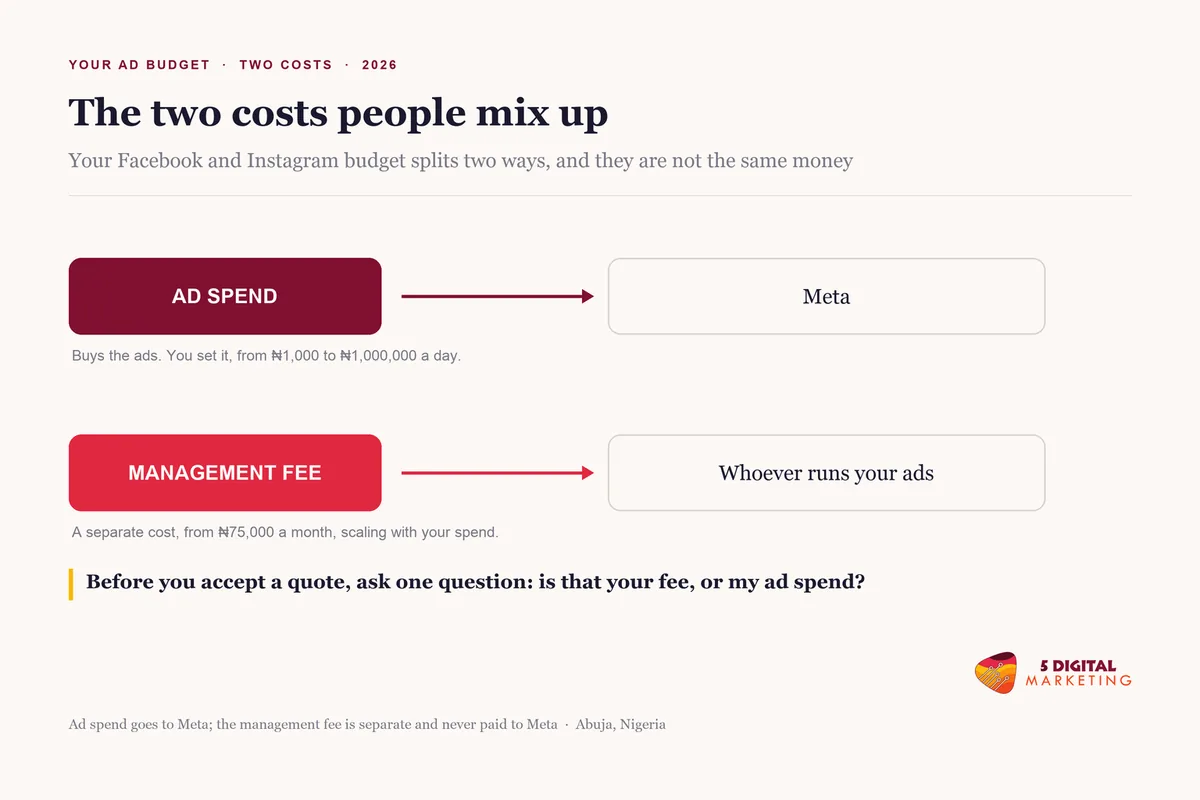
This is exactly where people get burned. A "cheap ad guy" quotes one small number and it sounds like a steal. Ask him one question: is that your fee, or my ad spend? If it is meant to cover both, the spend left over is too small for Meta's system to learn anything, and you have quietly paid to teach an algorithm nothing. You did not buy ads. You bought a lesson.
What you are actually paying for
Instead of a single price, think in the pieces that make up the cost. Only one of them is fixed.
| What you pay for | Who it goes to | What sets it |
|---|---|---|
| Ad spend | Meta | The auction: your objective, audience, competition and ad quality |
| VAT (7.5%, FIRS) | FIRS, via Meta | Fixed 7.5%, added on top of your ad spend |
| Creative | You or your producer | How much fresh image and video the account needs to keep costs down |
| Destination | You or your team | The landing page or WhatsApp the click lands on |
| Management fee | Whoever runs the ads | Structure and scope, priced to the work, kept on its own line |
Notice what is missing: a fixed cost per click or per view. Those move every day, and any figure you see quoted online, including in Google's own answers, is a rough market range, not a price you have been offered. What decides where you land is the auction.
Why your cost is not fixed: Meta runs an auction, and the highest bidder does not win
This is the part that changed how I run every campaign, and it is true whether you advertise in Lagos, London or New York. Every single time your ad could appear to someone, it enters an auction. Meta does not simply hand the slot to whoever pays most. It picks the highest total value:
Total value = your bid × estimated action rate + ad quality
Source: Meta Business Help Center, About ad auctions.
Read that twice, because it is the whole game. A relevant, well-made ad shown to the right people wins the slot cheaply. A weak ad has to bid higher just to show up, so it costs more for every result you get. That is the honest reason a skilled manager is cheaper, not more expensive. "Make my ads cost less" and "make my ads better" turn out to be the same sentence.
CPC, CPM, and the metric that actually matters
You will see four cost words thrown around. Here is what each one answers, and what it cannot tell you:
- CPC (cost per click): what you pay for a tap. Useful for reading interest, useless for reading sales.
- CPM (cost per 1,000 views): what you pay to be seen. Tells you how expensive attention is, not whether it converts.
- Raw CPL (cost per lead): what you pay for anyone who fills a form or sends a message. This is the number most "cheap ad" pitches wave around, and it hides the most.
- CPQL (cost per qualified lead): what you pay for a lead that actually fits your business. This is the only one tied to money in the bank.
A low CPC or a cheap raw CPL feels like winning. It often is not. Here is why.
The cheap-lead trap
A raw lead is anyone who raises a hand. A qualified lead is one that fits: the right location, a real need, able and ready to buy, and reachable. The gap between the two is where budgets quietly die.
The figures below are an illustration to show the trap, not 5 Digital performance data or a forecast.
| Campaign | Spend | Raw leads | Raw CPL | Qualified leads | CPQL | What it really means |
|---|---|---|---|---|---|---|
| A | ₦50,000 | 100 | ₦500 | 5 | ₦10,000 | Cheap-looking lead volume, weak qualification |
| B | ₦30,000 | 25 | ₦1,200 | 10 | ₦3,000 | Higher raw CPL, far stronger real economics |
Campaign A looks cheaper on every vanity metric and is the worse buy. The lesson is simple: judge ads on the cost of a lead that can actually become a customer, not the cost of a raised hand.
How to budget from the outcome backward
Stop starting from "what should I spend." Start from what a customer is worth, and let that set the budget. Four lines do it:
- Raw CPL = media spend ÷ leads captured
- CPQL = media spend ÷ leads that meet your qualification standard
- Maximum CPQL = what you can afford to acquire a customer × the share of qualified leads that close
- Planning media budget = the qualified leads you want × your target CPQL
Your qualification standard has to be explicit, in your words, not a manager's private judgement: location, service fit, a real need, affordability and readiness, and a contact you can actually reach.
A worked illustration, not a guarantee:
If you can afford ₦50,000 to acquire one customer, and you close one in five qualified leads, then the most you can pay per qualified lead is ₦10,000. Want ten qualified leads a month? That is a planning media budget of about ₦100,000, before VAT and any management fee. Change any input and the budget changes with it. That is the point: the number comes from your economics, not from a price list.
And it is why I am honest about who this suits. If your plan is a small "try it and see" test, any manager worth hiring will cost more than the test, and you are better off learning the basics yourself first. But if you are a growing business ready to put a real budget behind growth and want it run properly, that is the work we do. At that level the fee is not the number to worry about. The wasted spend is. That is what you are paying me to remove.
What actually moves your cost
Five things move your number, and you control most of them:
- How tight your audience is. The narrower and more specific the group, the more you pay to reach each person, and often the more each one is worth. Chasing "everyone in Nigeria" is cheap and useless.
- What you ask Meta to optimise for. Asking for a purchase or a booked call costs more than asking for a like, because Meta has to work harder to find people who are ready to act.
- How much competition you are in. Real estate, loans and e-commerce are expensive because everyone is bidding; a quiet niche is cheaper. Lagos generally costs more than a smaller city for the same reason.
- How good your ad actually is. The big one. A strong ad is rewarded with cheaper reach; a weak one is taxed by the auction.
- The time of year. Costs tend to climb into the October-to-December holiday period as competition for attention peaks. Plan your big pushes around that window, not into the teeth of it.
Four of those five are things a good manager influences on purpose. That is the job.
The 7.5% VAT nobody mentions
Nigeria's FIRS charges 7.5% VAT on advertising services, and Meta adds it on top of your budget. Set ₦100,000 and you will be billed about ₦107,500. It is small, but it stings when you have budgeted to the last naira, so plan for it now instead of finding it on the receipt. (Rate per FIRS guidance on VAT for online services.)
How to tell if you are already overpaying
If you are running ads now and they feel expensive, check these before you blame the platform:
- Are you boosting instead of using Ads Manager? The Boost button is built for reach and engagement. Ads Manager lets you optimise for enquiries or sales and control your targeting. For most lead goals, that control is why the same budget works harder, so set it up there. There is a money reason too: if you add funds or boost from the Instagram or Facebook iOS app, Apple adds a 30% service fee on top in most regions. Boosting from a browser at instagram.com avoids it. (Per Meta's help on the Apple service fee.)
- Is your ad optimised for the right thing? Optimising for "engagement" when you want sales trains Meta to bring you likers, not buyers.
- Is your tracking actually working? If Meta cannot see who converts, it cannot find more of them, and your cost per result drifts up quietly.
- Are you judging campaigns too early? Early spend buys learning as much as results. Meta needs enough conversion events to find who buys, and how long that takes depends on your budget and how often people convert, not a fixed number of weeks. Switch a test off too soon and you kill it before it learned anything.
Fix those four and most "expensive" accounts get noticeably cheaper without a naira more in budget.
If you close on chat: click-to-WhatsApp
Many Nigerian service businesses close on chat. If that is you, a click-to-WhatsApp ad is often the most efficient format: a Facebook or Instagram ad that opens a WhatsApp conversation instead of sending people to a page they will never fill in. Whether it is the cheapest route for your business depends on your funnel, so track the qualified conversations, not the taps. There is a newer route too, ads inside WhatsApp Status. I break down how it all works in the WhatsApp Ads in Nigeria guide.
Does Instagram cost more than Facebook?
Not in any fixed way. They share the same auction and the same budget, so placement is one input, not the whole price. Instagram can perform better or worse than Facebook depending on your audience and creative, especially in Stories and Reels. Test both and read the placement breakdown rather than assuming one is cheaper. If you want the how-to instead of the cost, read Facebook Ads in Nigeria and Instagram Ads in Nigeria.
Frequently asked questions
How much do Facebook and Instagram ads cost in Nigeria in 2026?
There is no fixed price. Meta runs an auction, so your cost depends on what you optimise for, your audience, the competition, your creative and where the click lands, plus 7.5% VAT on top. Plan by working backward from the outcome you need, and judge the ads on qualified enquiries rather than clicks.
Why is there no fixed price for Meta ads in Nigeria?
Because every time your ad could show, it goes through an auction. Meta picks the highest total value, which is your bid multiplied by the estimated action rate, plus ad quality, not the highest bidder. A more relevant, better-made ad wins the slot for less.
Is the management fee part of my ad budget?
No. Ad spend goes to Meta; the management fee goes to whoever runs the ads. Keep them as two separate lines, always, so you can see which naira buys ads and which pays the manager.
Do I pay VAT on Facebook ads in Nigeria?
Yes. FIRS charges 7.5% VAT on the advertising and Meta adds it on top of your budget. Set ₦100,000 and you will be billed about ₦107,500.
Why are my Facebook ads so expensive?
Usually one of three things: weak ad relevance or quality, because the auction charges weak ads more; the wrong objective, such as boosting instead of optimising for enquiries in Ads Manager; or broken tracking. Fix those and your cost per result falls.
What is the difference between a cheap lead and a qualified lead?
A raw lead is anyone who fills a form or messages you. A qualified lead fits your business: the right location, a real need, able and ready to buy, and reachable. A campaign can produce cheap raw leads that never buy, and a more expensive one can produce fewer leads that mostly close. Budget from cost per qualified lead, not cost per lead.
How should I set my Facebook ads budget in Nigeria?
Work backward. Decide what a customer is worth to you, estimate how many qualified leads you close per sale, and that tells you the most you can pay per qualified lead. Multiply by the qualified leads you want and you have a planning budget, before adding VAT and any management fee.
Want a straight answer for your business?
I have managed Meta ad budgets for Nigerian businesses since 2012, and I will tell you the truth before you spend a naira: what to budget for the result you want, and where your current ads are leaking money. No lock-in, no jargon, no "trust me."