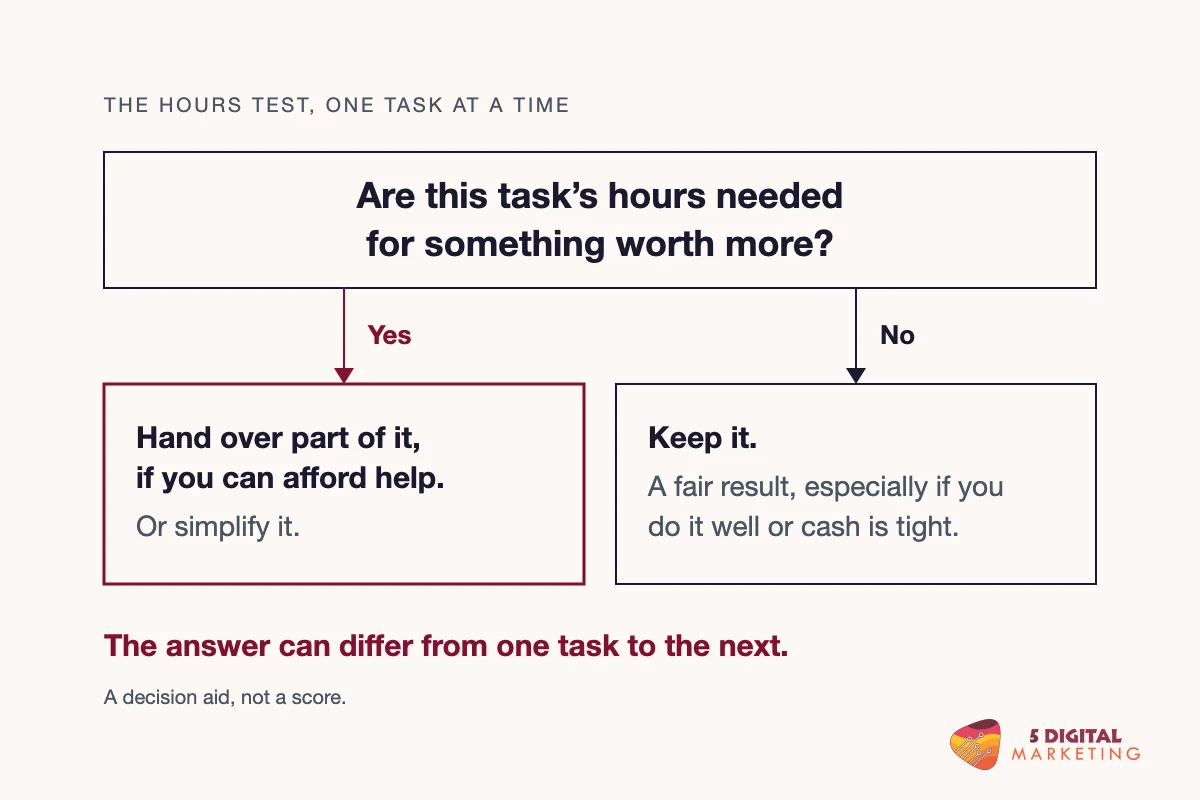
Short answer: it can be. If a task's hours are needed for something worth more, hand over part of it if you can afford help, or simplify it. If they aren't, keep it.
Owning your marketing and doing it yourself are different jobs. You can keep the decisions and hand over the work. If it isn't yet clear who owns which marketing decisions, start there. This article is about the work itself, and which parts of it are worth your own hours.
I run Facebook and Instagram ads for businesses, so I'm one of the people an owner might hand this work to. Keep that in mind as you read. Keeping a task is a fair answer here, and the check at the end needs nobody's help.
What counts as doing your own marketing?
Marketing is a bundle of separate jobs. Knowing your customers. Deciding the offer. Writing and designing. Posting. Running the ads. Answering enquiries. Reading the results. Approving the money.
Few owners do all of them, and few hand over all of them. So "should I do my own marketing?" is too big to answer well. "Should I keep writing next month's posts?" is a question you can work out.
Pick one task you do now. Keep it in mind as you read.
Which marketing tasks do owners keep when they could hand them over?
In my client work, I see owners hold on to two tasks in particular.
The first is planning the ad budget with nothing to compare it to. Without a benchmark, you can spend hours on the figure and still not know whether it fits the goal. Benchmarks can come from your own past campaigns, from published figures, or from someone who runs other accounts.
The second is tinkering with live ads. It feels like work. But when an ad changes every day or two, nobody can tell which change did what. The hours go in, and no clear answer comes back.
Neither is about ability. An owner can learn both. The question is whether this is the best use of your hours right now. If you'd otherwise be with a client or a guest, that's the trade to weigh.
What would you do with the hours instead?
Every hour spent on one task is an hour not spent on something else. Economists call the best of those other uses the opportunity cost. Researchers have tested whether reminding people of it changes their choices.
Ian Maguire, Andreas Persson and Gustav Tinghög pooled 39 experiments on this, with 12,093 participants in all. When people were reminded that their money had other uses, they were a little less likely to buy. The effect was small, and smaller still once the earliest experiments were left out. Most of the choices were hypothetical and about spending money, so apply the finding to your time with care.
Stephen Spiller's studies of how people weigh alternatives add a second point. Many of his participants were university students choosing what to buy. People thought more about other uses of their money when they felt short of it. And the uses people considered most often were the typical ones. Those may not be the best.
A practical step follows, though the studies didn't test it: name your alternative before you decide, and make it specific. "Two more client appointments on Thursday afternoons", for example, or "evenings with my family", will tell you something. "Growing the business" won't.
Then test it.
- Is the other work there? A higher value per hour only counts if there's work to fill the hour.
- Is the time in a usable shape? Twenty minutes here and there may not add up to anything you can use.
- What is the alternative worth to you? It might be money. It might be rest. Both count.
Time back can matter even when it earns nothing. Ashley Whillans and colleagues gave 60 working adults money to spend on two weekends. One weekend it went on something that saved them time, the other on something material. At the end of the day they bought time, they reported a better mood and felt less pressed for time. It was a small, short study of mood, and it says nothing about profit. Still, it's a reminder that an evening back counts.
The same test applies to money. Help costs money, and that money has other uses too, such as stock, staff or savings. Weigh both sides.
Does handing marketing over free up your time?

The numbers behind the chart
| Kind of help | One year in | Two years in |
|---|---|---|
| Training | −0.7 (−7.3 to +6.0) | +0.4 (−5.5 to +6.2) |
| Consultant | −2.5 (−8.7 to +3.7) | +4.1 (−1.7 to +10.0) |
| Hired worker | −1.4 (−7.3 to +4.4) | +3.6 (−2.2 to +9.5) |
| Outside specialist | −1.1 (−7.3 to +5.2) | +1.5 (−4.1 to +7.1) |
Hours per week, estimate (95% range). Owners in firms offered no help worked 46.5 hours a week in year one and 44.9 in year two.
Not automatically. A handover takes work of its own.
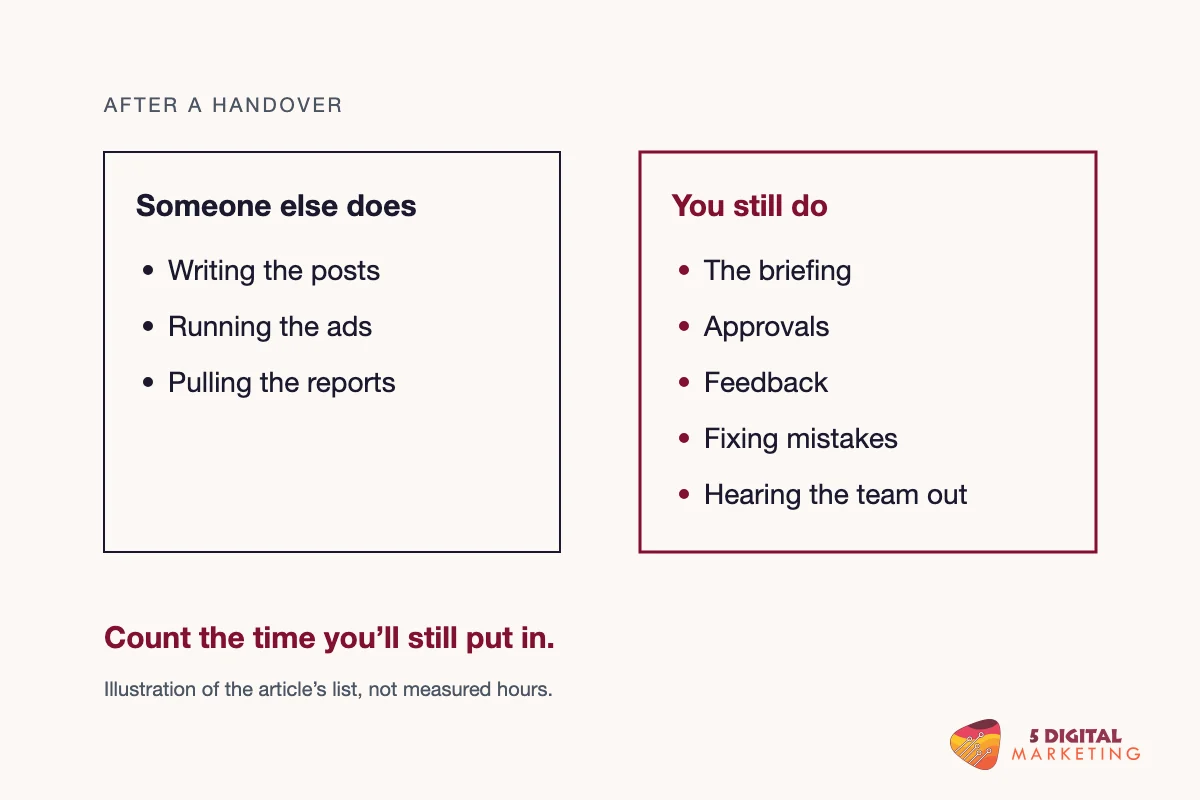
In my experience, owners underestimate the briefing: explaining the business, the customers and what good looks like. Then come approvals, feedback and corrections.
They also underestimate the room a team needs. The people doing the work need to be able to tell you what they see. That includes what you'd rather not hear. In my experience, giving the team a safe space to share its views is what best guides the owner. Making that space takes your time too.
An experiment published by the World Bank fits this, although it didn't measure briefing. Stephen Anderson and David McKenzie followed 753 small firms, each with 2 to 15 workers. Their owners had applied to a government programme for growing firms, and most were highly educated. About 600 of them were offered one of four kinds of help, for free. The options were training, a consultant, a hired worker with marketing or accounting skills, or an outside specialist. The rest were offered nothing, so they could serve as the comparison.
Compared with them, none of the four changed how many hours the owners worked by a measurable amount. The estimates were wide, so this doesn't prove the help saved no time. Owners who got a consultant, a hired worker or a specialist did change how they used their time. In the first year, a bigger share went to marketing and sales. The authors think owners with a hired worker or an outside specialist may have been learning from them. By the second year, that extra share had gone.
The help did improve the work itself. Firms with a hired worker or an outside specialist used better digital marketing practices. Firms with an outside specialist also showed some evidence of faster growth in sales and profits over two years. The help was paid for by the programme, so the study can't say whether paying full price would pay off.
For this decision, the lesson is narrower. Help can improve the work without giving you hours back. If you hand over a task to free up time, count the time you'll still put in. Some of it is time worth keeping anyway.
What should you keep, even when someone else does the work?
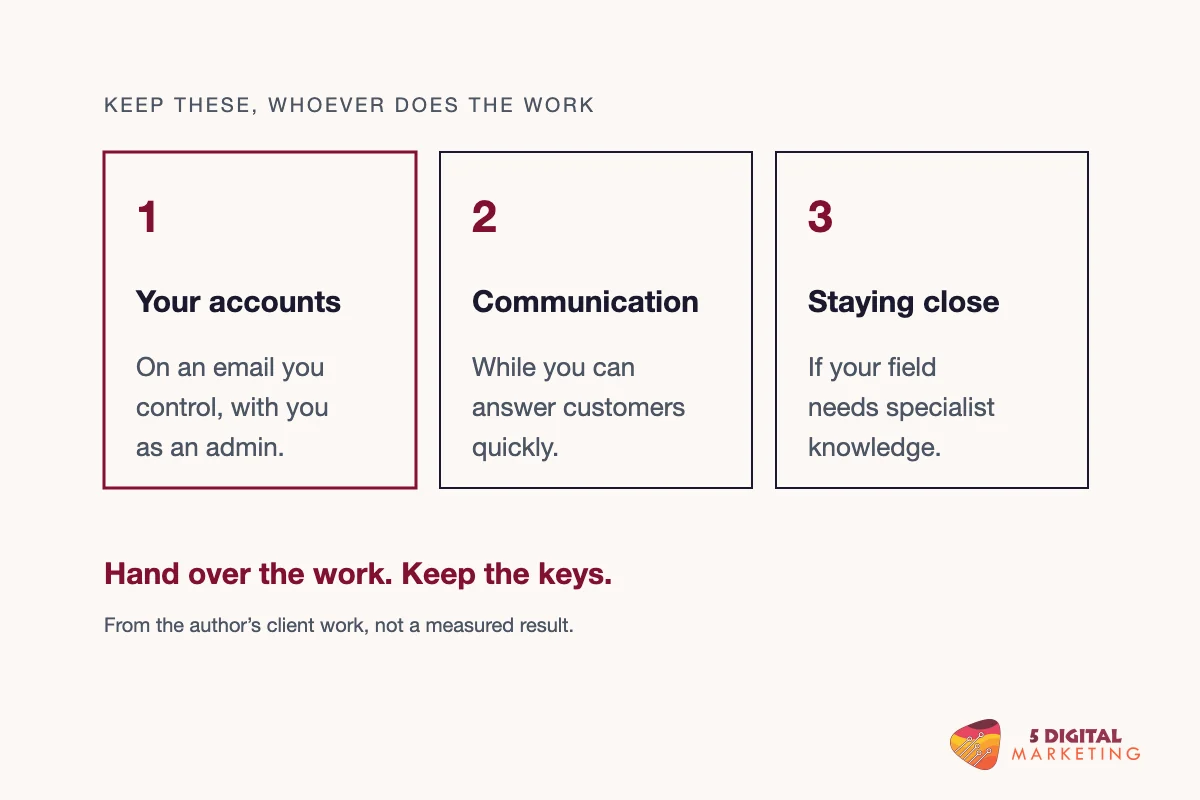
Some things stay with you whoever does the rest. They sit alongside the responsibilities that remain yours.
Your accounts. Set up ad accounts, pages and profiles on an email address you control, and make yourself an admin. I've seen owners locked out of their own pages by whoever set them up, and forced to start a duplicate page. Two pages split your followers and leave customers unsure which one is yours.
Communication, while you can answer quickly. If you handle what goes out and what comes in, you know best how to respond. But if your diary is what keeps customers waiting, hand it on. That's the time test, applied to one job.
Staying close, if your field needs specialist knowledge. In some businesses the marketing depends on depth you can't find online. There, stay close to whoever does the marketing, even if you don't do it yourself.
When is doing your own marketing the right call?
When the task passes the test. The test can come out either way.
I keep all of my own business's communication, incoming and outgoing. We're a lean team by design, and I've spent years in marketing, so I'm not a typical example. The rule I'd give any owner is the same, though. If you've built the skill and you do the task better than the help you could get, keep it. That holds as long as the hours aren't needed for something worth more.
Other reasons are fair too. Cash may be tighter than time. Then doing it yourself is a sensible choice, and not a stage you have to grow out of. Or you may want to learn the work. That counts.
How do you decide for one task?
Take the task you picked at the start. Write a short answer to each question.
- What does the task produce, and how good does it need to be?
- How many hours does it take in a normal month, including preparation and fixing mistakes?
- If someone else did it, what would you still do? Think of briefing, approvals, feedback, their questions and fixing their mistakes.
- Would that leave any hours free? If so, how many, and when would they fall?
- What exactly would you do with them?
- If that use earns money, is there demand for it, and what would it cost you to deliver?
- Who could do the task well enough, and what would they need from you?
- What would that help cost, and what else could the money do?
There's no score. You might keep the task, simplify it, do it less often, hand over one part, or find out what you don't know yet. Keeping it is a fair result. If handing it over looks worth it, choosing who should do it is a separate decision.
Questions owners ask
Can I do my own digital marketing for my business?
Yes. Many owners do. Decide task by task. If a task's hours aren't needed for something worth more, keeping it is a sound choice. That's especially true if you do it well, you're learning it, or cash is tight.
Is there a point where a small business should stop doing its own marketing?
There may never be one. No revenue figure or hour count settles it. Consider handing over a task when its hours are needed for something worth more, or when your schedule is what keeps customers waiting.
Does outsourcing marketing save the owner time?
Not automatically. An experiment published by the World Bank compared small firms offered free help, including outside specialists, with firms offered none. The owners' working hours showed no measurable difference. The estimates were wide, so a saving can't be ruled out, but it can't be assumed either. Help can improve the work without giving hours back.
Can I hand over only part of my marketing?
Yes. You might keep customer communication and hand over scheduling posts you've already approved. Whatever you hand over, keep the accounts on an email address you control.