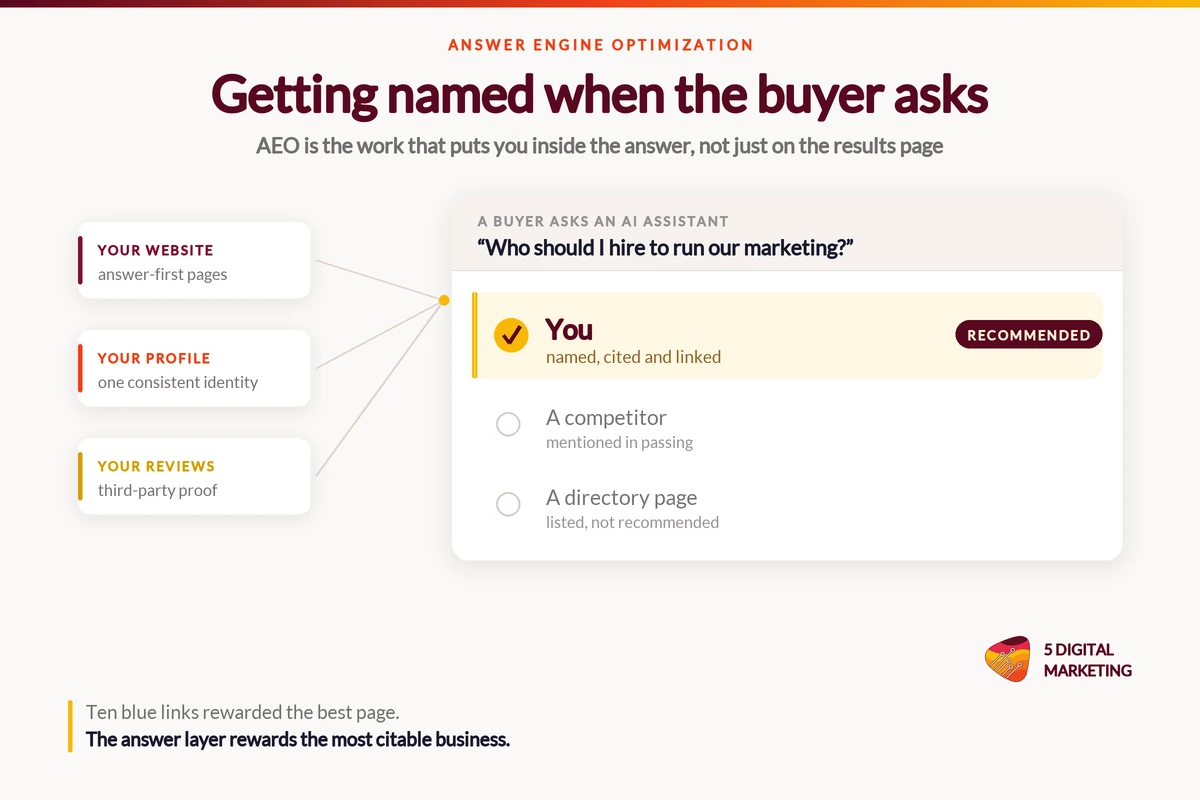
Answer Engine Optimization (AEO) is the work of structuring your business information so AI answer engines, such as ChatGPT, Perplexity, Gemini and Google's AI Overviews, can find it, trust it, and name it when a buyer asks who to work with. Traditional SEO earns you a link on a page. AEO earns you the recommendation inside the answer.
Your buyers changed how they research before most businesses changed how they publish. A founder comparing vendors used to open a dozen tabs and read for an afternoon. Now that same founder asks an assistant one direct question and reads one answer with a short list of named sources. If your business is not in that answer, you lose the introduction, even when you still rank on an ordinary Google page.
That is the real problem, and it is worth stating plainly before anyone sells you a solution. Search has not gone away. This is simply a second place your buyers now look, and it rewards the businesses that prepared for it. My rule for it is simple: own the asset, don't rent the attention.
This guide covers what AEO actually is, the model we use to build it, why it behaves like equity rather than a monthly ad bill, and how a business in Abuja or anywhere in Nigeria can start this week.
What Answer Engine Optimization Actually Means
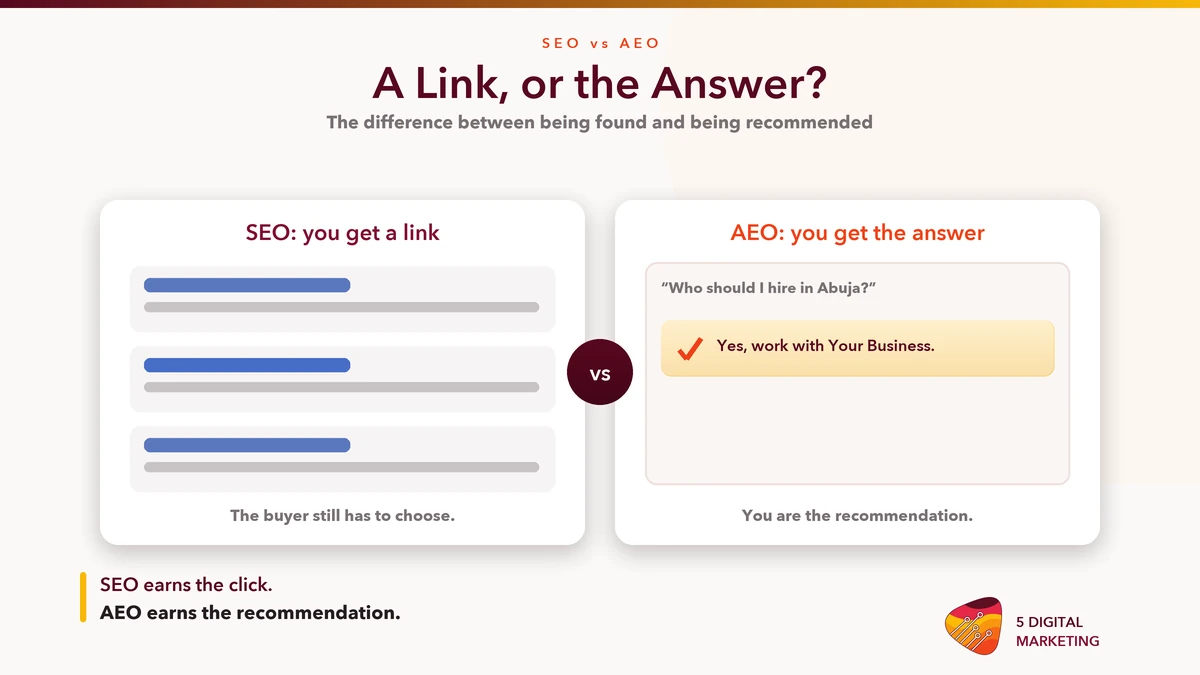
AEO is making your expertise easy for a machine to read, verify, and quote. SEO earns a ranked link that a person clicks. AEO earns a citation inside an answer that a person reads and acts on. The two share the same roots of useful content and a clean, credible website, then they split on one thing: format and trust signals built for extraction rather than for browsing.
The distinction matters because the outcome is different. A high ranking gives a buyer the option to find you. A citation inside an answer gives the buyer a recommendation to trust you. One is visibility. The other is endorsement.
Is AEO Even Real, or Just SEO With a New Name?
Fair question, and Google answered it plainly in 2026. Its own guidance states that optimizing for its generative AI features is, from Search's perspective, still SEO, and that you do not need llms.txt files, content chunking, or special AI schema to appear in Google's AI results (Google Search Central, 2026 AI-features guidance). For Google's surfaces, there is no separate bag of AEO tricks. There is good SEO and genuinely useful, well-structured content.
So here is our honest position. We do not treat llms.txt or special markup as the thing that earns you citations. We keep one on our own site as a cheap hedge for the non-Google engines, but the work that gets you cited is substance and structure, not a file. Two things stay true, and they are why AEO is worth naming at all. First, the answer engines your buyers actually use, ChatGPT, Perplexity, and Claude among them, are not Google Search and do not run on Google's ranking systems, so earning citations across them is its own discipline. Second, even on Google, being the cited answer rather than a ranked link asks for a specific kind of content: a direct answer, clean structure, and something worth quoting. AEO done honestly is not a trick set. It is the fundamentals of good SEO, extended to the engines Google does not control, and judged by one test: can a machine trust and quote you.
The Real Cost of Doing Nothing
The cost here is quiet, which is exactly why it is dangerous. Nothing breaks. Your rankings hold, your traffic looks stable, and your reports stay green. Meanwhile a growing share of your best buyers ask an assistant first, hear three other names, and never reach the page you optimized. You do not see the loss because it never shows up as a lost click. It shows up as a conversation that never started.
The businesses that noticed early are already building for it, and that is the real exposure: a competitor can occupy the answer before you do. Waiting also gets more expensive over time, and that is the part most guides miss. Answer engines reward consistency and earned trust, so a business that starts today builds a lead that keeps widening, while a late starter has to outspend that compounding margin to close it.
The Answer Authority Stack
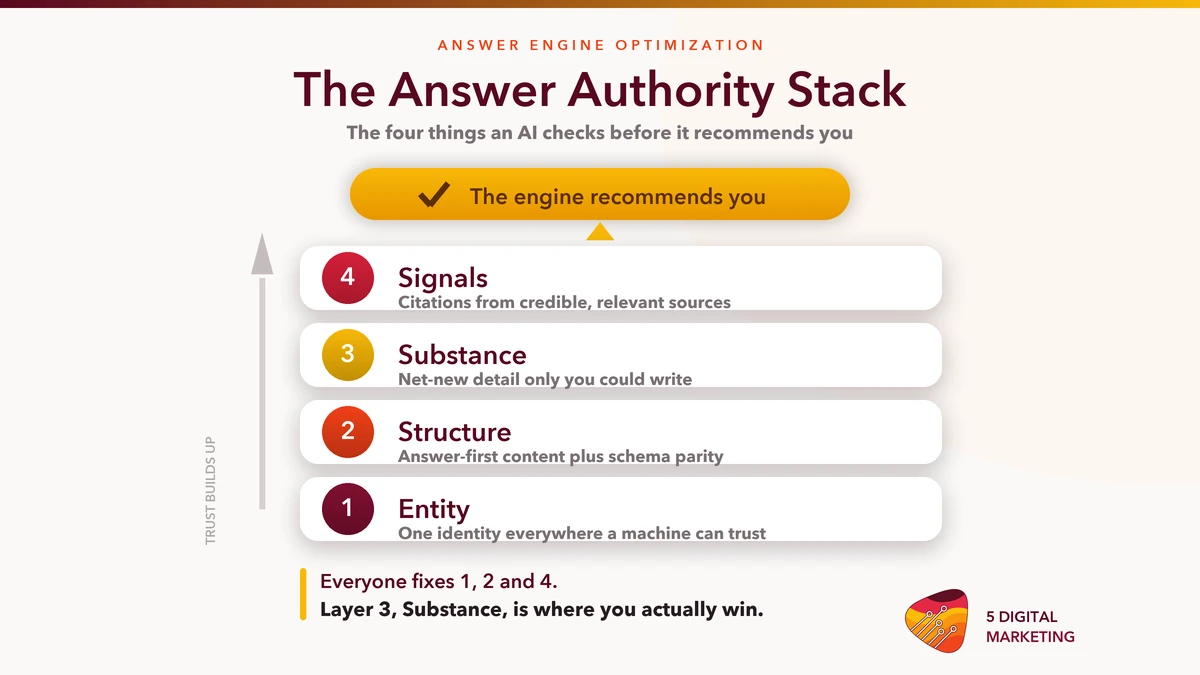
Here is a plain-English way to see what an AI actually checks before it recommends you. We call it the Answer Authority Stack. It is not a secret formula, and layered models like it exist elsewhere. What it gives you is an order of operations: four things the machine weighs, each answering one question, where getting the lower ones right makes the higher ones possible. Skip a layer and the ones above it leak.
Layer 1 (Entity): does the machine know who you are? Before an engine can trust you, it needs a stable, consistent identity to attach that trust to. That means one business name, one location, one description, and one positioning, matching across your website, your Google Business Profile, and every credible mention of you online. Inconsistency here fragments trust at the foundation, and no amount of good content above it recovers cleanly. If your entity is a mess, start with your Google Business Profile, because it is the anchor most engines cross-check first.
Layer 2 (Structure): can the machine read and lift your answer? Engines quote content they can parse without guessing. That means answer-first writing, where the first line under each heading states the answer directly, and schema markup that matches your visible text exactly. When your structured data and your on-page words agree, an engine can categorize and quote you with confidence. When they disagree, it lowers trust and moves on.
Layer 3 (Substance): does your page add anything the top results don't? This is where most businesses quietly fail. If your page repeats what the consensus already says, the engine has no reason to cite you over the source it already trusts. Substance means net-new detail, original data, a named method, or a clear point of view. Publishing more articles does not help here. Publishing something only you could have written does.
Layer 4 (Signals): do trusted sources treat you as an authority? The top layer is what other credible, relevant sites say about you, and how often your name appears alongside established players in your field. This is the layer money cannot shortcut and time compounds. It is earned through real work, real results, and real mentions.
When the four layers hold together, the fifth thing happens on its own: the engine recommends you. Most businesses can reach parity on Entity, Structure, and Signals, because everyone is told to fix those. The layer that decides who actually gets cited is Substance, whether your page adds something a model has not already read a hundred times. That is the whole game: a stack of trust a machine can verify, won or lost on what only you could have written.
The Answer Authority Stack at a glance
- Entity: a consistent, machine-readable identity across your website, Google Business Profile, and public mentions.
- Structure: answer-first content, plus schema that matches your visible text.
- Substance: net-new detail, original data, or a named method the top results do not have.
- Signals: citations and mentions from credible, relevant sources.
- Result: when the four hold, the engine recommends you.
| Layer | The question it answers | What it means in practice |
|---|---|---|
| Entity | Does the machine know who you are? | One name, location, and positioning everywhere |
| Structure | Can it read and lift your answer? | Answer-first copy plus schema parity |
| Substance | Do you add anything new? | Original data, a named method, a clear view |
| Signals | Do trusted sources vouch for you? | Credible citations and co-mentions |
Why AEO Is Equity, Not Rent
Paid ads are rent. You pay, you appear, you stop paying, you vanish. The attention is real, and it is gone the moment the budget is. AEO works differently. Every layer of the Answer Authority Stack you build stays built. A consistent entity, a well-structured page, a piece of original substance, a hard-won citation: each one keeps earning recommendations long after the work is done.
That is why we treat AEO as a compounding asset and an authority moat rather than a campaign. The curve is slow at first and then steep, because trust compounds and the engines favour the businesses that have earned it. A business that starts now owns that curve. A business that waits has to rent attention at rising prices while a competitor's asset compounds against it. Rankings and recommendations compound; ad spend resets to zero every month.
How AEO Differs From SEO
The short version: SEO optimizes to rank a link, AEO optimizes to be the cited answer. They are relatives, not rivals, and strong SEO foundations help both. The difference is that AEO leans harder on the Structure and Substance layers above, and on the entity consistency that lets a machine trust a source it is about to quote. Because the comparison deserves a proper side by side, including where generative engine optimization fits, we set it out in full in AEO vs GEO vs SEO. If you want the hands-on steps rather than the concepts, how to get found in AI search walks through the execution.
AEO for Businesses in Abuja and Nigeria
There is a genuine early-mover window here, and it will not stay open. Most competitors, locally and abroad, still publish content written for human skimming and have never cleaned up their entity signals. That gap is an opening for any business willing to build the stack properly now. It matters locally too, because buyers ask location questions. Someone comparing providers may well ask an assistant who the strong options are in Abuja, and the same four layers decide the answer. We cover the local specifics in AI search optimization for businesses in Abuja and Nigeria.
A 15-Minute Self-Check
You can find your honest starting point today, and the result tells you which layer to fix first.
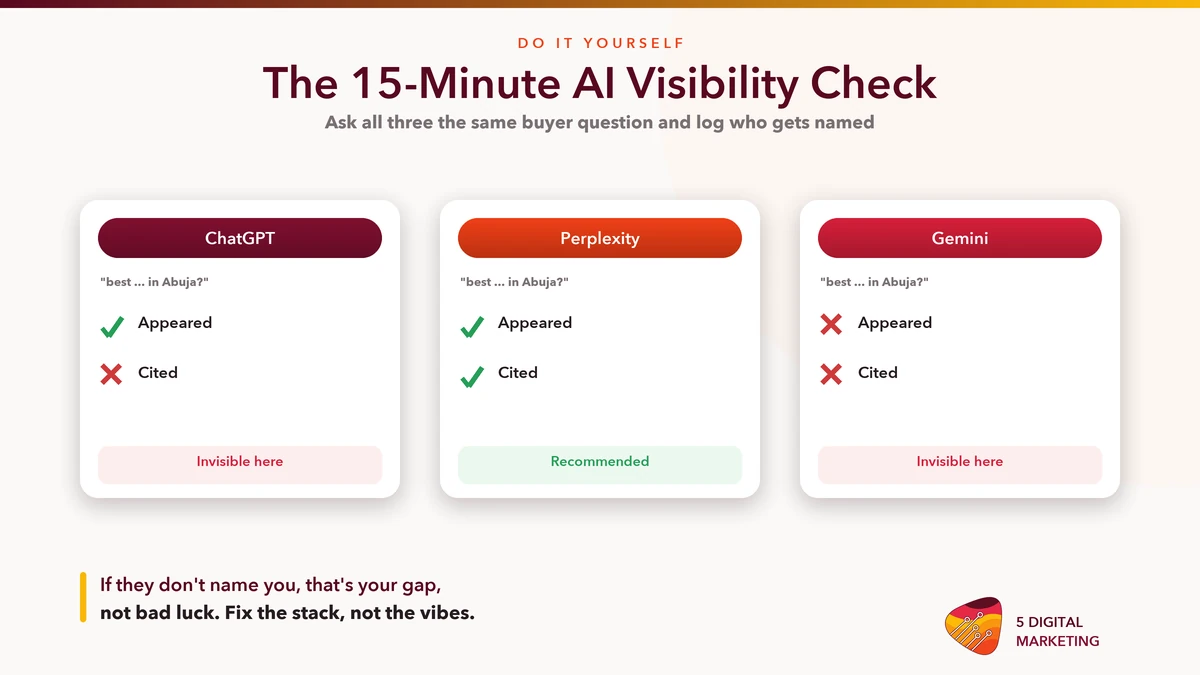
- Open ChatGPT, Perplexity, and Gemini.
- Ask each a real decision question a buyer in your category would ask, with a location where it fits.
- Note whether you appear at all, and whether you are cited as a source.
- Check whether your key pages carry structured data that matches their visible text.
- Check that your name, location, and description are identical across your website and profiles.
You do not have to take our word for any of this. Run the same three-engine check on your own brand and you get an honest read in about fifteen minutes. For the local version of this check, see AI search optimization for Abuja and Nigeria.
If you are absent, the gap is usually lower in the stack than people expect, at Entity or Structure, not at Substance. The fix is rarely to publish more. It is to structure what you already know so a machine can trust and quote it. If you want a clear read on where your stack breaks, we run a short, diagnostic-led AI visibility review for exactly that, and you can also just tell us what you are seeing.
Frequently asked questions
What is answer engine optimization in one sentence?
Answer engine optimization is structuring your business information so AI answer engines can find, trust, and recommend it when a buyer asks a question, instead of only ranking a link for that buyer to click and evaluate alone.
Is AEO the same as SEO?
No, though they overlap. SEO earns a ranked link; AEO earns a citation inside a synthesized answer. Both need useful content and a credible site. AEO adds answer-first structure, schema that matches your text, and a consistent business identity so a machine can quote you safely.
I already rank well on Google. Do I still need AEO?
Strong rankings help but do not guarantee you appear in AI answers, which draw on structure and entity trust as much as position. If your buyers increasingly ask assistants first, good rankings alone can still leave you out of the recommendation they act on.
How do I know it is working, and how is it measured?
You measure AEO by whether your business appears and is cited when buyers ask decision questions, tracked across engines over time, alongside the impressions and traffic your prepared pages earn. It is a trend you build and watch, not a single number you hit once.
Which AI engines should a business focus on?
Focus on the engines your buyers actually use for business questions, which today are ChatGPT, Perplexity, Google Gemini, and Google's AI Overviews. Track whether you appear and are cited in each, rather than assuming one engine stands in for all of them.
What should a business do first?
Start with the 15-minute self-check, then fix from the bottom of the stack up: entity consistency first, then answer-first structure and matching schema, then original substance. Structure before volume, always. A diagnostic will tell you which layer is costing you the most.
Own the asset, don't rent the attention
AEO is not a forecast about the future. It describes how a growing share of your buyers already research, and the specific, unglamorous work that gets your business recommended inside their answers. Build the Answer Authority Stack now, layer by layer, and it keeps earning recommendations long after the work is done. That is the difference between an asset you own and attention you rent, and it is the whole reason to start early.
If you want a team that builds AI search visibility into revenue-linked outcomes rather than vanity reach, book a Growth Diagnostic. Prefer WhatsApp? Message us here.