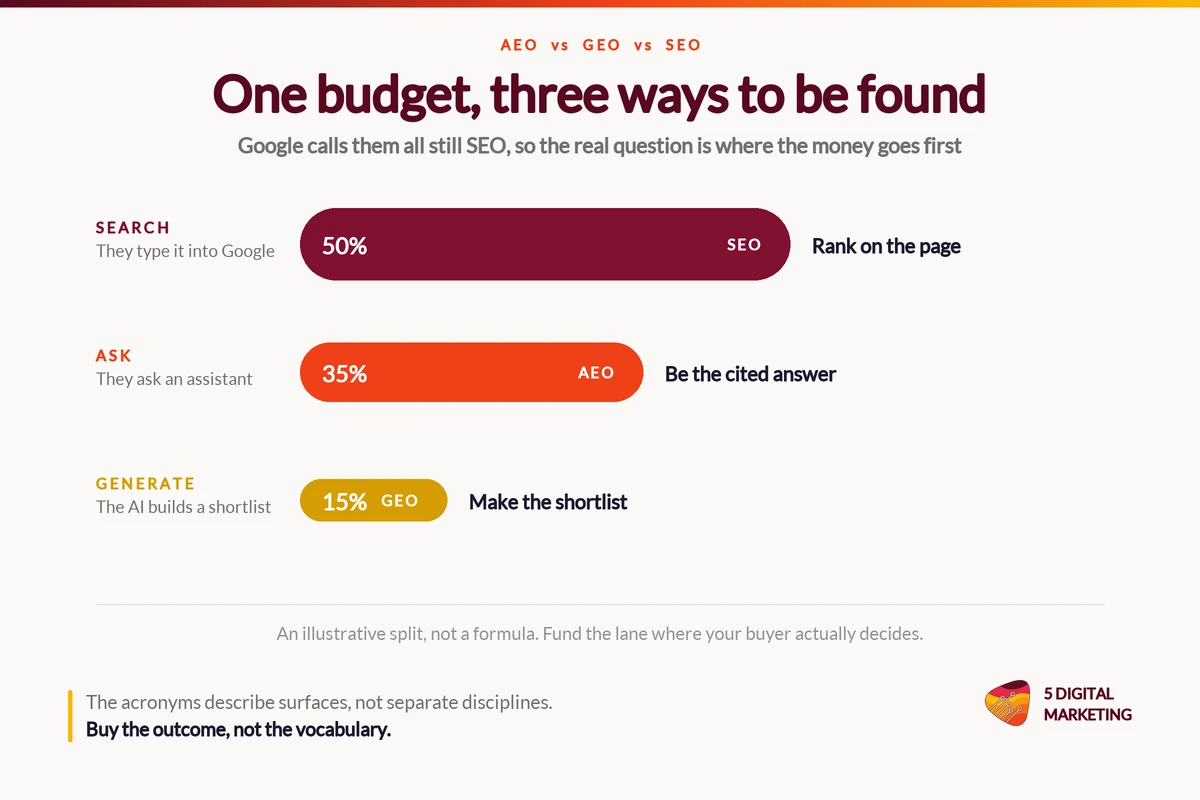
Google's 2026 guidance was blunt: optimizing for AI search is still SEO, and you do not need llms.txt, special schema, or "AEO/GEO hacks" to win Google's AI features (Google's 2026 Search Central guidance). So the useful question is not which of AEO, GEO or SEO to pick. It is where to spend, in what order, and how much, decided by where your buyers actually make the decision. This guide answers that.
If the acronyms feel like alphabet soup, that is not your fault. The industry never agreed on definitions, and most comparison guides still sell AEO and GEO as separate disciplines with their own tactics and budgets. In 2026 Google said the quiet part out loud: for its own AI features, this is still SEO done well. That single fact retires most of the advice ranking for this search. My rule for what is left: stop buying acronyms, and start funding where your buyer decides.
First, the Part Everyone Already Agrees On
Here is the consensus, so we can move past it quickly. The three terms describe three ways a buyer now finds you: Search (they type a query and scan links; SEO optimizes to rank), Ask (they ask an assistant a direct question; AEO optimizes to be the cited answer), and Generate (an AI composes a response and may name you; GEO optimizes for that presence). Every guide agrees they are complementary layers built on an SEO foundation, not rivals. That is true, and it is also where almost every article stops.
| SEO | AEO | GEO | |
|---|---|---|---|
| Optimizes for | Ranking a link | Being the direct answer | Being named in AI-generated responses |
| Shows up in | Google and Bing results | AI Overviews, snippets, ChatGPT, Perplexity, Gemini | AI-generated answers across engines |
| The win | The click | The citation | The mention |
| Reality (Google, 2026) | The foundation | "Still SEO" | "Still SEO" |
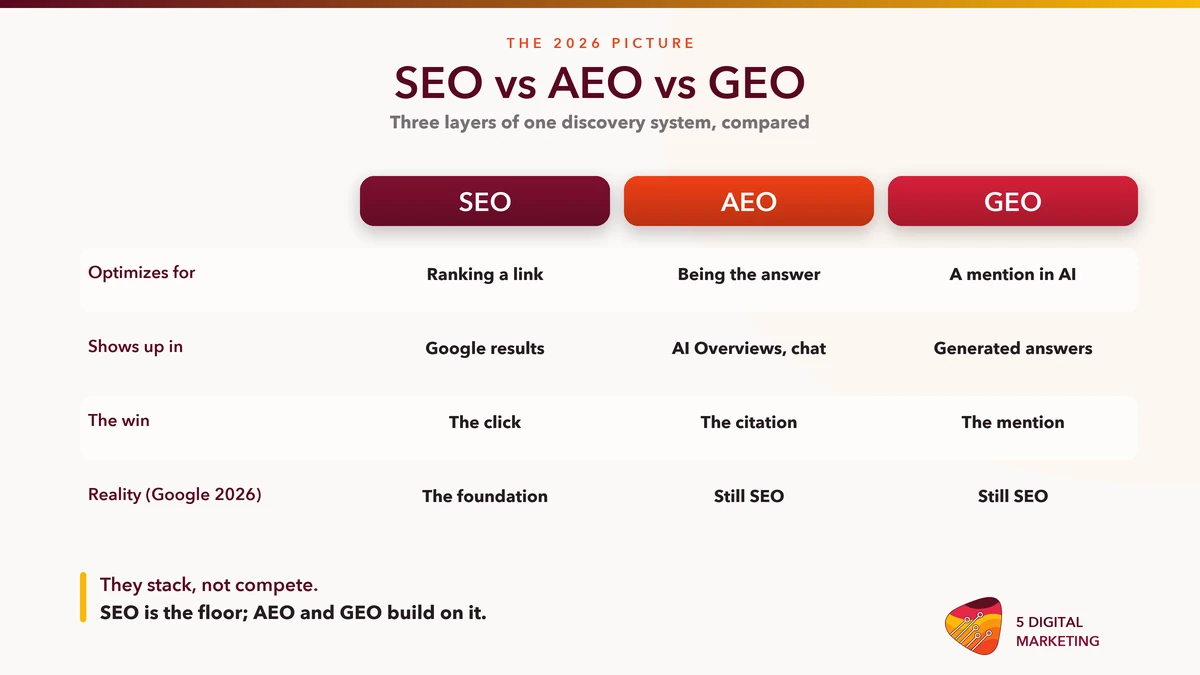
Treat that table as settled and read on, because the decision that actually spends your money starts here.
What Google Actually Said, and Why It Matters to Your Budget
In 2026 Google published guidance stating that optimizing for its generative AI features is, from Search's perspective, still SEO, and that tactics like llms.txt files, content chunking, and AI-specific schema are not required for Google. It advised prioritizing strong SEO over "AEO/GEO hacks" (Google's 2026 Search Central guidance). For the record, we keep an llms.txt on our own site as a cheap hedge for the non-Google engines; we just do not pretend it moves Google.
The practical consequence is a budget one. If a vendor is quoting you a separate line item for "GEO" or "AEO," ask what it buys that good SEO and genuinely useful, well-structured content do not. For Google's surfaces, often nothing. Other answer engines like Perplexity and ChatGPT are not Google and reward some things differently, so being genuinely citable still matters. The point is not that AEO is fake. It is that the work is mostly excellent SEO plus answer-ready structure, and you should not pay a premium for a rebranded acronym.
The Real Question: Where Does Your Buyer Decide?
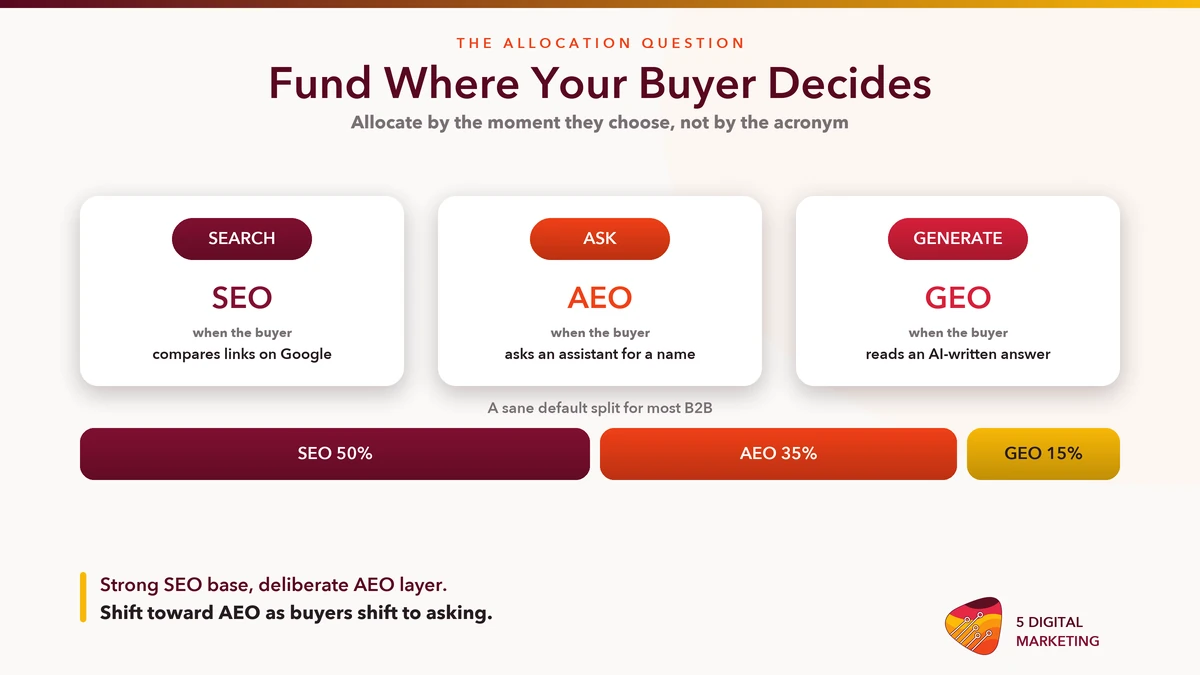
This is the decision no comparison guide makes for you. Do not allocate by acronym. Allocate by where your buyer actually reaches the decision.
- If your buyers still open several tabs and compare, your money belongs in SEO and conversion.
- If they increasingly ask an assistant and act on its recommendation, weight the answer layer so you are the one cited.
- If they lean on an AI to shortlist a whole category, invest in the authority and structure that gets you into that shortlist.
Most B2B buyers are moving from the first toward the second. So a sane default for a service business is a strong SEO and conversion base, a deliberate answer layer on top, and generative presence treated as the reward for doing the answer layer well rather than a separate budget. Shift the weighting only when you have evidence your buyers have moved.
The Money: Owned Assets vs Rented Attention
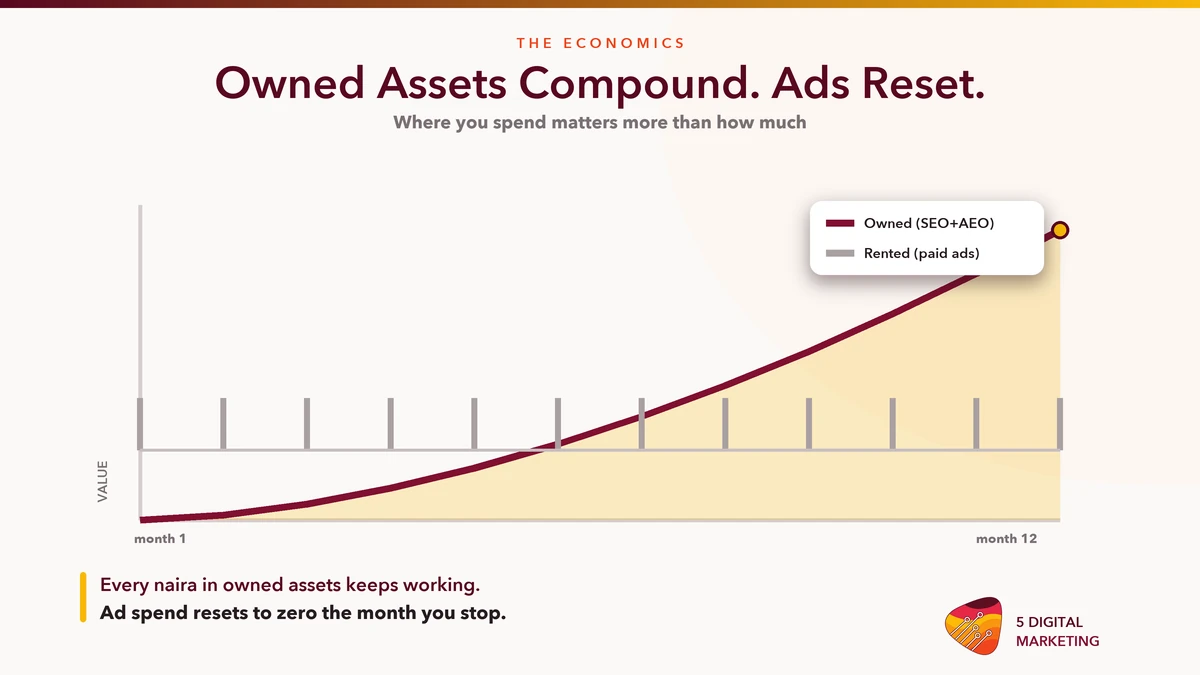
Here is the part the comparison posts leave out entirely. SEO, AEO and GEO are assets you own. Paid ads are attention you rent. An ad works for exactly as long as the budget lasts and then stops. A ranking, a cited answer, and a consistent authority signal keep working after the work is done, and they compound.
That reframes the whole "which to invest in" question. Against each other, the three are layers of one owned system. Against paid media, all three are the compounding side of your acquisition economics while ads are the resettable side. The biggest budget mistake we see is a business renting all its attention through ads while owning almost nothing, then starting from zero every month. The second is paying for "GEO" and "AEO" as separate premium services when Google just said the foundation is the same SEO you should already be funding.
Where does that leave a real budget? A useful default for a service business is to put the largest share into the SEO and conversion foundation that everything else reads from, a deliberate slice into the answer layer that makes you citable, and little or nothing into a separate line item labelled GEO or AEO. As your buyers shift toward asking assistants, move budget from the foundation toward the answer layer, not toward a new acronym.
The reason this matters more than the exact split is compounding. Every naira you put into an owned asset, a page that ranks, an answer an engine keeps citing, a consistent entity a machine keeps trusting, keeps working next month at no extra cost. Every naira you put into ads stops working the moment it is spent. So the allocation question is really a question about what you want to own a year from now. Two businesses can spend the same budget this month, one on owned assets and one on ads, and look nothing alike a year later. That is the case for deciding by where your buyers convert and funding the assets that stay, rather than splitting a budget across acronyms because a vendor named three of them. Decide once, fund what compounds, and let the acronyms sort themselves out.
What Changes Locally, in Abuja and Nigeria
The allocation logic shifts locally for one reason worth naming: a large share of Nigerian B2B enquiries end in a WhatsApp message rather than a form, so a good AI answer tends to convert through a chat, not a click. That makes the answer layer a real acquisition step here, not a vanity play, and it should be measured as a conversation. The full local build, with the WhatsApp funnel, naira ranges, and Abuja examples, is covered in AI search optimization for businesses in Abuja and Nigeria.
Proof: The Same Question, Three Engines
Assertion is cheap, so here is a test you can run in about fifteen minutes. Ask the same real buyer question from your category in Google Search, ChatGPT, and Perplexity, and note who each one names. The businesses winning the AI answer are often not the ones ranking first on Google, because the answer layer rewards structure and citability that pure ranking does not. That gap is the whole case for funding the answer layer, and you can see it in your own market rather than take our word for it. For the local version of this check, see AI search optimization for Abuja and Nigeria.
How to Sequence It
You build one system in order, not three projects.
- Fix the foundation: clean entity signals, a crawlable site, useful content, and for local businesses a complete Google Business Profile.
- Add the answer layer: answer-first pages, accurate schema, and the authority signals that make you citable. The mechanics are in how to get found in AI search, and the underlying method is in what answer engine optimization is.
- Let generative presence follow, and measure the real outcome, including WhatsApp conversations, not just clicks.
Key takeaways at a glance
- Google (2026): optimizing for AI search is still SEO; no llms.txt or special hacks needed for Google.
- Do not allocate budget by acronym. Allocate by where your buyer decides.
- SEO, AEO and GEO are owned assets; paid ads are rented attention that resets to zero.
- The biggest mistake is renting all your attention and owning none.
- In Nigeria, the answer layer often feeds a WhatsApp funnel, so measure the conversation, not the click.
What to Do First
Find out where you stand across search results and the main answer engines, and confirm your entity signals are consistent. That read tells you which layer to fund first. If you want it done properly, we run a short, diagnostic-led review that scores all three layers against your real buyer-decision points, and you can also just tell us what you are seeing.
Frequently asked questions
Are AEO and GEO just SEO now?
For Google's AI features, largely yes. Google stated in 2026 that optimizing for its generative results is still SEO, with no llms.txt or special schema required. Other engines like Perplexity and ChatGPT differ, so being citable still matters, but do not pay a premium for a rebranded acronym.
Is SEO still worth it with AI search?
Yes, more than ever. SEO is the foundation the AI layer reads before it decides whom to trust, and Google now says AI optimization is still SEO. Weak SEO starves answer engines of a citable source, so it costs you both rankings and AI recommendations.
How should I split my budget across SEO, AEO and GEO?
Do not split by acronym. Fund the SEO and conversion foundation first, add a deliberate answer layer, and treat generative presence as the reward for doing the answer layer well. Then shift weight toward whichever discovery mode your buyers actually use to decide.
Should I pay for a separate GEO or AEO service?
Be cautious. Since Google says the foundation is the same SEO, ask what a separate GEO or AEO line item buys beyond strong SEO and answer-ready content. If the answer is vague, you are likely paying a premium for a relabel rather than new work.
Does any of this change for a business in Nigeria?
The logic is the same; the measurement is not. Many Nigerian B2B enquiries end in a WhatsApp message, not a form, so an AI recommendation often becomes a WhatsApp conversation. Fund the local SEO and Google Business Profile foundation first, then the answer layer, and measure the conversation.
What should I do first this week?
Run a visibility check across Google and the main answer engines, and confirm your entity details are consistent everywhere. That single read shows which layer is costing you the most, and a short diagnostic will turn it into a funded plan.
Stop buying acronyms. Start funding where your buyer decides.
The AEO versus GEO versus SEO debate mostly resolves once you read Google's 2026 guidance: this is SEO done well, plus content structured to be the answer. The decision that remains is a budget one. Fund where your buyers decide, own your assets instead of renting all your attention, and in Nigeria measure the WhatsApp conversation that a good AI answer produces. Do that and you are spending on a compounding system, not on acronyms.
If you want a team that allocates across AI search visibility by where your buyers actually decide, book a Growth Diagnostic. Prefer WhatsApp? Message us here.