
Most business websites fail because they are built for looks, not conversion. The best approach is to plan your website as a sales system before design begins: define one conversion goal, map buyer questions, build pages that answer those questions, and track each step from first click to submitted inquiry.
If you run a business in Nigeria, this matters even more. Attention is expensive, mobile usage is high, and trust is fragile online. A website that looks premium but does not produce inquiries is a cost center. A website that answers buyer questions, makes the next step obvious, and measures conversion actions becomes a growth asset.
Why Most Nigerian Business Websites Fail at Conversion
Most underperforming websites in Abuja and Lagos fail for one reason: no conversion architecture was defined before design started.
- Homepages lead with vague slogans but no clear offer.
- Service pages describe activity, not outcome.
- CTAs are inconsistent and create decision fatigue.
- Forms ask too much too early.
- No analytics setup exists to show where users drop.
The result is predictable: traffic comes in, inquiry volume stays flat, and owners conclude websites do not work. In reality, the page flow is leaking intent before a user reaches contact.
The 7-Step Website Planning Process That Converts
Step 1: Define One Primary Conversion Goal
Choose one main action your website is designed to produce. For most Nigerian service businesses, this is a qualified call request such as Book a Growth Diagnostic.
Step 2: Map Buyer Questions by Journey Stage
Map what buyers ask before they contact you: "Do you solve my exact problem?", "Can I trust you?", "How much does it cost?", "How long does this take?", and "What happens after I submit this form?"
Step 3: Build Pages That Answer Those Questions
At minimum, build a conversion-focused homepage, clear service pages, FAQ support blocks, and a contact route with WhatsApp fallback.
Internal route structure for this cluster:
- our website conversion optimization system
- local SEO foundations for your online presence
- setting up your Google Business Profile
- Book a Growth Diagnostic
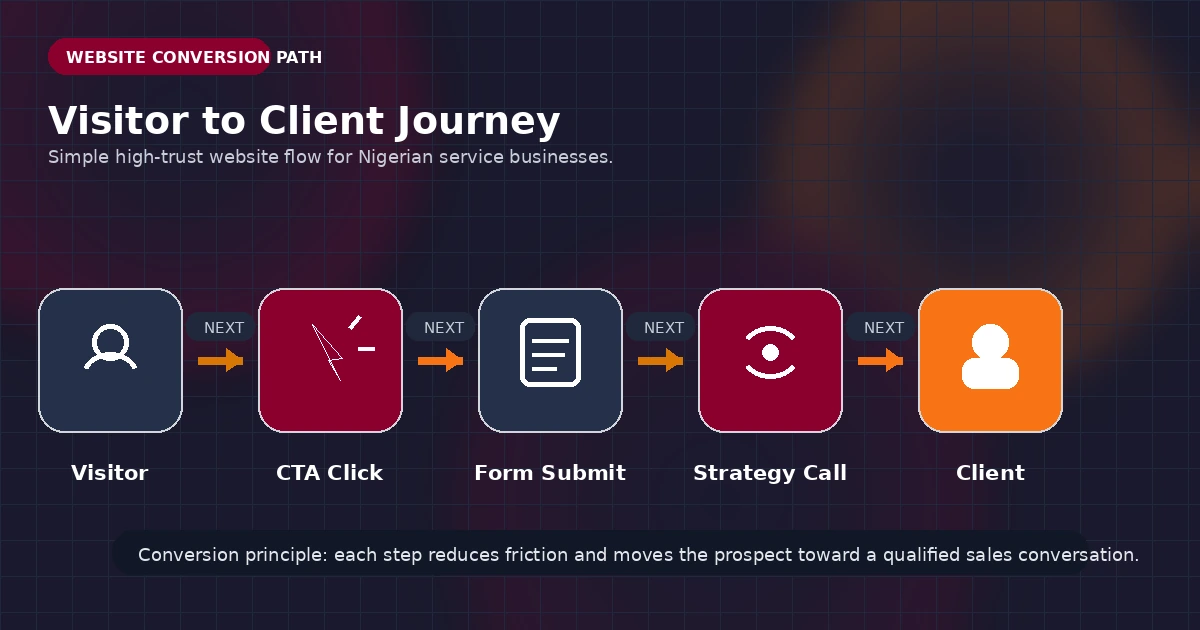
Step 4: Design the Next-step flow End-to-End
Plan and test this path: visitor lands -> sees clear value and proof -> clicks CTA -> completes short form -> receives confirmation -> gets timely response from your team.
Step 5: Choose a Tech Stack Based on Reliability and Speed
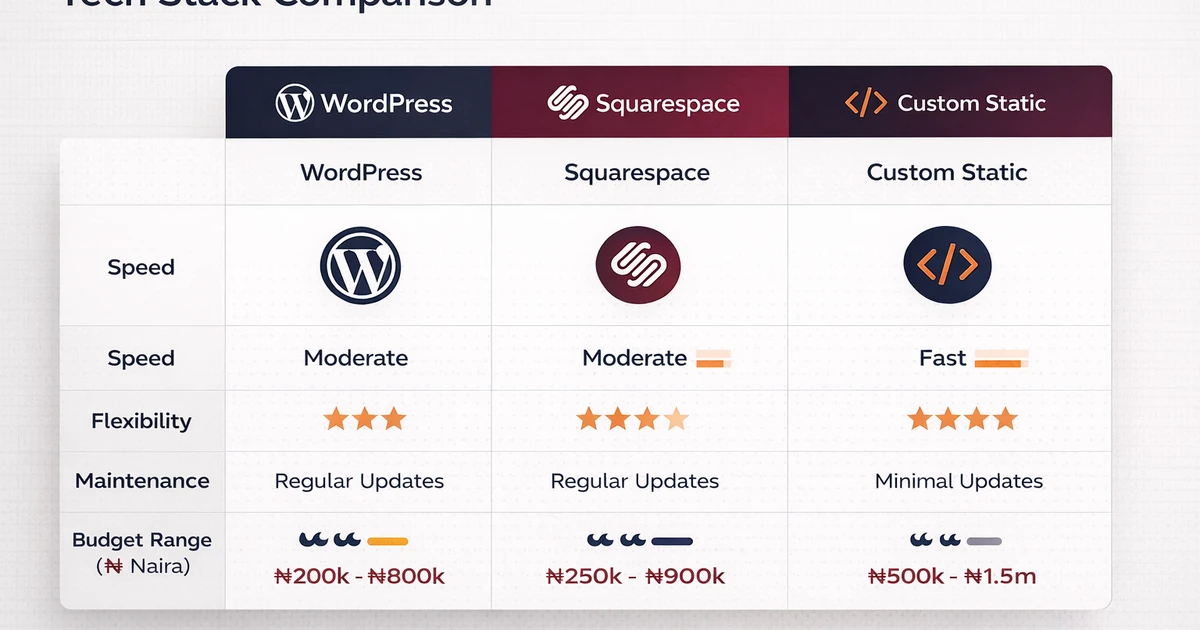
Pick tools based on performance and maintainability, not trend value. For many businesses in Nigeria, lightweight setups outperform heavy stacks because users browse on mid-range devices and mixed network quality.
| Option | Best For | Pros | Risks | Typical Budget Range |
|---|---|---|---|---|
| WordPress | Businesses needing flexibility and content scale | SEO control, broad plugin ecosystem | Plugin bloat and maintenance overhead | ₦600,000 to ₦3,000,000+ |
| Squarespace | Small teams needing fast launch | Quick setup, low maintenance | Less flexibility for advanced funnels | ₦350,000 to ₦1,200,000 |
| Custom static stack | Performance-critical brands | Speed, security, cleaner codebase | Needs technical support for updates | ₦900,000 to ₦4,500,000+ |
Step 6: Plan Content Before Launch
Launch with intentional content: one strong homepage, key service pages, FAQ sections, and foundational blog posts answering real buyer questions. This improves both conversion and discoverability.
Step 7: Set Up Measurement on Day 1
Track these events from launch:
cta_clickform_submitwhatsapp_clickpage_scroll_depthservice_page_view
Use Google Analytics 4 setup guide and UTM tags consistently so you can attribute quality inquiries by source, not just by volume.
What Your Homepage Must Do in 3 Seconds
A homepage that converts should pass this three-second test:
- Visitor understands who you help.
- Visitor understands what result you create.
- Visitor sees exactly what to do next.
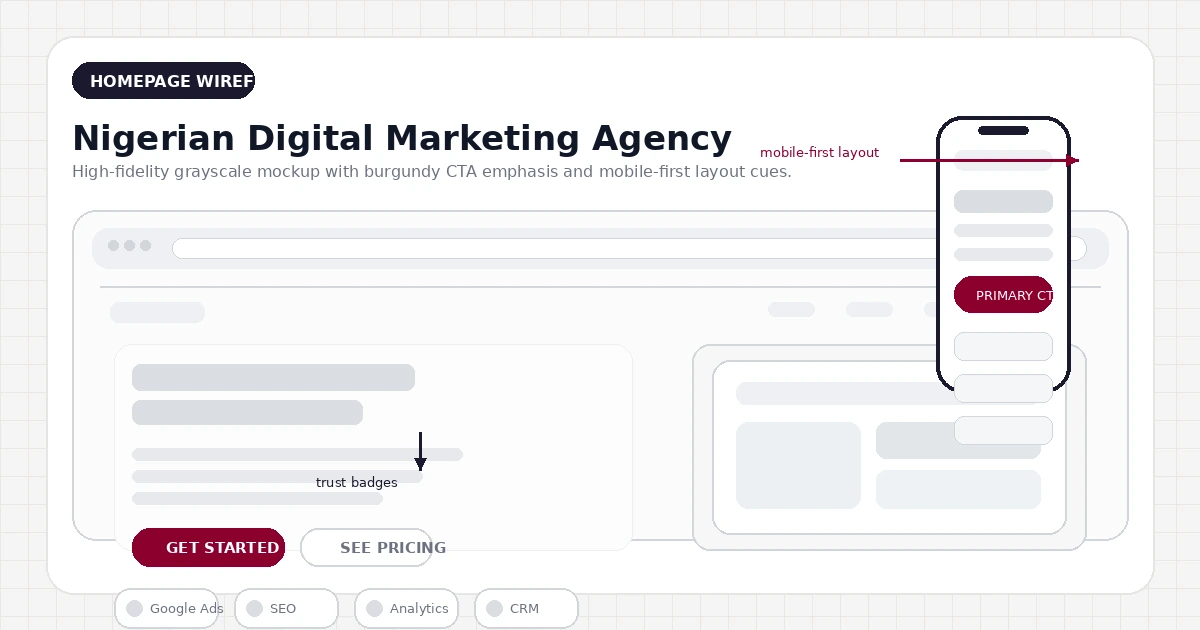
Minimum above-fold structure: outcome-led headline, short supporting line, one primary CTA, and one trust signal close to the CTA.
Service Pages That Turn Browsers Into Callers
High-converting service pages follow one consistent structure: problem -> mechanism -> proof -> CTA.
For Nigerian buyers, trust elements that usually matter most are local context, real contact channels (including WhatsApp), professional identity, and clear process timeline.
Common errors to remove:
- multiple competing CTA labels on one screen
- long forms at first touch
- generic stock-heavy pages with no concrete offer
- hidden next-step expectations
The Technical Foundation: Speed, Mobile, and SEO
Mobile-first performance is non-negotiable. Most service inquiries start on mobile. If buttons are hard to tap or forms break, intent dies before value transfer.
Use web performance best practices and validate schema with Google's Rich Results Test.
SEO basics for every page:
- clear title tag and meta description
- one H1 and structured headings
- internal links to the next logical action
- schema markup where relevant
Measuring What Matters in the First 30 Days
Week 1: confirm tracking integrity and contact path reliability.
Week 2: improve pages with high traffic and low CTA click rate.
Week 3: compare mobile and desktop behavior, then reduce high-friction steps.
Week 4: prioritize top three pages for conversion-focused iteration.
Start simple: improve CTA click-through rate, form completion rate, and response speed week over week.
Frequently Asked Questions About Business Website Design in Nigeria
How much does a business website cost in Nigeria in 2026?
Business website cost in Nigeria depends on complexity, conversion requirements, and content depth. Basic brochure sites can start around ₦350,000, but conversion-focused service websites with strong page architecture and tracking often range from about ₦900,000 to ₦3,000,000 or more.
Do I need a custom website or can I use a website builder?
A builder can work if your needs are simple and speed-to-launch is the priority. Custom builds are better when performance, advanced tracking, and conversion flexibility matter. The right choice is the one that supports your growth model without creating technical debt.
How long does it take to build a website that actually converts?
A conversion-focused site usually takes 3 to 8 weeks depending on scope, approvals, and content readiness. The timeline is faster when planning is clear upfront and slower when decisions on offer, pages, and next-step flow are still changing mid-project.
What CMS should a Nigerian service business use?
The best CMS is the one that balances speed, maintainability, and conversion control for your team. WordPress is strong for flexibility, Squarespace is strong for simplicity, and a custom static setup can be strongest for speed and reliability if technical support is available.
How do I know if my current website needs a complete redesign?
You need a redesign when core conversion behavior is structurally broken, not just cosmetically weak. If your site gets traffic but low inquiries, has poor mobile UX, unclear messaging, and weak measurement setup, redesign is usually more efficient than patching isolated sections.
What should I look for when hiring a web designer in Abuja?
Choose a partner that can explain conversion logic, not just visual style. Ask for process clarity, mobile-first execution, performance standards, tracking setup, and proof of business outcomes. If they cannot define how your site will generate inquiries, keep looking.
Conclusion: Plan for Conversion Before You Design
A business website that converts is planned like a revenue system, not a decoration project. Define one conversion goal, map buyer questions, structure pages around decision intent, and track key actions from day one.