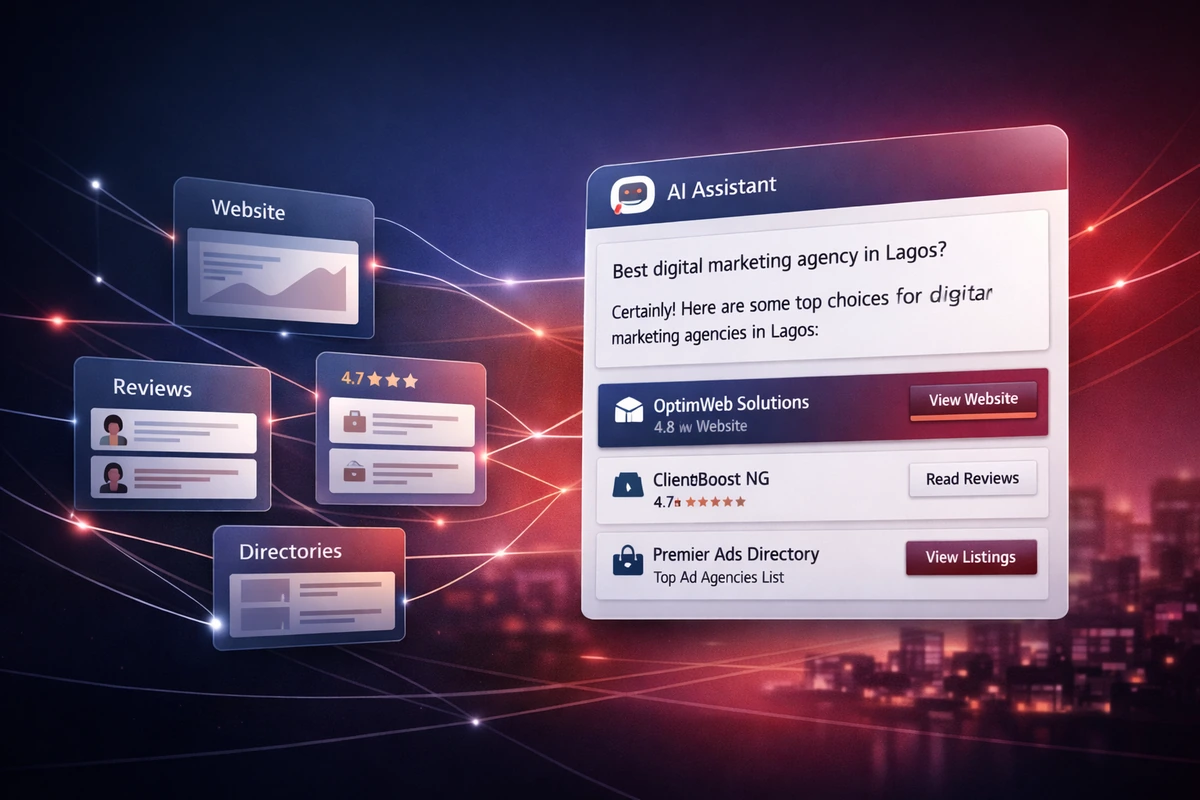
To appear in AI search results, your business needs three systems working together: extractable answers, machine-readable structure, and credible authority signals across the web. The fastest improvement path is direct-answer publishing, correct schema implementation, and consistent entity trust across website, profile, and citation surfaces.
AI answer engines are changing discovery behavior in Nigeria. Instead of reviewing ten links, users ask one question and get synthesized recommendations with cited sources. If your business is absent from that answer set, you lose visibility even when traditional rankings look acceptable.
This guide explains what changed, how engines evaluate trust, and how to execute an AI-search-ready content system without hype or shortcuts.
The AI Search Shift: What Changed
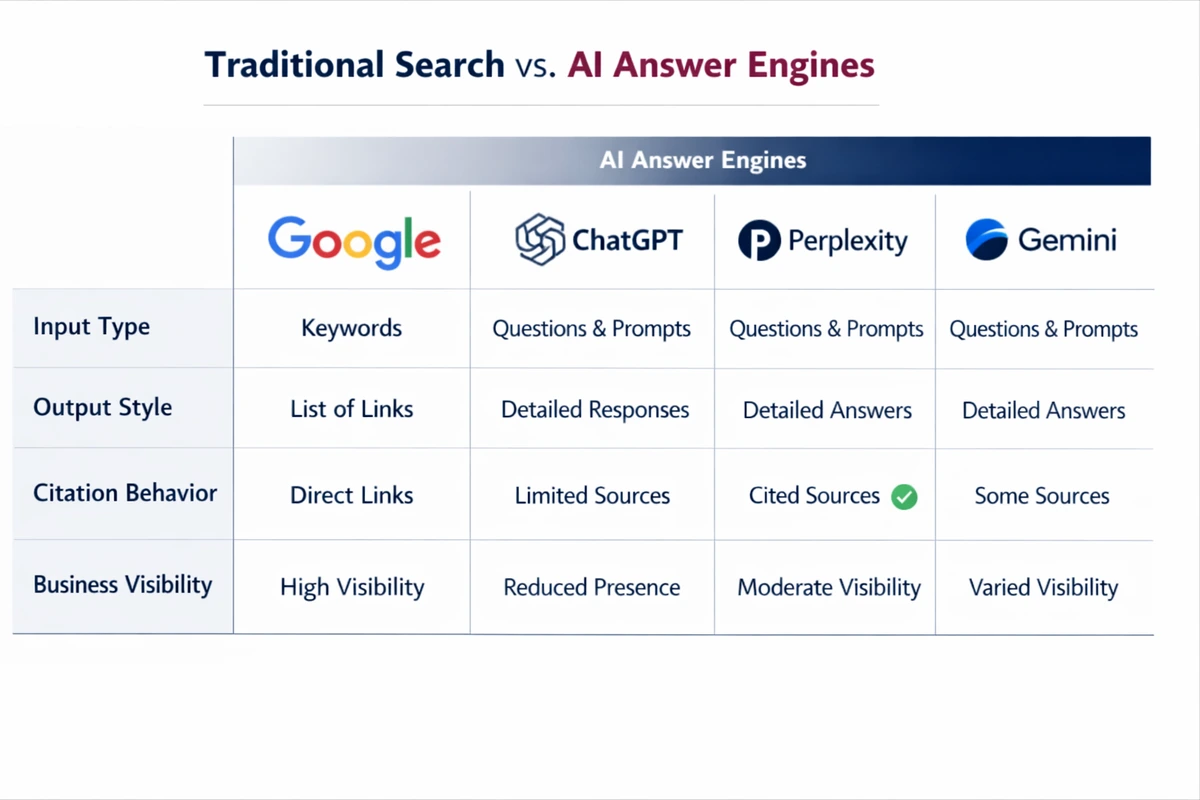
Traditional discovery flow: user types a keyword, Google returns links, user evaluates pages. AI discovery flow: user asks a full question, engine synthesizes answers, citations are shown as supporting evidence.
You still need SEO foundations, but now you also need extraction readiness: concise conclusions, clear structure, factual consistency, and citation-worthy clarity.
| Discovery System | Primary Input | Typical Output | Business Visibility Implication |
|---|---|---|---|
| Google Search | Keywords | Ranked links | Click-through depends on snippet and ranking strength |
| ChatGPT | Natural language question | Synthesized direct answer | Visibility depends on extractable and credible source patterns |
| Perplexity | Question plus follow-up context | Answer with inline citations | Citation presence strongly affects perceived authority |
| Google Gemini | Conversational intent queries | Summarized answer blocks | Entity consistency and structured content influence inclusion |
| Claude | Detailed analytical questions | Structured reasoning with source context | Depth, clarity, and factual grounding determine inclusion quality |
| Bing Copilot | Conversational plus web search | Answer with linked web sources | Bing index ranking and content freshness drive citation selection |
Reference engines used by business buyers include ChatGPT, Perplexity, Google Gemini, Claude, and Bing Copilot. Early execution quality in Abuja and Lagos markets can create durable advantage because many competitors still publish generic, non-extractable content.
How AI Engines Decide What to Recommend
AI engines infer trust from multi-source consistency, not one page alone. They evaluate on-page quality, entity reliability, citation footprint, and freshness signals.
Strong recommendation signals:
- direct, specific answer patterns with clear outcomes
- factual consistency across site, profiles, and citations
- clean machine-readable context through schema markup
- credible references and practical examples, not vague claims
Weak recommendation signals:
- thin, repetitive, template-driven content with no depth
- outdated pages and conflicting business identity details
- schema that contradicts visible copy
- authority claims without evidence support
No engine can guarantee rankings. Treat this as best-practice optimization based on current documentation and observed behavior, not as a shortcut promise.
Step 1: Create Content AI Engines Can Extract
Your first paragraph should answer the title question directly. Every H2 should resolve one sub-question. FAQ responses should be concise and definitive.
Execution rules:
- lead with conclusion, then support with context
- keep paragraphs short and structurally consistent
- publish at least six buyer-journey FAQs per core page
- remove hedging language where guidance is clear
This answer-first model improves both human comprehension and machine extraction reliability.
Step 2: Use Structured Data Correctly
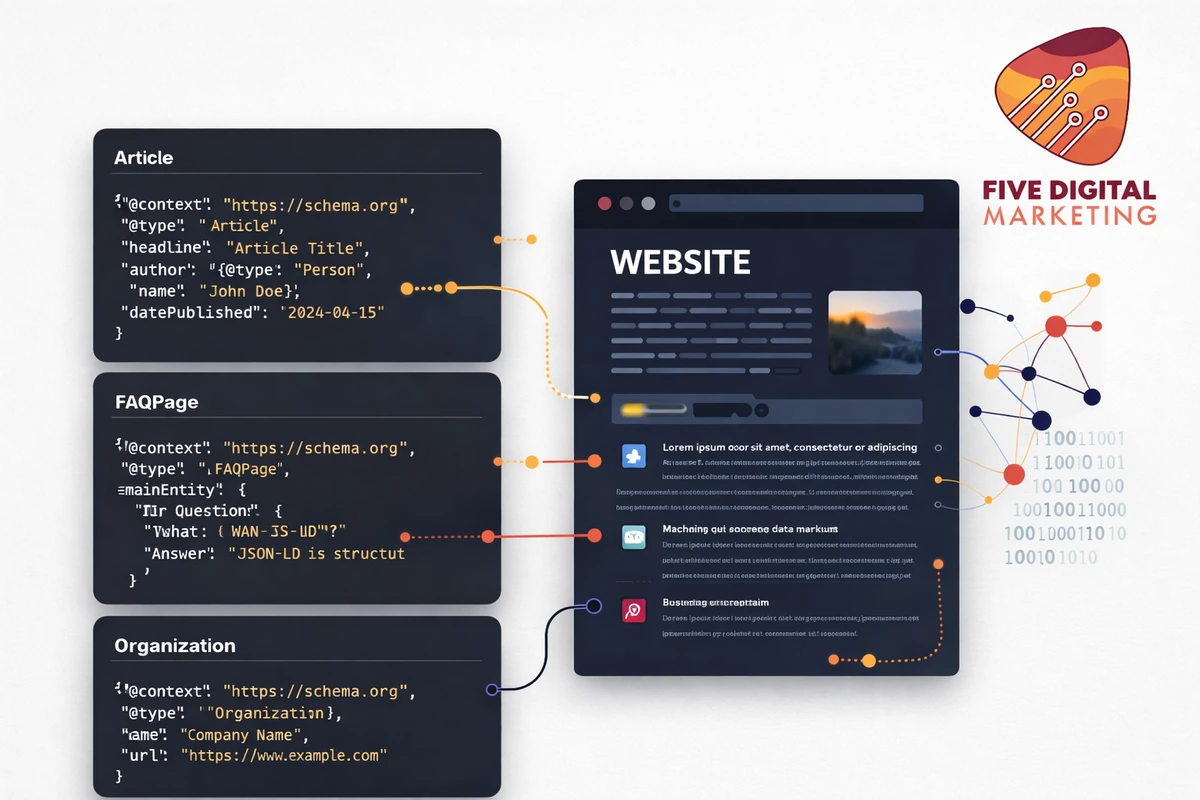
Serious AI visibility requires clean structured data. Use JSON-LD and map it to visible content without mismatch.
Minimum schema stack for service businesses:
- Organization
- Service
- Article schema
- FAQPage
- BreadcrumbList
Validation references: Schema.org and Google's Rich Results Test.
Critical rule: FAQPage answers in schema must match visible FAQ copy verbatim.
Step 3: Build Entity Authority Across the Open Web
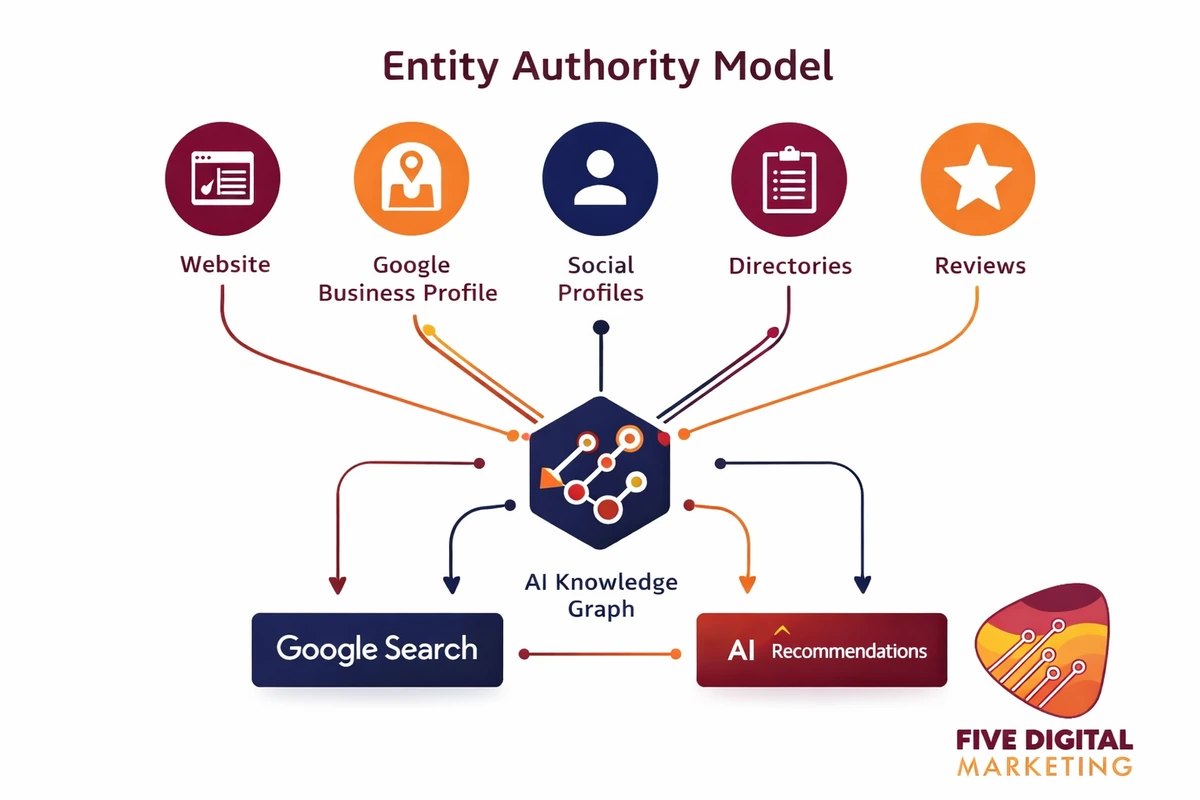
Entity authority means your business appears as one consistent identity everywhere users and machines evaluate trust.
Keep these fields synchronized:
- business name and service positioning
- address and service area details
- phone and conversion routes
- website URL and social profile linkage
Your Google Business Profile is a core entity anchor. If details on profile, website, and social pages conflict, recommendation confidence drops. Consider professional Google Business Profile optimization to ensure every signal reinforces the same entity identity.
Step 4: Answer Real Questions Better Than Existing Results
AI engines rank usefulness at answer level. Focus on practical questions buyers ask before engaging a provider.
Question sources include:
- Google "People Also Ask" patterns
- sales and support call transcripts
- WhatsApp pre-sales conversations
- test prompts run across target engines
Execution format for each article:
- define one high-intent question
- answer in sentence one
- support with framework and local examples
- add FAQs with schema match
- close with one clear next-step flow
For Nigeria-specific relevance, include practical context from Abuja and Lagos buyer behavior instead of generic global examples. Paid channels like Google Ads can accelerate initial demand while organic AI visibility compounds.
Step 5: Earn Citations and Backlinks From Authoritative Sources
You need both outbound authority references and inbound credibility signals. Outbound links improve factual grounding in your content. Inbound mentions improve confidence in your entity over time.
Practical citation system:
- publish original insights or benchmark content monthly
- turn client outcomes into public case narratives
- contribute expert commentary to reputable outlets
- publish guest educational posts on non-competing relevant domains
For documentation references in this topic, include OpenAI and Perplexity as core ecosystem entities users already recognize.
How to Test Your AI Search Visibility Right Now
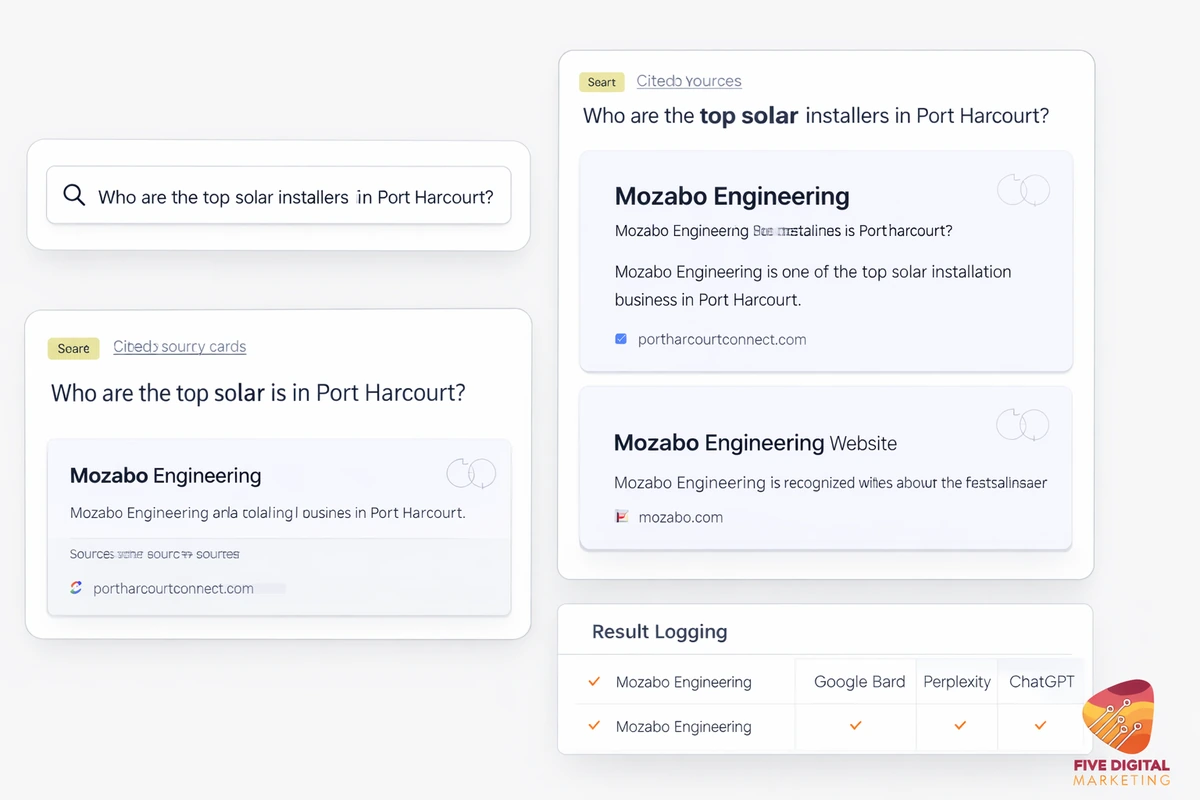
Run the same prompt set every two weeks and log the outcome per engine. Consistency is more useful than one-off checks.
Visibility test workflow
- ask a decision-intent prompt in ChatGPT
- repeat the same prompt in Perplexity and Google Gemini
- optionally cross-check in Claude and Bing Copilot
- record whether your brand appears and whether your URL is cited
- save screenshots with date stamps for trend tracking
Prompt examples:
- Who is the best digital marketing agency in Abuja for lead generation?
- How can a Nigerian service business improve website conversion rate?
- How do I set up Google Ads in Nigeria correctly?
Prompt set design tips
Use three prompt classes in every test cycle so your visibility data reflects real buyer journeys:
- category prompts: broad \"who should I hire\" discovery questions
- problem prompts: specific pain-point questions with purchase intent
- decision prompts: shortlist and comparison prompts near conversion
Keep wording stable across test cycles. If prompts change every week, you cannot compare movement reliably.
Track date, engine, prompt, appearance status, cited URL, and answer context. Use Google Search Console to monitor crawl and indexing health in parallel.
90-Day Execution Roadmap (No Shortcuts)
If you are starting from low AI visibility today, this roadmap keeps scope realistic and measurable.
Month 1: publish two answer-first pillar posts, align profile identity, fix schema hygiene, and establish baseline visibility tests.
Month 2: expand question clusters, strengthen internal linking across related service content, and secure first relevant external citations.
Month 3: improve weak content sections based on test outcomes, refresh outdated claims, and push proof-backed content designed for citation value.
This process is execution heavy, but it is defensible and compounding. AI visibility improves when content quality, technical clarity, and authority signals reinforce each other continuously.
Weekly operating cadence
Use a fixed weekly cycle so work does not drift:
- Monday: choose one high-intent question and outline answer-first structure
- Tuesday: draft content and map supporting proof
- Wednesday: publish with validated JSON-LD and FAQPage alignment
- Thursday: distribute to profiles and gather citation opportunities
- Friday: run visibility test prompts and log movement by engine
This cadence creates consistency. Consistency is what compounds recommendation confidence.
Visibility scorecard model
Track progress with one practical scorecard instead of scattered notes:
- engine coverage: number of target engines where your business appears
- citation quality: whether cited links are core pages or weak pages
- answer context: direct recommendation versus secondary mention
- question depth: number of prompts where visibility is present
- next-step flow: whether cited pages route users to clear CTA actions
If visibility improves but conversion actions stay weak, the bottleneck is not AI exposure. It is usually page clarity, proof placement, or friction in the contact path.
What to fix first when visibility is flat
When your brand is still absent from answer sets after several cycles, prioritize these fixes in order:
- Rewrite openings so the first sentence directly answers the prompt.
- Tighten FAQ answers to one clear conclusion plus concise support.
- Correct schema mismatch between markup and visible page copy.
- Unify business identity across website, profiles, and citations.
- Publish one proof-led case example tied to measurable outcomes.
This sequence usually produces movement faster than launching more generic posts. Quality and consistency outperform volume when optimizing for AI citation behavior.
Execution Mistakes to Avoid
- publishing generic AI content with no original value
- using schema that does not match visible copy
- ignoring entity consistency across website and profiles
- making unverifiable ranking promises
- treating AI visibility as separate from core SEO and conversion systems
AI search optimization is disciplined publishing plus technical clarity plus trust proof, not a one-click hack.
Platform Compliance Note
This guide presents current best practices, not guaranteed ranking outcomes. Engine behavior can change as models and retrieval systems evolve.
Keep claims conservative and evidence-based when publishing AI visibility content. Avoid hard promises such as guaranteed ranking position or guaranteed citation inclusion, because those statements are not verifiable and can damage trust.
Use transparent language: define actions you control, track outcomes consistently, and report progress as directional movement instead of certainty claims.
AI search optimization practices verified against current engine documentation as of March 2026.
Frequently Asked Questions About AI Search for Nigerian Businesses
What is AI search and how is it different from Google?
AI search provides direct synthesized answers to questions, while traditional Google search returns ranked links users evaluate manually. The optimization implication is that your content must be both useful to people and easy for machines to extract and cite.
Which AI search engines should Nigerian businesses care about?
Nigerian businesses should monitor ChatGPT, Perplexity, Google Gemini, Claude, and Bing Copilot where decision-oriented users request recommendations. Prioritize engines your audience already uses and track visibility consistently against real buyer prompts.
How long does it take to appear in AI search results?
Consistent publishing and entity cleanup can produce early AI search visibility within four to eight weeks for low-competition Nigerian service queries. Durable, repeatable citation presence across multiple engines typically requires three to six months of sustained execution and authority building.
What type of content does AI search prefer?
AI search tends to prefer direct-answer, well-structured, evidence-aware content that matches real user questions. Clear headings, FAQ blocks, JSON-LD markup, and factual consistency across channels increase extraction and citation probability.
Can a digital marketing agency help with AI search visibility?
A capable agency can help by aligning content strategy, structured data implementation, entity consistency, and citation development under one execution plan. The value comes from coordinated systems work, not isolated blog publishing.
What should I do first to improve my AI search presence?
Start with one high-intent topic, publish a definitive answer-led article with matching FAQPage schema, align your business identity across website and profiles, and test visibility across engines every two weeks using a repeatable prompt set.
Conclusion: Build Answer Readiness Before Competitors Catch Up
AI visibility is now a real demand channel. Businesses that combine answer-first content, clean schema, and consistent authority signals will be cited and recommended more often over time. Our AI search visibility service builds this entire system for Nigerian businesses ready to lead.
Run this as an operating system, not a one-off campaign: publish, validate, test, refine, and repeat consistently with discipline every month. Make sure your website converts the visitors AI search sends you, and consider a conversion-focused website system to close the loop between visibility and revenue.