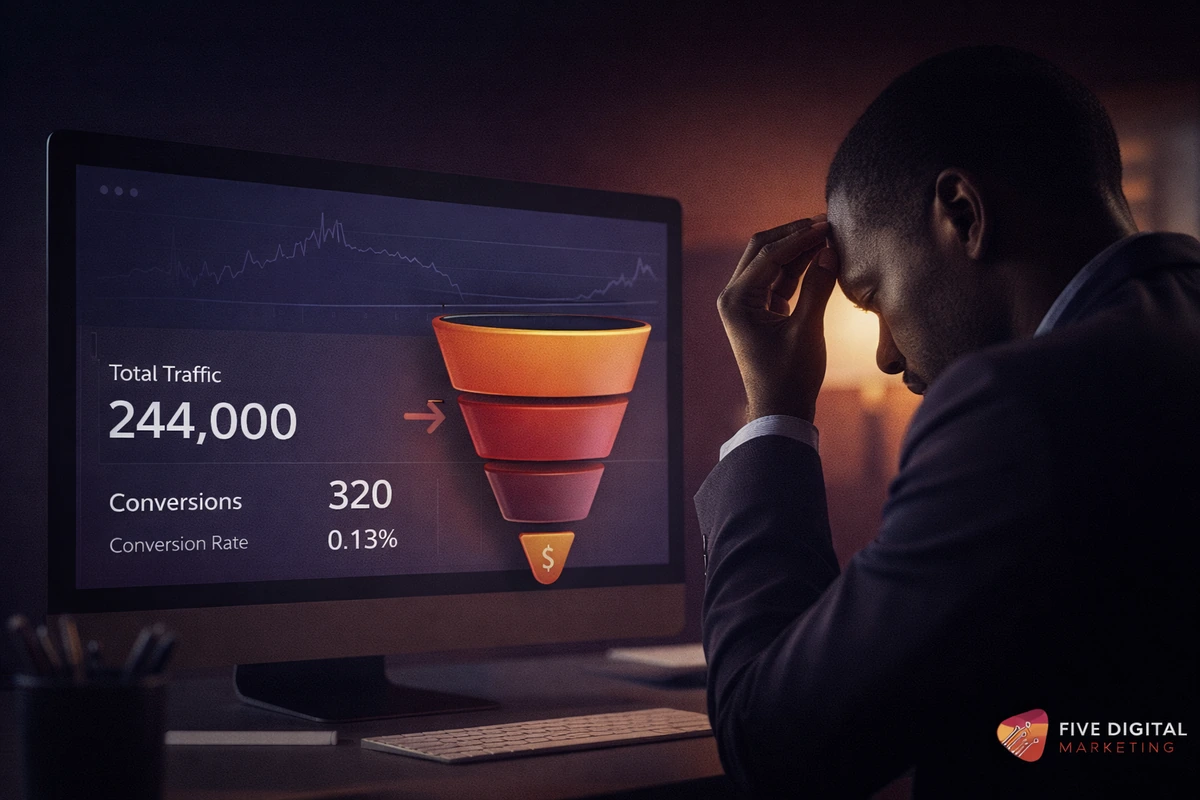
If your website gets traffic but no inquiries, the issue is usually conversion architecture, not visibility. The fastest fix is to remove friction between first visit and contact action by tightening CTA clarity, trust proof, mobile speed, form usability, and event tracking.
Many Nigerian businesses in Abuja and Lagos are in the same position: SEO, referrals, social, or paid ads drive sessions, but qualified conversations stay flat. That usually means demand is arriving but leaking before users submit a form, click WhatsApp, or request a call.
This guide breaks down the leak points and the practical CRO updates you can implement now without waiting for a full redesign.
The Traffic Trap: Why Visitors Do Not Equal Customers
Traffic is potential. Conversion is outcome. You can get 2,000 monthly sessions and still struggle to close pipeline if the next-step flow is weak.
We regularly see businesses spending about ₦200,000 per month on traffic while converting below 0.5 percent. At that level, campaigns become financially fragile even when traffic volume looks healthy in reports.
For many service businesses, a useful working benchmark is 2 to 5 percent conversion rate depending on traffic quality, offer fit, and trust maturity. A move from 0.8 percent to 2.0 percent often drives more revenue than doubling traffic.
- conversion fixes monetize existing demand better
- paid traffic waste drops because more clicks become inquiries
- sales conversations improve because lead quality rises
- performance compounds instead of resetting each month
CRO is not cosmetic polishing. It is risk removal between attention and action.
5 Conversion Killers on Nigerian Business Websites
1) No clear CTA above the fold
If users cannot identify the next step in the first screen, intent drops fast. Your core action should be visible immediately, especially on mobile.
2) Multiple competing CTAs
When one page asks users to call, WhatsApp, fill a form, and download a file at once, decision friction rises. Choose one primary action and support it consistently.
3) Weak trust near decision points
Claims alone do not convert premium buyers in Abuja or Lagos. Buyers look for real proof: location clarity, visible people, credible reviews, and clear process expectations.
4) Slow mobile experience
Most first visits are mobile. If pages load slowly, buttons are hard to tap, or layouts break in Chrome and Safari, users leave before understanding value.
5) High-friction forms
Long first-touch forms reduce completion rates. Ask for only what you need to start a qualified conversation. Collect extra details later.
The Next-step flow Audit: Do This Right Now
Run this quick audit on your own phone in 10 minutes.
Step 1: Open your homepage on mobile
In three seconds, can you tell who the business helps, what outcome it delivers, and what to do next? If not, the hero section is leaking intent.
Step 2: Find the primary CTA without scrolling
If CTA visibility is weak, click-through rate drops. Use one clear CTA phrase above the fold and repeat it after key value sections.
Step 3: Click through to the contact action
Does the form load instantly? Does WhatsApp open with context? Is there one obvious next step?
Step 4: Submit a test inquiry
Confirm the form actually submits, success feedback is clear, and your team receives the lead quickly.
Step 5: Check measurement integrity in GA4
Track at least cta_click, form_submit, whatsapp_click,
page_scroll_depth, and service_page_view. If events are
inconsistent, strategy decisions become guesswork.
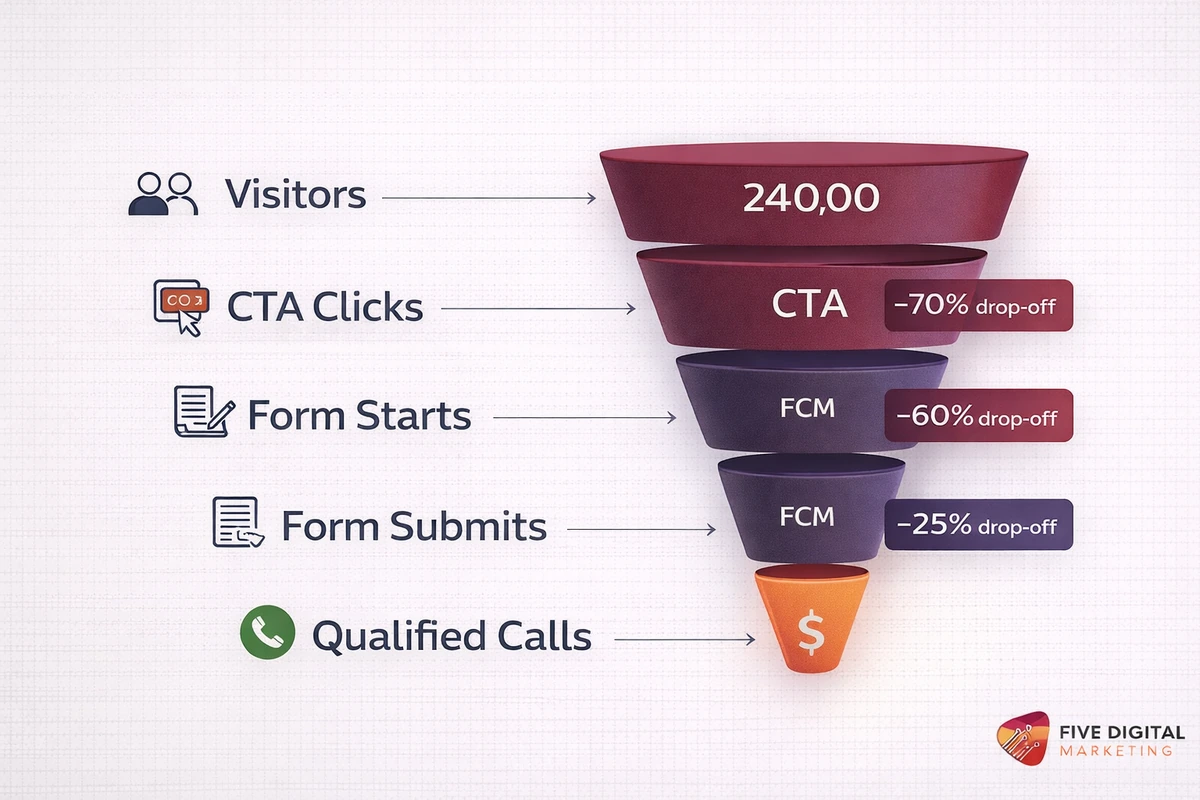
CTA Placement and Language That Works
High-converting pages usually use one primary CTA phrase across high-intent sections. Consistency lowers cognitive load and improves completion behavior.
Effective examples include:
- Book a Growth Diagnostic
- Request a Strategy Call
- Get a Conversion Audit
Underperforming examples often include generic phrases such as Learn More, Contact Us without value framing, or plain Submit buttons.
Placement model
- above the fold: primary button
- after first value section: repeat primary button
- after proof section: repeat primary button
- final section: primary button plus WhatsApp fallback
| CTA Phrase | User Clarity | Expected Conversion Impact | Typical Use Case |
|---|---|---|---|
| Book a Growth Diagnostic | High | High | Premium service businesses |
| Request Strategy Call | High | Medium-High | B2B consultative services |
| Get Free Proposal | Medium | Medium | Price-sensitive segments |
| Learn More | Low | Low | Informational pages only |
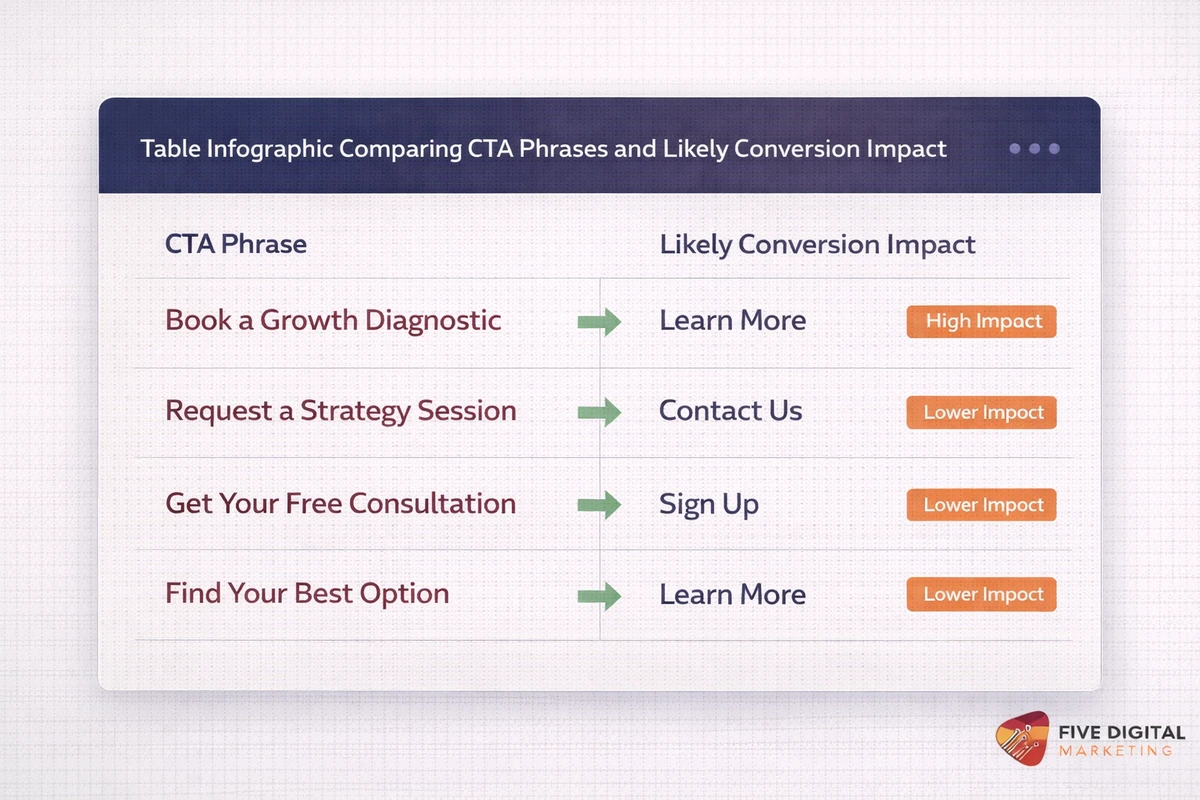
Trust Signals That Convert Nigerian Buyers
Trust is often the conversion multiplier. Buyers who are ready to pay premium rates still need risk reduction before they take action.
High-impact trust elements include:
- real Google Reviews near decision blocks
- clear service area signals for Abuja, Lagos, or nationwide delivery
- professional contact identity (domain email, reachable phone, active WhatsApp)
- real founder or team visibility
- transparent process after inquiry submission
Do not hide trust in the footer. Place proof where users hesitate most.
Helpful references for this stage:
Measuring Conversion: The Numbers That Actually Matter
Do not rely on one site-wide conversion number. Segment by page intent and source quality.
Core metrics to track:
- CTA click-through rate by page
- form completion rate by page
- WhatsApp click-to-conversation rate
- conversion rate by
utm_source,utm_medium, andutm_campaign - time to first response after inquiry submission
For implementation references, use setting up Google Analytics 4 and Hotjar for heatmap analysis. For technical speed checks, test your page speed with PageSpeed Insights.
30-day CRO rhythm
Week 1: validate tracking integrity, fix form path failures, and standardize CTA language.
Week 2: improve weak hero clarity and reduce unnecessary form fields.
Week 3: compare mobile versus desktop behavior and remove friction points.
Week 4: prioritize top pages by conversion opportunity and iterate quickly.
Keep a simple scorecard for each week: sessions, CTA clicks, completed forms, WhatsApp starts, and average first-response time. This keeps execution grounded in business outcomes, not vanity metrics, and helps your team decide where to allocate effort next month.
Practical performance example
Assume 3,000 monthly visits at 0.8 percent conversion. That produces 24 inquiries. After core CRO updates, even a rise to 2.1 percent delivers 63 inquiries, or +39 additional inquiries without buying more traffic.
That is why conversion work often produces faster ROI than traffic expansion when foundation issues are unresolved.
Internal route structure for this post
The Before-and-After Checklist You Can Apply Today
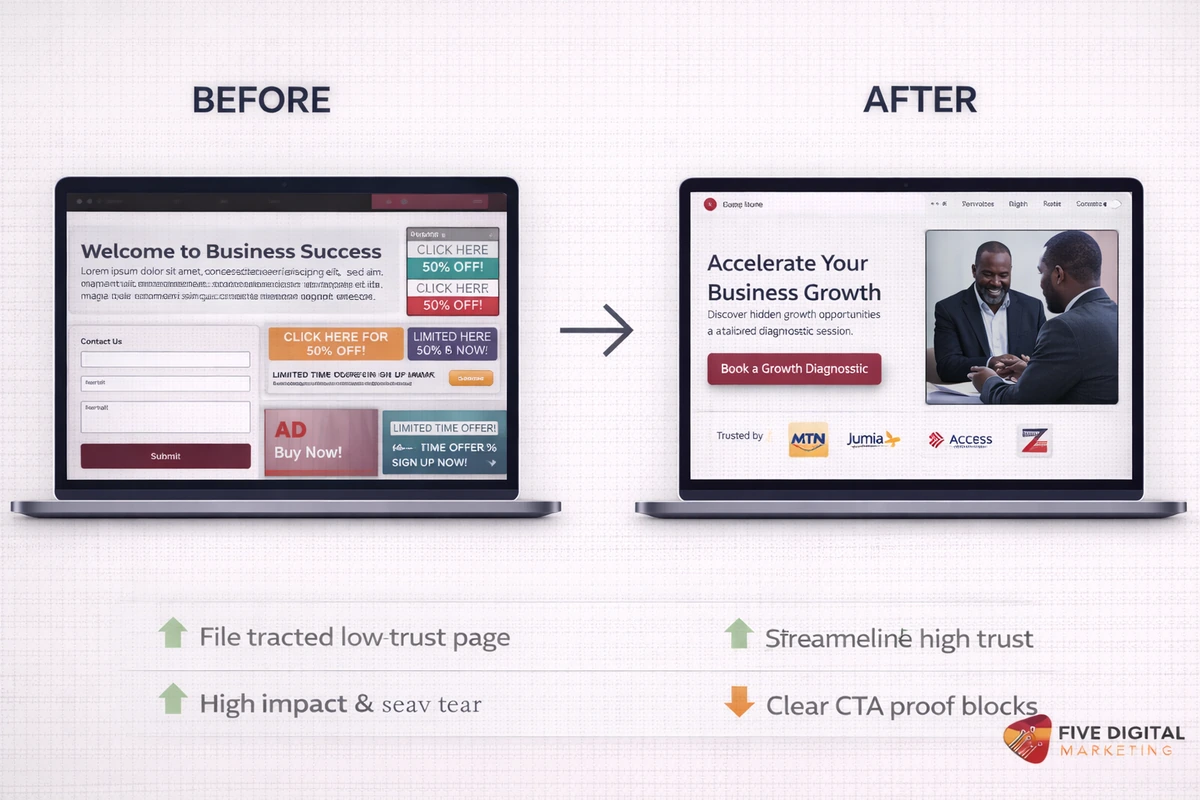
Most conversion gains come from fixing simple structural issues repeatedly, not from one perfect redesign. Use this before-and-after checklist on your top three traffic pages first, then roll fixes across the rest of the site.
| Area | Before | After |
|---|---|---|
| Headline | Generic slogan with no outcome | Outcome-led statement with audience clarity |
| CTA visibility | Primary action below fold | Primary action visible on first screen |
| CTA consistency | Different button labels on one page | One core phrase repeated in key sections |
| Trust proof | Reviews and proof hidden in footer | Proof placed beside high-intent CTA blocks |
| Form friction | 8 to 12 fields at first touch | 3 to 5 essential fields for first contact |
| Mobile speed | Large uncompressed hero assets | Compressed images and cleaner script load |
| Tracking quality | Missing or duplicated event firing | Clean GA4 event map validated monthly |
| Lead handling | Unclear response time | Fast response SLA with owner accountability |
Execution order for lean teams
If your internal team is small, sequence work by impact and effort:
- Fix form submission reliability and response flow first.
- Rewrite hero message and standardize one CTA phrase.
- Move high-trust proof above key decision blocks.
- Reduce first-touch form fields and improve mobile input flow.
- Run speed cleanup on large media and non-essential scripts.
This order is practical because each step improves conversion independently. Even if you pause mid-cycle, you still bank measurable gains instead of waiting for a full rebuild.
What to review every month
At the end of each month, review top landing pages by sessions, CTA clicks, and inquiry completion. Compare Abuja versus Lagos traffic behavior, then compare mobile and desktop outcomes. If one page receives strong traffic but weak action rates, that page is your next CRO sprint candidate.
Frequently Asked Questions About Conversion Rate Optimization
What is conversion rate optimization (CRO)?
Conversion rate optimization is the process of increasing the percentage of website visitors who take a desired action, such as submitting a form or booking a call. It focuses on removing friction in messaging, design, trust, and user flow so existing traffic converts at a higher rate.
What is a good conversion rate for a Nigerian service business?
A good conversion rate depends on traffic quality and offer strength, but many service businesses aim for around 2 to 5 percent as a practical working benchmark. The better your page clarity, trust signals, and follow-up speed, the closer you move toward the top end of that range.
What are the most common conversion killers?
The most common conversion killers are unclear CTA placement, too many competing actions, weak trust proof, slow mobile loading, and high-friction forms. These issues reduce user confidence and increase drop-off between first visit and inquiry submission.
Should I focus on traffic or conversion first?
If your site already gets consistent traffic but low inquiry volume, fix conversion first. Improving conversion lets you generate more leads from existing demand before spending more on additional traffic acquisition.
How quickly can CRO improvements show results?
Simple CRO changes can produce visible improvement within two to four weeks, especially when they target high-traffic pages. Larger gains usually come from continuous monthly testing and iteration rather than one-time edits.
When should I hire a CRO specialist versus doing it myself?
Do it yourself if your site is simple and you can execute the core audit and fixes consistently. Hire a specialist when traffic spend is significant, conversion remains weak after basic improvements, or your team lacks the time and technical depth to run reliable testing.
Conclusion: Fix the Next-step flow Before Buying More Traffic
If your website gets visitors but no inquiries, demand is probably not the issue. Friction is. Start by tightening CTA clarity, trust placement, mobile speed, form simplicity, and tracking integrity.